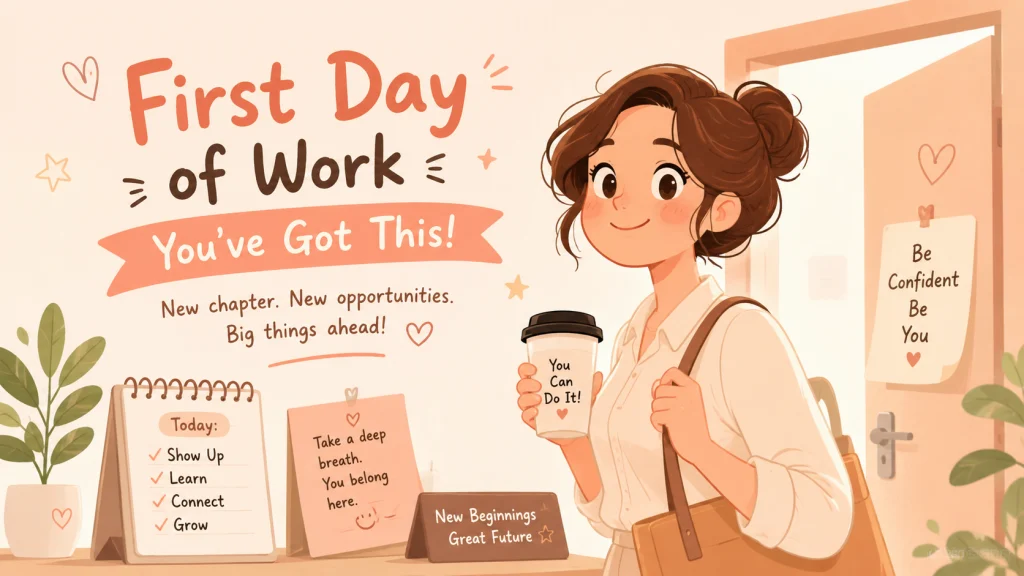
Getting the job is the part everyone congratulates you for. Walking through the doors on day one is the part nobody quite knows how to talk about, that mix of excitement and low-grade dread that comes with starting something brand new. These first day of work encouragement messages are built for that exact moment: the night before when sleep won’t come, the morning when the outfit gets changed twice, and the days after when someone just wants to know how it actually went. What follows are real, specific things to say instead of a flat “good luck,” organized by the moment they’re meant for.
Why a First Day Message Isn’t the Same as a Congratulations Message
Getting the job was one thing. Walking in on day one is something else entirely, and that gap is exactly where this list of first day of work encouragement messages lives. Somewhere between the celebration and the actual sitting-down-at-a-new-desk reality, the messages people send tend to get strange. They either repeat the same congratulations from two weeks ago, or go quiet entirely, as if there’s nothing left to say once the job is already secured. There is. The night before a new job and the morning of it feel nervous in a completely different way than the moment someone got the offer, and the right message meets that nervousness instead of skipping past it.
I think about this every time someone asks what to say to a friend who just started a new job. A congratulations on a new job message is for the achievement, the part where someone applied, interviewed, and got picked. A first day message is for the part where all of that turns real, when the new job stops being an idea and becomes a building someone has to walk into on Monday morning. I have sent both kinds, and they are not interchangeable. The friend who got the offer wants to hear that the work paid off. The friend sitting in the car outside a new office, running through everything that could go wrong, wants something closer to company than congratulations.
| Moment | What They Actually Need to Hear |
|---|---|
| Night before | Reassurance, not predictions. Keep it short. |
| Morning of day one | A quick line that takes ten seconds to read. |
| Close friend, big change | Something more personal, naming the leap they took. |
| End of first week | A specific question, not a yes-or-no one. |
That timing matters more than people probably expect, so the messages below are split by exactly when they land best, starting with the night before, when the nerves are usually loudest.

For the Night Before
The night before a new job rarely looks like excitement from the outside. It looks like someone re-reading the same onboarding email for the fourth time, or laying out an outfit and changing their mind about it twice. A message that lands well here does not try to talk someone out of being nervous. It just sits next to the nervousness for a second, which is sometimes the only thing that actually helps.
The line people reach for first is almost always “you’ve got this,” said the same way to everyone regardless of who they are or what tonight actually feels like for them. It’s not wrong, exactly, just thin. Some of the lines below work fine as simple new job good luck wishes for almost anyone, while a few lean more personal for someone you actually know well. Either way, the point is the same: meet the nervous part directly instead of talking around it.
- Whatever tomorrow throws at you, you already did the hardest part: showing up and saying yes to something new.
- Sleep if you can, and if you can’t, know that being a little nervous tonight just means you care about getting this right.
- Tomorrow is just one day. It doesn’t have to be perfect, it just has to happen.
- You’re allowed to feel excited and terrified at the same time right now. Most people about to do something good feel exactly that.
- Thinking about you tonight. Tomorrow’s a big one, and you’re more ready for it than you think.
- However the first day goes, you’ll have stories by tomorrow night. Try to enjoy the nervous part too.
- You worked hard to get here. Let tomorrow be the easy part, even if it doesn’t feel that way right now.
- Lay out your stuff, set two alarms, and let the rest take care of itself. You’ve gotten this far on your own.
- Tonight’s the calm before something good. Rest if you can, and remember why you wanted this in the first place.
- Whatever happens tomorrow, you’re not walking in there alone. Sending you steady thoughts for the morning.
- Try not to rehearse every version of tomorrow in your head tonight. You can’t plan for all of it, and you don’t need to.
- One nervous night doesn’t cancel out everything you did to get this far. Try to remember that before you fall asleep.
- If your stomach’s in knots right now, that’s normal. It means this actually matters to you.
- Tomorrow doesn’t need to go perfectly to go well. Most first days don’t, and most people still land on their feet.
- You don’t have to feel ready to be ready. Those are two different things, and you’ve already got the second one.
- Whatever you’re imagining could go wrong tomorrow, the odds are it won’t be that dramatic. New jobs are rarely as scary in person as they are at midnight.
- Get some rest if you can. Tomorrow’s going to ask a lot of you, and you’ve got more in you than tonight is letting you believe.
Those work best sent the evening before, somewhere between dinner and the unavoidable scrolling-through-tomorrow’s-schedule moment. The morning itself calls for something shorter, mostly because there’s no time left to read anything long.
For the Morning of Day One
Morning-of messages have one job: get read in the ten seconds between brushing teeth and grabbing keys, and still land. Long, thoughtful paragraphs are wasted here, not because the sentiment doesn’t matter, but because nobody about to walk into a new building is going to stop and read three careful sentences. Short and warm beats long and earnest on a morning like this, every time.
This is exactly the kind of moment that calls for a quick good luck text for someone’s first day at a new job, not a long one, something that fits in the time it takes to wait for a coffee order. The messages below are built for that window.
- Good luck today. You’re going to be great.
- Today’s the day. Go show them what we already know.
- Deep breath. You’ve prepared for this more than you realize.
- Rooting for you this morning. Go knock ’em dead, gently.
- First days are never as scary once they actually start. You’ll see.
- Sending good luck your way for the new job. Today’s just the beginning.
- You don’t need to have it all figured out today. Just show up and be yourself.
- Coffee in hand, good thoughts on the way to you. Have a great first day.
- Today’s nerves are just tomorrow’s funny story. Go get ’em.
- However today goes, I’m proud of you for starting it.
- Walk in like you belong there, because you do. They picked you for a reason.
- Today’s not about being perfect. It’s about showing up and letting the rest sort itself out.
- Good luck out there. Text me when you get a minute, I want to hear how it went.
- You’ve got this morning, and if you don’t feel like you do yet, that’s fine too. Go anyway.
- New building, new faces, same person who’s handled plenty of first days before. You’ll be okay.
- Sending you calm energy for the next few hours. You don’t need much more than that today.
- Whatever happens in there today, it’s just the start of the story, not the whole thing.
Most of those work for almost anyone: a coworker, a cousin, someone you don’t know well enough yet to get specific. For someone closer, a little more detail usually fits better.

For a Close Friend Starting Something Scary
There’s a message I almost didn’t send to a friend who left a stable, boring job for something riskier and far less certain. I worried it would sound like too big a deal, so I almost shortened it down to something forgettable. I sent the longer, more specific version instead, the one that actually said why I thought she was brave for doing it. She told me weeks later that it was the message she reread before walking in on her own first morning, not the dozen shorter ones she got that day.
These kinds of new job encouragement messages mean more once you actually know the person well enough to reference what the leap cost them, not just what it might earn them.
- I know how much you wanted this, and I know how scary wanting something can be once it’s actually here. You’re going to be amazing today.
- Leaving what was comfortable for something uncertain takes real guts. I’ve watched you do hard things before, and this is no different.
- You’ve talked yourself out of believing you’re ready for this more times than I can count. You are. Today proves it.
- Whatever nerves you’re carrying into today, they don’t cancel out how capable you actually are. Go show them.
- I’m not worried about you today. I know that’s easy for me to say from the outside, but I mean it.
- This is the leap you’ve been talking about for months. I’m so glad you took it.
- However today goes, you already did something brave just by saying yes to it.
- Text me later if you want, or don’t. Either way, I’m thinking about you all day.
- I remember how long you sat on this decision before you made it. Watching you actually go through with it today means a lot.
- You don’t owe today a perfect performance. You already did the hard part by choosing yourself over staying comfortable.
- If today feels like too much at any point, that’s not a sign you made the wrong call. It’s a sign you did something that actually mattered.
- I’ve seen you talk yourself into smaller things than this. Today’s bigger, and so are you.
- Whatever happens in there, you’ve already proven to yourself you can do the scary thing. That part’s done.
- Thinking of you all morning. You took the harder, better path, and I’m proud of you for it.
Send one of these the night before or the morning of, whichever fits the friendship better. A week from now, a different kind of message fits.

After Their First Week
A first week check-in works best as a specific question instead of a flat “how’s the new job going,” the kind of question that’s easy to answer with one word and then drop. The same idea shows up in a lot of ordinary, day-to-day check-in messages, where specific almost always beats generic.
This same kind of first-day encouragement doesn’t stop mattering once day one is over. It just shows up differently, less about courage and more about curiosity.
- How’s week one treating you? Tell me the one thing that surprised you most.
- You survived the first week. How are you feeling about it now that the nerves have worn off a little?
- Thinking about you and wondering how the new job is settling in. Anything good happen yet?
- One week down. What’s been the best part so far?
- Checking in on how the new job’s going. No pressure to have a big answer, just curious.
- You made it through week one. That’s worth celebrating, even quietly.
- Has it started feeling a little more familiar yet, or still mostly new faces and new passwords?
- What’s been the hardest adjustment so far, the people, the pace, or just the commute?
- A week in is usually when the nerves start to fade and the actual job starts to show itself. How’s that going?
- Curious if anyone’s stood out yet, for better or worse. New jobs always come with at least one character.
- You don’t have to have an opinion on the whole job yet. Just tell me one thing you noticed this week.
- One week behind you, however many more ahead. How are you actually doing with it?
However the answer comes back, even a short one, it tells someone that the question wasn’t just polite. That’s worth more than people usually expect.
The Right Message Is Smaller Than People Think
None of the messages above need to be perfect, and trying to make them perfect is usually what kills them. The ones that land are the specific ones, the ones that sound like they came from someone who actually knows the person starting tomorrow, not from a list. If the situation started a little earlier, back before the offer was even confirmed, a quick word of good luck before a job interview covers that earlier nervous stretch the same way these cover day one. And for the wider range of good luck messages for any situation, that’s where this one fits into something bigger.
If you’re sending one of these today, don’t worry about making it sound impressive. The simplest version, the one that sounds like you actually wrote it instead of copied it, is almost always the one that gets remembered. That is just as true when you are wishing someone good luck starting a new job as it is for anything else worth saying to someone you care about.
FAQs
🌙 What do you say to someone the night before their first day at a new job?
Keep it short and steady. Something like “you’re more ready than you think” works better than trying to predict how tomorrow will go.
🌅 How do you wish someone good luck on their first day of work?
A short, specific line sent that morning beats a long one. “Today’s the day, go show them what we already know” takes ten seconds to read and still lands.
💬 What’s a good short message for someone starting a new job?
Something brief and warm: “Sending good luck your way for the new job. Today’s just the beginning” covers it without overdoing it.
🤝 What should you avoid saying to someone on their first day?
Avoid anything that promises a specific outcome, like guaranteeing they’ll get along with everyone. Nerves are normal, so skip messages that imply they shouldn’t feel nervous at all.
📅 When’s the best time to send a first day of work message?
The night before for reassurance, and a short one again the morning of. Sending both isn’t excessive, they serve different moments.
✨ How do you check in on someone after their first week at a new job?
Ask something specific instead of a flat “how’s it going.” A question like “what surprised you most this week” gets a real answer.