Most morning messages are written toward brightness. These are not. A morning message when someone is going through a hard time needs to do something different: acknowledge what is already there before the day begins, rather than trying to lift it. The 65 messages here are organized by situation, from grief and loss to a hard event today to an ongoing difficult season. Find the one that fits where they actually are, not where you wish they were.
Before the Day Starts: Why These Messages Are Different
They are facing something today. You know it. A good morning message for them is not really about the morning. It is about what you want them to feel before they have to face whatever is coming, or whatever is still there from yesterday, or whatever has been sitting with them for months. That framing changes the message entirely. For related message ideas, see good morning for someone struggling.
Most good morning messages are warm and forward-looking, written toward the open possibility of the day. That is the right tone for most situations. For someone who is grieving, or bracing for something hard, or exhausted from a long difficult stretch, that same warmth can land like you have forgotten what they are carrying. The message that actually helps is quieter. It sits with them first, before it tries to offer anything.
I have seen this happen: someone sends a cheerful good morning text to a friend two days into grief, not out of carelessness but out of wanting to offer something bright. The person goes quiet, because the message arrived in a reality that had nothing to do with where they were. A morning message for someone sad does not need to solve anything. It just needs to meet them where they actually are.
Here is how the right tone shifts depending on the situation:
| The situation | What the message should do | What tends to miss |
|---|---|---|
| Grief or loss | Acknowledge the weight of the morning without trying to lift it | Cheerful openers, silver linings, anything that implies the day should feel normal |
| Hard event today | Name what they are walking into, express belief in them specifically | Generic “good luck” without showing you understand what it actually is |
| Long difficult season | Show sustained presence, not just a one-time check-in | Promises that things will get better before sitting with how hard right now is |
| General struggling or sad | Sit with them, not pull them toward positivity | Anything that makes them feel like they should be feeling differently than they do |
Here are the messages, organized by where they actually are this morning.

When They’re Going Through Grief or Loss
Mornings are one of the hardest parts of grief. The moment of waking up, the brief window before you remember, and then the remembering. That is a specific experience, and a good morning message for someone in that place is not about encouraging them to have a good day. It is about letting them know you are thinking of them before they even have to start.
These messages do not try to offer comfort so much as company. They acknowledge the weight of the morning rather than stepping past it. If you know they are grieving but are not sure what to say, almost any of these will do more than saying nothing.
- Good morning. I know waking up is its own kind of hard right now. I just wanted you to know I am thinking of you before your day starts.
- Morning. You do not have to be okay today. I just wanted to say that before anything else.
- Good morning. I know the beginning of the day is one of the harder parts. I am here.
- Sending you a morning thought. You do not have to feel it less. You just have to get through today, and I will be right here while you do.
- Good morning. I know there is weight to this day before it even starts. You are not carrying it alone.
- Morning. I am not going to tell you to have a good one. I just want you to know someone is thinking of you.
- Good morning. I thought about you before I thought about anything else today.
- These mornings are going to feel different for a while. I just wanted to say I know that, and I am here through them.
- Good morning. Grief has its own mornings, and they are hard. I am glad you woke up. I am thinking of you.
- Morning. You do not have to grieve on any particular schedule. Take this day as slowly as you need.
- Good morning. Another morning of carrying this. I just want you to know I am thinking of you, today specifically.
- Good morning. Some days you just have to get through, and that is enough. Today might be one of those days. I am with you.
- Morning. If the day feels heavy before it starts, that is because it is. You are not imagining it. I am right here.
- Good morning. I have no words that are big enough for what you are carrying. But I wanted you to have this one before you start your day.
- Morning. You do not have to pretend this day is fine. It does not have to be fine. I just want you to know I am thinking of you through it.
- Good morning. However today goes, you do not have to face it alone. I am here.
- I am thinking of you this morning, the way I have been thinking of you every morning since I heard. Sending you whatever gets you through today.
- Good morning. Loss has its own weight in the mornings. I just wanted to say I know, and that I am here.
If you knew the person they lost, using that person’s name in the message can make it feel more real and less generic. The same rule applies here as it does anywhere in grief: specificity is almost always kinder than keeping things general.
When They Have Something Hard Today
A medical procedure, a difficult conversation, a performance review, a court date, a first day of something they did not choose. These are the mornings where someone knows exactly what they are walking into, and the weight of it starts long before they get there. Morning encouragement for a hard day works differently here: it needs to acknowledge the specific thing, not just offer general warmth.
These messages name what is happening, or leave space for it, rather than being cheerful over the top of it. If you know the details, use them. If you do not, these work without them.
- Good morning. Today is a big one. I am thinking of you and I believe in you.
- Morning. Whatever happens today, you are more ready for this than it feels like right now.
- Good morning. I know today has something hard in it. I am in your corner the whole time, wherever I am.
- Good morning. I just wanted to say I know what you are walking into today, and I think you are going to do better than you think.
- Morning. Breathe. You have prepared for this. And if it still feels impossible, I have been thinking about you since yesterday.
- Good morning. I am thinking about you before you even get there. Whatever today looks like, I want to hear about it after.
- Morning. I know today is the hard one. I am with you. Tell me how it goes.
- Good morning. The thing you are afraid of today is also the thing you are walking toward. That takes a specific kind of courage. You have it.
- Morning. I have been thinking about today since yesterday. You have prepared. You are more ready than you feel.
- Good morning. However today goes, it will be done by tonight, and then I want to hear everything.
- Good morning. I know you have been dreading today. I just wanted to make sure someone was thinking of you before you faced it.
- Morning. One step, then the next. That is all today is. I am with you through all of them.
- Good morning. Whatever happens in that room today, you are not alone in it.
- Morning. You have carried harder things than this. I know that, even if you cannot feel it right now. Good morning.
- Good morning. I will be thinking about you. Go get through it. Then call me.
A message like this lands best when it sounds like you, not like a quote you found somewhere. If you have a specific detail, one thing you know about how they prepared or what they are afraid of, working that in will do more than any of these messages as written.
When They’re in a Long Difficult Season
Some difficulty is not one day or one event. It is a stretch that goes on for weeks or months, illness that has no quick ending, a job loss that is taking longer than expected, a relationship that quietly fell apart, a depression that does not lift on any particular morning. For these situations, a morning message works differently. The goal is not encouragement before a hard thing, but sustained presence during one.
What makes sending a daily message to someone you care about matter most during a long season is simply the continuation of it. It is not what you say on the first day. It is that you are still saying something on the thirty-first. These messages are written for those later mornings, when the acute part has passed and the person is still in the middle of something hard.
- Good morning. I know these mornings are harder than they look to most people. I see you.
- Morning. Another day of this, and you are still here. That is something. That is more than something.
- Good morning. I have no idea how you keep going. But you do, and I am proud of you for it.
- Morning. I am not going to pretend today is the day things turn around. I just want you to know I am still here, same as yesterday.
- Good morning. You do not have to be grateful for this season. You do not have to find the lesson. You just have to get through today.
- Morning. I know “I am here” does not fix anything, but I mean it. I am here for this day too.
- Good morning. I have been thinking about everything you have been carrying lately. I want you to know I have not stopped thinking about it, and about you.
- Morning. Long seasons are exhausting in ways that are hard to explain to people who are not in them. I see how tired you are. I am here.
- Good morning. You are doing better than you think. I know you do not believe that. I mean it anyway.
- Morning. I know this has been going on a long time. I am not going anywhere.
- Good morning. I just wanted you to have something in your morning that was not about what you are going through. I am thinking of you.
- Morning. Some seasons just have to be survived. You are surviving this one. I see it.
- Good morning. You are still here. So am I. Let us see what today holds.
- Morning. I know one day at a time is a lot to ask some days. So just: one hour. I am with you for it.
- Good morning. Even in this. Especially in this. I am here.
The most useful thing about a morning message during a long season is not any single line. It is the fact of receiving one. If you have been showing up for someone consistently, keep going. The message you send on day forty will mean more than the one you sent on day one.
Short Morning Texts for a Hard Day
Sometimes the right morning text to someone going through something is not long. It is just evidence that you thought of them. When someone is going through something, a short morning text can carry as much as a longer message, sometimes more, because it does not ask anything of them in return. No response required, no emotional labor on their end. Just: I am here, and I am thinking of you.
These are written to stand alone. Send one, and mean it.
- Good morning. I am thinking of you.
- Morning. You have got this.
- Good morning. I am here if you need me.
- Morning. Thinking of you today.
- Good morning. One step at a time.
- I am in your corner. Good morning.
- Morning. You do not have to face this alone.
- Good morning. Today does not have to be perfect. It just has to happen.
- Morning. I believe in you.
- Good morning. Call me after.
- Thinking of you this morning. Sending love.
- Morning. I am here.
- Good morning. Take it slow.
- Morning. You are stronger than this day.
- Good morning. No words today. Just: I am with you.
- Thinking of you as you start this day.
- Good morning. I know. I am here.
The last one, “Good morning. I know. I am here,” is worth noting. It works precisely because it does not explain itself. You do not have to name what you know. They already know that you know. That shared understanding is its own form of comfort.
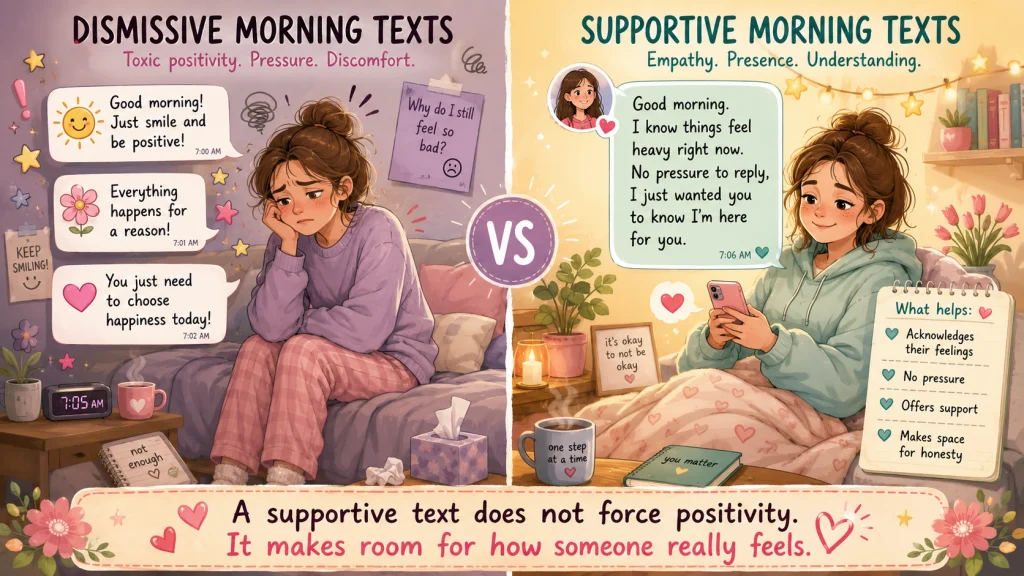
What Not to Say in a Morning Message to Someone Struggling
Most of what goes wrong in a morning message to someone who is struggling is not cruelty. It is misplaced brightness. The instinct to offer something positive is real and comes from care. The problem is that it can arrive before the person has had a chance to feel acknowledged, and when that happens the encouragement lands hollow at best and dismissive at worst.
These are the phrases worth avoiding:
- Good morning, sunshine! (or any aggressively cheerful opener that ignores the context completely)
- Things will get better soon. (It may be true. It is also not what a hard morning needs to hear first.)
- Stay positive! (This asks them to feel differently than they do before their day has even started.)
- You have got this! (Said alone, without any acknowledgment of what “this” actually is, it can feel empty.)
- Everything happens for a reason. (No version of this helps on a hard morning.)
- At least… (Anything that follows “at least” is a comparison that minimizes the actual experience.)
The shift is small but significant. Instead of “Things will get better,” try “I know this morning is hard.” Instead of “Stay positive,” try “You do not have to be okay right now.” The acknowledgment comes first. The encouragement, if it comes at all, comes after. If you want to go further than a morning message, the broader collection on words of encouragement for hard times covers what to say across the full arc of a difficult period.
A Note on Sending Them
The best morning message for someone going through a hard time is the one you actually send. Most people wait until they have found the perfect words, and most of the time that wait means the person gets nothing. The messages above are not perfect. They are honest. And an honest message sent imperfectly will always do more than the ideal one that never arrives.
If you are not sure whether to send one at all, send it. The risk of reaching out is almost always smaller than the risk of staying quiet. A message that says “I am thinking of you this morning” is rarely the wrong thing to send. What can be wrong is silence when someone is struggling, and someone who cared enough to look for the right message is almost certainly someone who should send one.
FAQs
🌅 What should I say in a morning message to someone who is grieving?
Acknowledge the morning itself before anything else. Mornings are hard in grief, and the most useful message is one that says: I know this is a difficult time to wake up, and I am thinking of you. Avoid bright openers and silver linings. Just be present, and say so.
💬 How do you send a supportive morning text without being too much?
Keep it short and make it clear no reply is expected. “Thinking of you this morning. No reply needed.” removes the pressure immediately. A message that asks nothing of the person is easier to receive than one that opens a conversation they may not have the energy for yet.
🕊️ Is it okay to send a morning message every day to someone struggling?
Yes, and it often matters more than you think. The first message is easy to send. The message you send on day twenty, when everyone else has moved on, is the one that carries the most weight. If you are going to do it, keep going past the point where it feels like the acute moment has passed.
💙 What if I do not know what they are going through exactly?
You do not need the details to send a meaningful message. “Good morning. I have been thinking about you” is enough. You do not have to name what you know or do not know. The fact of the message says what needs to be said.
📱 How long should a morning text be for someone who is struggling?
As short as it needs to be. Two sentences is often ideal. Long messages can feel like they require a response, which adds pressure. A short, warm message that asks nothing back is usually easier to receive, and often remembered just as clearly.