Starting over messages are different from messages about a fresh start, even though people often use the words the same way. A fresh start looks only forward. Starting over carries something with it, the part of your life that came before, the things you’re choosing to leave even though they mattered. What follows are 65 messages about starting over, organized by what you’re starting over from: a relationship that ended, a career that didn’t go the way you planned, a sense of direction you lost somewhere along the way, or simply the open, uncertain space that comes after deciding you can’t stay where you were.
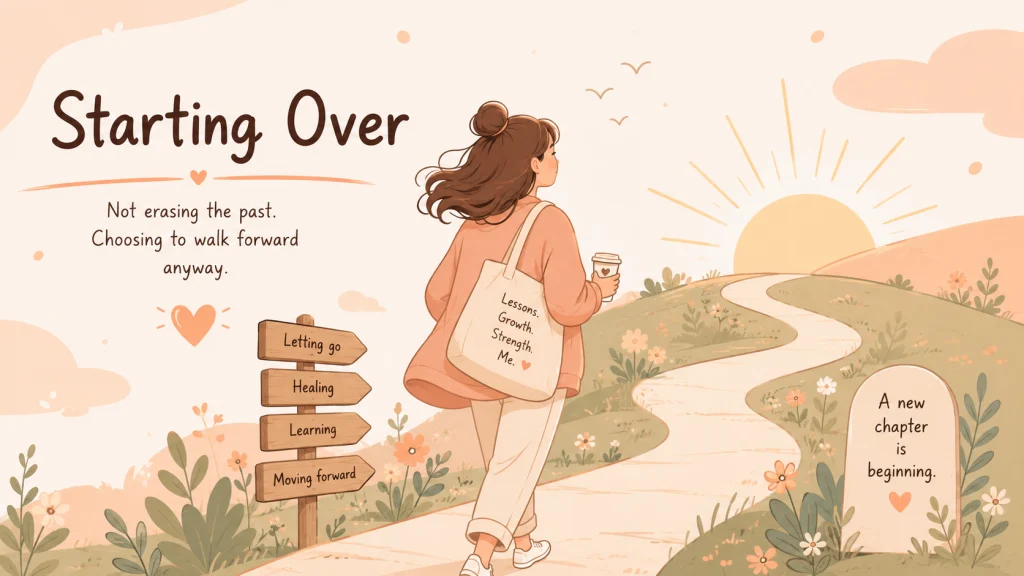
Starting over and starting fresh are not the same thing
Most starting over messages get written like fresh-start messages with a different label stuck on top, all forward motion and no acknowledgment of what came before. That’s understandable. Looking back can feel like it slows you down, like it keeps one foot in a place you’re trying to leave. But starting over is not the same as starting fresh, and the difference is worth sitting with for a moment before you write anything.
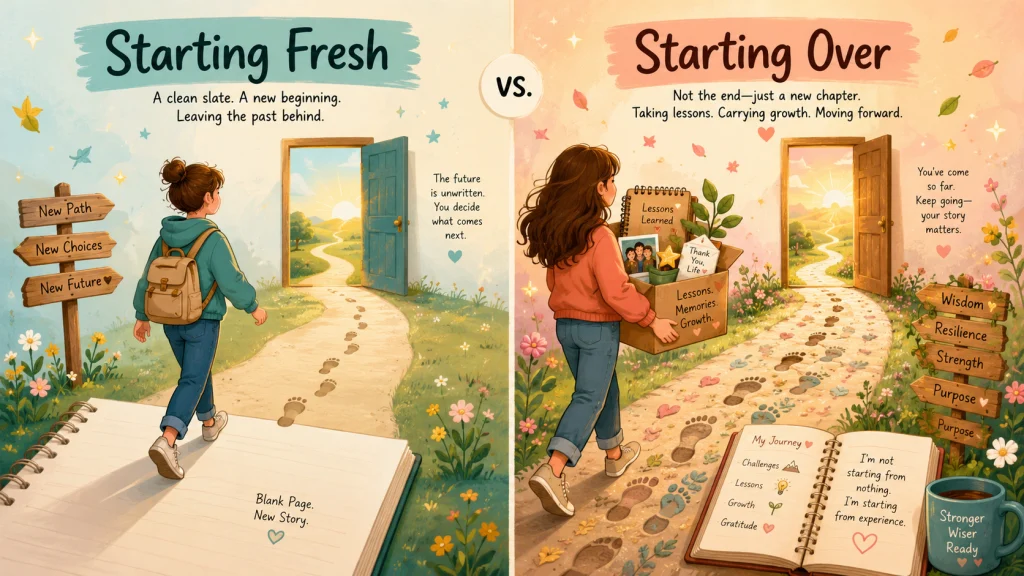
A fresh start suggests nothing came before it, a page with nothing written on it yet. Starting over admits there was a before, and that the before mattered, even if it ended badly, even if it’s something you’re relieved to be done with. I think this is the part most messages skip. They jump straight to the hopeful part, the new chapter, the open road, without spending even a sentence on what’s actually being left. From what I’ve found, that skip is exactly what makes a message feel hollow, even when the feeling behind it is real.
I noticed this most clearly after I left a job that had stopped being right for me a long time before I actually left it. I wrote something to a friend about starting fresh, about how good it felt to finally have a clean slate. She wrote back asking how I was actually doing, underneath the clean slate part. I didn’t have a quick answer. The job had been wrong for a while, but it had also been mine for a long time, and leaving it wasn’t only relief. It was also something ending. That’s the part starting fresh messages tend to skip, and the part that messages about starting over, the kind that actually mean something, tend to hold onto.
| Starting fresh | Starting over |
|---|---|
| Reads like nothing came before this moment | Acknowledges that something happened, even briefly |
| Tone is light and forward-only | Tone holds both what’s ending and what’s beginning |
| Fits a new chapter with no real loss attached | Fits a beginning that follows something hard, unfinished, or no longer working |
None of this means starting fresh messages are wrong, exactly. They’re just for a different moment, one where there genuinely isn’t much to leave behind yet, or where nothing has happened that needs acknowledging. What follows here is for the other version, the one that comes after something real, a relationship, a job, a sense of direction you thought you had, and still chooses to walk forward anyway.
For starting over after a relationship ended
A relationship ending, whether it was sudden or something that had been coming for a long time, is probably the most common reason people search for starting over messages in the first place. The mistake I see most often here is going to one of two extremes. Either the message pretends the relationship barely mattered, all bravado and moving on, or it stays so focused on what was lost that there’s no room left for anything else. Neither one tells the truth, which is usually somewhere in between.
What tends to work is a message that does both things in the same breath: it acknowledges that something real happened and still chooses to move. I’ve written versions of this myself, more than once, usually late at night when the version I’d write in the morning would have been too careful. The honest ones are rarely the polished ones. They’re the ones that admit the relationship shaped you and that you’re walking away from it anyway.
- “I’m not pretending the last few years didn’t happen. I’m just choosing to walk forward anyway, carrying what mattered and leaving the rest.”
- “Some chapters end before we’re ready, but they still end. I’m starting the next one, and I’m taking what I learned with me.”
- “I loved who we were, even the parts that didn’t work. Now I’m learning who I am without that.”
- “Letting go doesn’t mean it didn’t matter. It means I’m ready for whatever comes after it.”
- “I spent a long time trying to fix what couldn’t be fixed. Now I’m spending that energy on starting again.”
- “There’s a version of me that existed in that relationship. I’m grateful for her, and I’m ready to meet whoever comes next.”
- “I’m not erasing the last chapter. I’m just turning the page, slowly, and seeing what’s written on the next one.”
- “Some love doesn’t end because it failed. It ends because it was finished. I’m starting over with that in mind.”
- “I used to think starting over meant pretending none of it happened. Now I know it means honoring it and still moving.”
- “This isn’t about forgetting. It’s about making room for what comes next, even if I don’t know what that is yet.”
- “I keep catching myself looking back at what we were, and I think that’s allowed. Looking back and starting over aren’t opposites.”
- “We were good for each other for a while, and then we weren’t. I’m starting over holding onto the first part.”
- “I didn’t want it to end this way. I’m starting over anyway, because the way it ended doesn’t get to decide what comes next.”
- “There’s a version of this where I pretend none of it mattered. I’m choosing the other version, the one where it mattered and I still move on.”
- “I’m not over it yet, not completely. But I’m starting anyway, because waiting to feel ready might take longer than I have.”
These work whether you’re writing them for yourself, in a note you never send, or sharing them somewhere more public, a caption, a message to someone who’s been checking in on you. What matters less is who reads them. What matters is that they don’t ask you to pretend the relationship was nothing in order to be ready for what comes next. The same honesty applies just as much when what’s ending isn’t a relationship at all, but something you built somewhere else entirely, like a job or a path you’d been following for a long time.
For starting over after a career change or failure
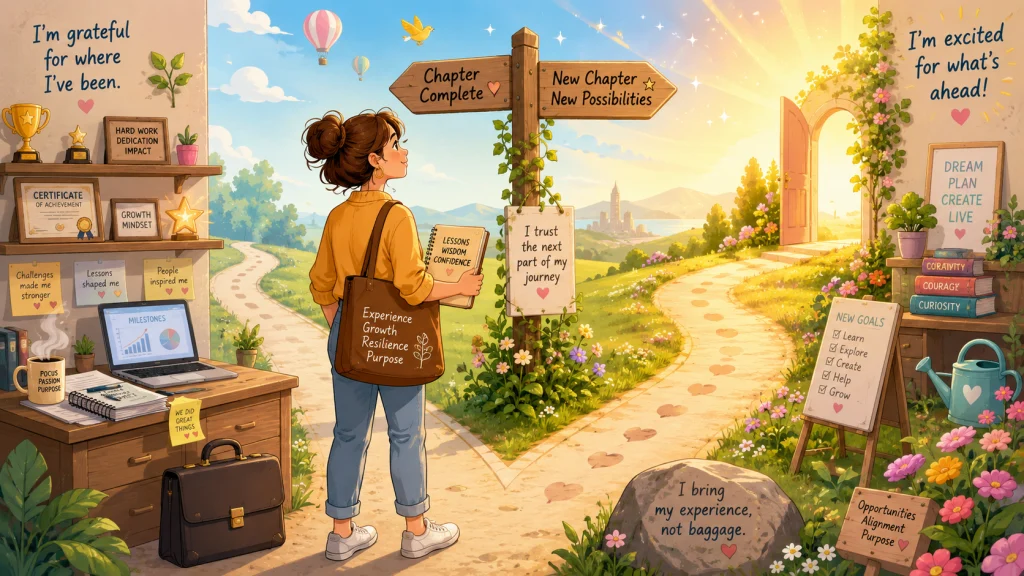
A career ending or falling apart carries its own particular weight, partly because so much of how people see themselves gets tied up in what they do. When that changes, whether by choice or not, starting over messages here often lean too hard into the next opportunity, the new role, the next chapter, without acknowledging that something just didn’t work, and that not working is allowed to sting for a while before it turns into anything useful.
What I’ve found helps most is naming what was actually learned, even if what was learned is uncomfortable. Maybe it’s that the job was never the right fit. Maybe it’s that you stayed longer than you should have. Either way, that knowledge is not nothing, and a message that carries it forward feels different from one that pretends the slate is wiped completely clean. If part of what you’re sitting with is whether it’s too late to try something different after this, it’s never too late messages goes into that question more directly than anything here can.
- “The job didn’t work out the way I hoped, but it taught me things I wouldn’t trade. I’m starting over with that in my pocket.”
- “I spent years building toward something that didn’t pan out. Now I’m building something else, and I’m bringing what I learned with me.”
- “Failure isn’t the opposite of progress. Sometimes it’s just the part before it. I’m starting again, a little wiser.”
- “I’m not starting from zero. I’m starting from everything I learned the first time, which is not nothing.”
- “The plan didn’t work. So I’m making a new one, and this time I know a few things I didn’t know before.”
- “Some doors close because they were never meant to stay open. I’m walking toward whatever’s next.”
- “I gave that job everything I had. It still ended. Now I’m giving the next thing everything I have left.”
- “Starting over professionally doesn’t erase what came before. It just means the next chapter gets to be informed by it.”
- “I’m allowed to grieve the version of my career I thought I’d have, and still be glad about the one I’m building now.”
- “This isn’t a step backward. It’s a step sideways into something I haven’t tried yet, and I’m bringing everything I know with me.”
- “I thought this would be the thing that finally worked. It wasn’t. I’m starting over with a little less certainty and a little more honesty.”
- “Some skills I built don’t apply anymore. Others do, more than I expected. I’m starting over with the ones that still do.”
- “I’m not embarrassed that this didn’t work out. I’m just ready to try something that might.”
- “The version of me that started this job doesn’t exist anymore. The version that’s leaving knows more, even if it doesn’t feel like it yet.”
- “I spent a long time hoping it would get better. It didn’t. So I’m building something else, starting now.”
These can work for a job that ended on someone else’s terms just as much as one you walked away from yourself. The circumstances change the tone slightly, but the core of it stays the same: something didn’t work, and you’re starting again anyway, carrying what you learned instead of leaving it behind with everything else. Sometimes, though, what’s ending isn’t tied to one specific thing at all. It’s more like the sense of direction itself went quiet, and that’s its own kind of starting over.
For starting over after losing your sense of direction
This one is harder to write toward because it’s harder to name. A relationship ending or a job falling through has an event attached to it, something you can point to. Losing your sense of direction usually doesn’t. It’s quieter than that, more like waking up one day and realizing the thing you’d been working toward doesn’t feel like yours anymore, without any single moment you can blame for it.
Some people search for begin again messages when they’re in this particular place, which makes sense, because what’s missing isn’t a person or a job, it’s a sense of where you’re even headed. What helps here, more than anything else, is permission to not have an answer yet. The messages that work in this category don’t pretend to know what’s next. They just acknowledge that staying still wasn’t working either, and that starting again doesn’t require having the whole path mapped out first.
- “I don’t know exactly where I’m going, but I know I can’t stay where I was. That’s enough to start moving.”
- “Losing direction isn’t the same as losing yourself. I’m still here. I’m just figuring out which way to walk.”
- “For a while, I didn’t know what I wanted. Now I’m starting to find out, one small choice at a time.”
- “I spent a long time waiting for clarity before I moved. Turns out, sometimes you have to move to find it.”
- “Not knowing what’s next used to scare me. Now it just feels like the part before something I haven’t found yet.”
- “I’m starting over without a map, and for the first time in a while, that feels less like being lost and more like being free.”
- “The direction I had stopped making sense. So I’m not forcing it. I’m just taking the next right step.”
- “I’m allowed to not have it figured out. I’m allowed to start anyway.”
- “Some people know exactly where they’re headed. I don’t, not yet. But I’m walking, and that counts for something.”
- “I lost the thread for a while. I’m picking it back up, even if I don’t know yet where it leads.”
- “I used to have a five-year plan. Now I have a today plan, and that feels like enough for now.”
- “Starting over doesn’t mean starting from nothing. It means starting from wherever I actually am, which is here.”
- “I don’t need to know the whole plan to take the first step. I just need the first step.”
- “For a long time, I was following a direction that wasn’t mine. Starting over means finally choosing my own.”
- “The path I thought I was on disappeared. I’m not panicking. I’m just looking for the next part of it.”
If what you need most right now is something to hold onto while you figure the rest out, something steadier than these, uplifting messages can sit alongside this kind of starting over well. But if it’s the beginning itself you’re trying to put into words, even without knowing where it leads, that’s exactly what comes next.

For starting over when you don’t know what comes next
There’s a specific moment that happens after you’ve already decided to start over, and before you have any idea what that actually looks like. You’ve left, or stopped, or closed the door on whatever it was. And now there’s just space, open and a little unsettling, with nothing in it yet. Whether you call them starting over messages or starting again messages, this is usually the moment they’re written for, the in-between part that doesn’t get talked about as much as the ending or the beginning that supposedly follows it.
I remember a stretch like this myself, after a relationship ended and before I had any real idea what my life was going to look like without it. I didn’t write anything hopeful during that time, not really. What I wrote, when I wrote anything, was closer to an honest account of not knowing, paired with a small, stubborn decision to keep going anyway. Looking back, that was probably more useful than anything more polished would have been.
- “I don’t have the next step figured out. But I’m done standing still, so here I go.”
- “Not knowing what comes next used to feel like failure. Now it just feels like the truth, and I’m okay with that.”
- “I’m starting over without a plan, which terrifies me a little, and also feels like the most honest thing I’ve done in a while.”
- “Maybe the not knowing is the point. Maybe this is just what beginning actually feels like.”
- “I used to need certainty before I’d take a step. Now I’m taking the step and figuring out the rest as I go.”
- “There’s no map for this part. I’m making it up, one day at a time, and that’s allowed.”
- “I don’t know where this leads. I just know I couldn’t keep standing where I was.”
- “Starting over without knowing what’s next isn’t the same as starting over without hope. I still have that. I’m just figuring out where to put it.”
- “I keep waiting for it to make sense before I move. Maybe it makes sense after.”
- “This is the part where I’m supposed to have a plan, and I don’t. I’m starting anyway.”
- “I don’t know what I’m walking toward. I just know I’m walking, and that’s different from standing still.”
- “Nobody tells you that starting over can feel like nothing at all for a while. I’m in the nothing part, and I’m still here.”
These work best when you’re not trying to convince yourself of anything, just naming where you are. The not knowing doesn’t need to be fixed before you’re allowed to begin. Sometimes the beginning and the not knowing happen at the same time, and that’s fine, even if the version of it you want to share with someone else is shorter than any of this.
Short starting over messages
Not every moment like this needs a full message. Sometimes what you want is a single line, something for a caption, a note to yourself, or a message to someone who already knows the context and doesn’t need the whole story retold. Short doesn’t mean less honest. If anything, a short message has less room to hide behind, which can make it feel more direct.
These work well after something hard, when you want to mark the moment without unpacking everything that led to it. They’re also useful as a starting point. If one of these is close to what you mean but not quite right, it’s often easier to adjust a short message than to write a long one from scratch.
- “Starting over, and bringing what mattered with me.”
- “New chapter. Same person, a little more sure of what I’m looking for.”
- “Letting go of what didn’t work, and making room for what might.”
- “I’m not the same person who started the last chapter. That’s the point.”
- “Beginning again, with everything I learned still in my pocket.”
- “Here’s to the next part, whatever it turns out to be.”
- “Still figuring it out. Still moving.”
- “One step. Then the next one.”
Whichever version fits, short or long, specific to a relationship or open enough to cover whatever you’re walking away from, the point is the same. You get to acknowledge what came before and still choose to move.
Final thoughts: The beginning is allowed to carry some weight
From what I’ve found, the messages about starting over that feel most true are the ones that don’t rush past what’s being left. Not dwelling on it, not making it the whole message, but not skipping it either. A beginning that acknowledges what came before isn’t a weaker beginning. If anything, it’s the more honest one, and honesty tends to be what makes a message land, whether you’re writing it for yourself or for someone else.
If what you want is something even shorter than these, closer to a single line you’d write down or send exactly as it is, new beginnings quotes leans further in that direction. And if the beginning you’re thinking about doesn’t really have anything being left behind attached to it, if it’s more open than that, new beginning messages is probably closer to what you’re looking for.
FAQs
🌱 What’s the difference between starting over and starting fresh?
Starting fresh tends to look only forward, like nothing came before it. Starting over acknowledges that something did, a relationship, a job, a version of your life that didn’t get to continue. Both are valid, but they’re for different moments.
💬 What do you say to someone who is starting over?
Skip the part where you tell them everything happens for a reason. Acknowledge that what they’re leaving mattered, even if it needed to end, and let them know you’re glad they’re taking the next step, whatever that ends up looking like.
🧭 What if I don’t know what I’m starting over toward?
That’s more common than it might feel like. A lot of starting over happens before there’s a clear direction attached to it. The not knowing doesn’t disqualify you from beginning. It’s often just part of what beginning looks like.
✨ Is there a short way to say you’re starting over?
Yes, and short can actually feel more honest than something longer. A single line that acknowledges the shift, without over-explaining it, often says more than a paragraph trying to cover everything at once.
💔 What’s a good message for starting over after a breakup?
The ones that work best hold two things at once, that the relationship mattered, and that you’re choosing to move anyway. Avoid anything that pretends it didn’t happen, and avoid anything that stays stuck only on what was lost.
🤍 Is it normal to feel sad about starting over even when it’s the right choice?
It’s one of the most normal parts of it. Something ending is still something ending, even when staying wasn’t really an option. Starting over messages that make room for that feeling tend to land more honestly than ones that skip straight to excitement.
🌧️ What’s a good message for starting over after hard times?
When what you’re starting over from was something genuinely hard, a loss, an illness, a stretch of time that took more out of you than you expected, the message doesn’t need to explain all of it. It just needs to hold both things: that it was hard, and that you’re still here, choosing to begin again.