For related message ideas, see messages for new beginnings.
Why the Type of New Beginning Changes Everything About What to Say
The same message that lands perfectly for someone who chose to start over can feel completely tone-deaf to someone who had no choice. “This is so exciting, here comes everything you’ve been working toward” reads beautifully to a person who left a stable job for something they believed in. It lands like a bad joke to someone who just lost that stable job and has to figure out what comes next. New beginning messages aren’t interchangeable, and the people sending them mostly sense this but don’t know where to draw the line.
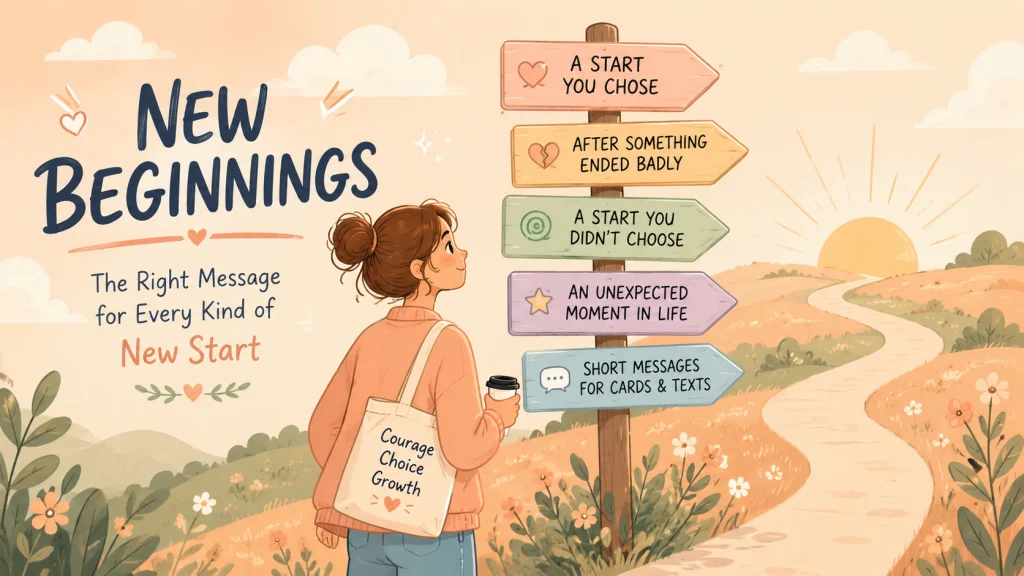
What I’ve found is that the organizing question isn’t “how hopeful should this be?” It’s “what actually ended here, and did this person choose it?” Those two things determine tone almost entirely. A voluntary beginning can handle celebration. A forced one needs steadiness first. A beginning that came after loss needs acknowledgment before it needs encouragement. The sections below are built around that distinction, so the message you send actually fits the beginning the person is standing at.
Finding the right section for the situation
If you’re not sure which section fits, the table below maps the most common situations to the message tone that tends to work. When in doubt, lead with acknowledgment rather than enthusiasm. You can always add warmth after you’ve shown you understand what the beginning actually cost.
| The situation | What it usually feels like | Which section to use |
|---|---|---|
| Career change, new city, relationship they chose | Excited, clear-eyed, maybe nervous in the good way | Voluntary new beginning |
| Breakup, business failure, personal loss, painful ending | Raw, determined, uncertain about what’s next | After something ended badly |
| Restructuring, relocation, forced change of plans | Disoriented, adjusting, not yet at peace with it | New beginning you didn’t choose |
| Milestone birthday, later-in-life restart, off-schedule moment | Surprised, quietly hopeful, not sure what the timeline is | Unexpected moment in life |
| Any situation, short format | Varies | Short messages for cards and texts |
One thing worth noting: these categories aren’t rigid. A voluntary new start can still carry grief. A forced one can carry relief. Use the section that fits the dominant emotional reality, and adjust the message from there.

New Beginning Messages for a Start You Chose
When someone has made a deliberate choice to begin something new, they’ve already done the hardest part before the beginning even arrives. The decision. The moment of deciding the old thing was done and the new thing was worth the risk. Messages for a voluntary beginning can celebrate that without over-explaining it. They work best when they name the courage the choice required, not just the excitement of what’s coming.
These suit career changes (if you’re the one writing the resignation part of that career change, this guide to a career-pivot resignation email covers how to frame it professionally), moves to a new city, new relationships someone chose carefully, going back to school, or leaving something comfortable to pursue something true. If you know the specific thing they left behind, one sentence acknowledging what it cost them tends to land more than any amount of forward-looking encouragement.
- This is what choosing yourself looks like. I’m so proud of you.
- You’ve been heading here for a while. I’m glad you finally let yourself arrive.
- I know this took more courage than it looked like from the outside. It shows.
- This is the part where you find out what you’re actually capable of. It’s a good part.
- You made the harder choice and the right one. Those are sometimes the same thing.
- Watching you do this is one of the best things I’ve gotten to see. So glad you’re here.
- You’ve earned this beginning. Now let yourself enjoy it.
- This is your season. You built it, you chose it, now you get to live in it.
- Some doors you walk through. Some you kick open. I love that you kicked this one.
- Whatever made this necessary, you moved toward something instead of only away from something. That matters.
- The version of you that made this call is one I’ve always believed in. I’m glad that version got heard.
- You’re not starting over. You’re starting from here, with everything you know. That’s different.
- New doesn’t have to mean uncertain. You walked in knowing more than you think.
- Here’s to the decision that took everything you had and made sense anyway.
- The brave version of your life is the one happening right now.
- What you’re doing takes more than talent. It takes conviction. You have both.
- This is the beginning of the story you’ve been trying to tell for years. I can’t wait to see what happens.
- Choosing something new when the old thing was comfortable isn’t easy. You did it anyway, and it looks right on you.
For someone who’s been building toward this decision for a long time, a message that shows you noticed the buildup, not just the moment, will carry more weight than one that treats it as sudden.
New Beginning Messages for When Something Ended Badly
Starting over after something breaks is one of the harder emotional situations to write for, and one of the most common. The person on the receiving end is usually holding grief and determination at the same time. They know, intellectually, that things can get better. They don’t feel it yet. Messages that skip straight to optimism can feel dismissive. Messages that only acknowledge the pain without moving anywhere can feel like they’re keeping the person stuck. The goal is to hold both: what ended mattered, and what comes next is still worth something.
These work for the aftermath of a breakup or divorce, the end of a business that didn’t make it, a friendship that broke painfully, a public failure, a personal loss, or any ending that came with real damage. Keep the message short if you’re not close to the person. If you are, the specific detail of what they’re leaving behind is almost always worth naming.
- I know this beginning wasn’t the plan. But here you are, and here is somewhere worth being.
- Starting over after something breaks isn’t weakness. It’s the hardest kind of courage there is.
- You didn’t fail. You landed somewhere that hurt, and now you’re getting up. Those are different things.
- The next chapter doesn’t have to explain the last one. It just has to be yours.
- You’re allowed to grieve what’s behind you and still move forward. They can be true at the same time.
- I won’t tell you it was meant to be this way. I’ll just say I believe in what comes next for you.
- There’s a version of your future that exists because you survived this. I hope it surprises you gently.
- Starting again after real loss is its own kind of strength. You have more of it than you know.
- The ground shifted and you found your footing anyway. That’s worth something.
- You’re building something on harder ground than most people start with. That makes what you build matter even more.
- I’m not going to tell you to look on the bright side. I’ll just tell you I see you, and I believe in what’s ahead.
- Some losses ask you to become a new version of yourself before you’re ready. I believe you’ll get there.
- Whatever you lost here, you are still here. That is not small.
- After what you’ve been through, the fact that you’re starting again means everything.
- I won’t pretend this makes sense yet. I’m not there either. But I believe in you right now, today.
Resist the urge to add “and everything happens for a reason” or any version of that. It almost never helps. What helps is being specific about your belief in the person, not in the situation.
New Beginning Messages for a Start You Didn’t Choose
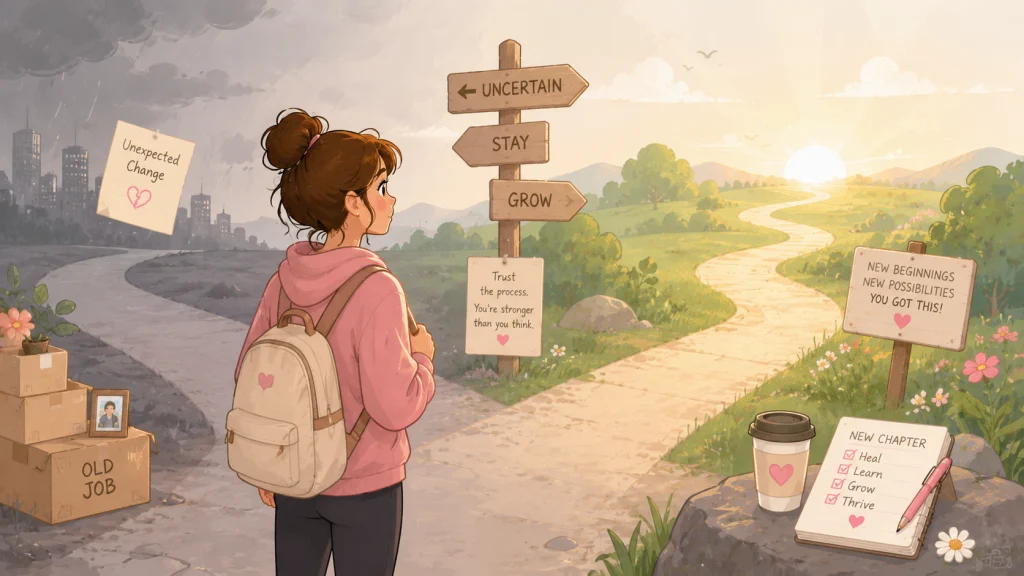
There’s a specific kind of new beginning that arrives without an invitation: a restructuring that changes your role, a relocation you didn’t ask for, a family responsibility that suddenly becomes yours, a forced move, or a change of plan that came entirely from outside. The person in this situation is doing something harder than starting something new. They’re adapting to a beginning they would have chosen not to have. Messages for this kind of start need to acknowledge that first and foremost. The hope can come, but it earns nothing until the acknowledgment comes first.
These messages are also useful for situations that are harder to categorize: the person who is “fine” but clearly not, the beginning that looks exciting from the outside and feels disorienting from the inside. Finding the right tone here is harder than for any other category. For more options across different emotional situations, the collection of uplifting messages covers a range of circumstances where the balance between honesty and hope is the central question.
- This wasn’t your plan, and you don’t have to pretend to love it yet. But I believe you’ll find your way in.
- Some of the best places people end up started with a beginning they never would have chosen. I’m holding that hope for you.
- You didn’t choose this, and that matters. And you’re still here, still moving. That matters too.
- I know the version of the future you’d planned looked different. I’m sorry this one wasn’t your call.
- Being brave about something you didn’t want takes more than ordinary courage. You’re showing that right now.
- I hope this beginning surprises you. I genuinely believe it has the capacity to.
- New doesn’t always mean better immediately. But it does mean possible. And possible is worth something.
- You’re doing the hard work of adjusting to something you never asked for. That is not a small thing.
- This is a beginning you didn’t write. I believe you’ll still find the words to make it yours.
- The beginning you didn’t choose can still become the one you grow into. Give yourself time.
- I know this isn’t what you wanted. And I know you’re going to handle it in a way that matters.
- You don’t have to be at peace with this yet. You just have to keep going. You’re doing that.
- There’s a kind of strength that only shows up when circumstances force it. Yours is showing up now.
- Not every beginning comes with excitement. Some come with grit. Yours is the second kind, and grit is enough.
- Whatever got you here, you’re here, and here isn’t as small as it feels right now.
These messages work because they don’t require the person to feel something they don’t feel. They meet the situation where it is and leave the optimism as a possibility, not a demand.

New Beginning Messages for an Unexpected Moment in Life
Some new beginnings are unusual for their timing rather than their content. Starting a business at 60. Going back to school at 45. Finding a new relationship after spending years thinking that chapter was closed. Moving somewhere new at an age when most people in your life have stopped moving. These beginnings carry a particular kind of disorientation, not because the change is bad but because it arrived off-schedule, outside the life script, at a moment that makes the person aware of their own expectations about how things were supposed to go.
Messages for this kind of beginning should acknowledge the unusual timing without making it the dominant fact of the situation. The person doesn’t need to be reminded that they’re “starting late” or doing something “at an unexpected age.” What tends to land is a message that treats the beginning as exactly what it is: a beginning. Uncommon. Worth marking. Worth believing in.
- No one warned you this season would hit different. But here it is, and here you are.
- Starting something new at a point when most people are settling in takes a specific kind of nerve.
- Whatever chapter this is, it’s not too late to mean something new.
- This wasn’t the timeline you imagined. It might be better for it.
- The plan never looked like this, but the possibilities look a lot like something worth doing.
- I’ve watched you adapt to things most people wouldn’t have managed. This is next, and I believe you’ve got it.
- Starting over in the middle of a life you didn’t expect to restart is something only certain people can do. You’re one of them.
- This might be the least expected chapter, and the one you look back on most.
- The thing no one tells you about unexpected beginnings is that they often ask you to become someone more interesting.
- Everything that brought you here was preparation you didn’t know you were getting. Use it.
- I know this wasn’t in the plan. I also know you’re better at this than you think you are.
- The version of you that’s starting this chapter knows things the earlier version didn’t. Start from there.
- You are not starting from zero. You are starting from here. There’s a real difference.
- Whatever this looks like from the outside, from here it looks like someone choosing to be fully alive in their life. That’s everything.
The best of these messages take the unusual timing and make it less important: what matters isn’t when this is happening, but that it’s happening, and that the person chose to show up for it anyway.
Short New Beginning Messages for Cards and Texts
Sometimes a short message, sent simply and without embellishment, does more than a long one. A card in the mail with a single good sentence. A text that says exactly the right thing in eight words. These short messages work across all the types above: adjust the tone slightly based on whether the beginning was chosen or forced, but the brevity is the point. Don’t overexplain. Say the one true thing and let it be that.
For quote-style options and short phrases with a more reflective tone, the collection of new beginnings quotes has a wider range of shorter formats that work well for notes and captions. The messages below are more conversational, written to sound like something a real person would actually say rather than print on a card.
- Here’s to wherever this takes you.
- New beginning, new story. I’m so glad to be watching.
- You’re ready for this. Trust that.
- Whatever comes next, I’m in your corner.
- This is a beginning. I’m here for you through it.
- Go make something worth telling.
- New chapter. Still you. That’s a good combination.
- I believe in this beginning because I believe in you.
- Here comes everything you’ve been working toward.
- Rooting for you from here. Always.
- What a start. Can’t wait to see what you do with it.
- This is only the beginning, and the beginning already matters.
- Fresh start, same incredible person. Lucky combination.
- Go on, then. The next part of your story is waiting.
- Wherever this begins, here’s to the whole journey.
- New beginnings deserve all the good things. Wishing you every one of them.
- I’m proud of you, wherever this takes you.
- Something new is starting. I’m glad it’s yours.
Short messages pair well with a specific memory or detail added at the end: “New chapter. Still you. That’s a good combination. (Also, I’ve always known you’d end up doing something like this.)” That one added sentence turns a general message into something personal.
One Last Thing Before You Send
The distinction between a message that means something and a message that merely says something is almost always specificity. The person receiving your message has heard “here’s to new beginnings” before. What they haven’t heard is “here’s to this specific beginning, which I understand is happening because of this specific thing, and which I believe in because I know you.” You don’t have to say all of that. You just have to let one specific thing through.
A name, a detail, a reference to something you know about what they’re leaving or what they’re walking toward. That one specific thing is what makes a borrowed message into a real one. Take the message that fits, add what you know, and send it. The imperfect version that actually arrives is worth more than the perfect one still sitting in the drafts.
FAQs
💬 What do you say to someone starting a new beginning?
Start by thinking about what kind of beginning this is. If they chose it, you can celebrate. If it was forced on them, acknowledge the difficulty before anything else. If it came after loss, lead with that. The right tone depends entirely on what ended and whether they had a say in it.
🌱 What’s the difference between a new beginning message and a good luck message?
A good luck message looks forward. A new beginning message acknowledges both what’s behind and what’s ahead. The best ones name what this beginning actually is, voluntary, forced, after loss, unexpected, and speak to the emotional reality of that specific kind of start rather than treating all new beginnings as equally exciting.
😟 What do you say to someone starting over after something painful?
Acknowledge what ended before you point toward what’s starting. Skip phrases like “everything happens for a reason” and “it was meant to be.” What lands better is something honest: “I know this wasn’t the plan, and I believe in you anyway.” Short is often better here than trying to say everything.
✍️ How do you personalize a new beginning message?
Add one specific detail about either what they’re leaving or what you believe about where they’re going. It doesn’t have to be long. “New chapter. Still you. That’s a good combination. (I’ve always known you’d end up doing something like this.)” That last sentence is the part that makes it personal rather than generic.
📅 Can you send a new beginning message to someone starting over at an unexpected point in life?
Yes, and you should. The key is to treat the beginning as exactly what it is, without making the timing the center of the message. Avoid phrasing that emphasizes how unusual or late the beginning is. What the person wants to hear isn’t “good for you for doing this at your age.” It’s just: “I believe in this beginning.”
🎴 What should you write in a card for a new beginning?
Pick one of the short messages above and add one specific thing you know about the person or their situation. Cards work best when they’re brief and honest rather than long and general. A single sentence that shows you understood what this beginning cost them, or what it means to them, will stay with the person longer than a paragraph full of encouragement.