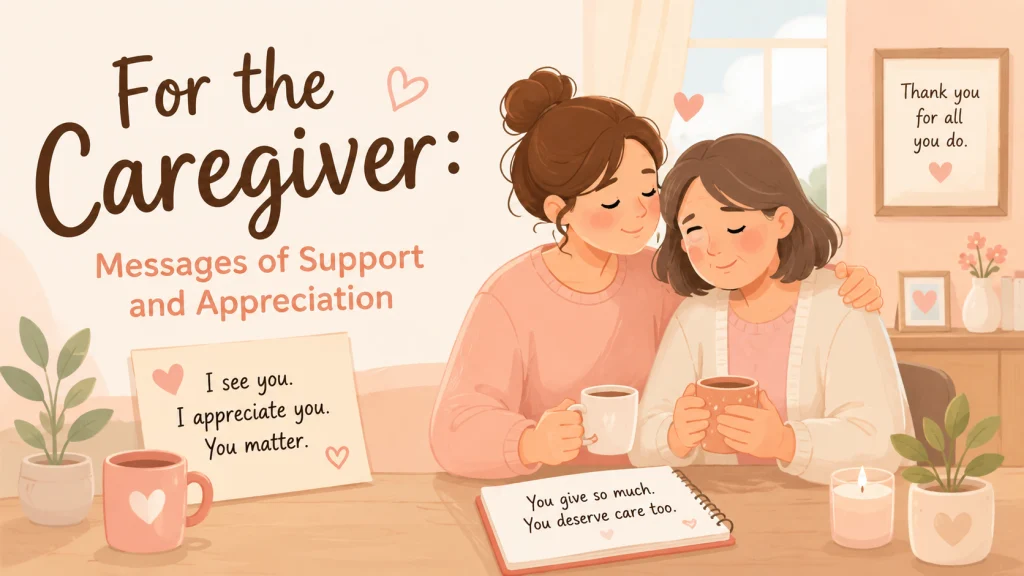
Most people think to ask how the person who is sick or struggling is doing. Almost nobody thinks to ask how the caregiver is. These 60 messages are for the person standing just outside the frame, the one who has quietly reorganized their entire life around someone else’s need. Sending something, even something small, is how you tell them they have not disappeared into the role. This is how you say: I see you, not just what you do.
The Person Who Is Always Giving
There is a particular kind of invisibility that comes with being a caregiver. The attention goes where it makes sense to go: toward the person who is sick, or aging, or struggling. The caregiver becomes the background. They are competent, present, and almost entirely unseen. Finding the right messages to send a caregiver who needs support is harder than it sounds, because most of us have been trained to ask after the patient, not the person sitting beside them.
I noticed this for the first time when a friend of mine was three weeks into caring for her mother full-time. I texted her one afternoon and, instead of asking how her mom was doing, I asked how she was doing. She did not reply for two days. When she finally did, she wrote: “That’s the first time anyone has asked me that.” I have thought about that message ever since. It took me thirty seconds to send. It took her two days to know what to do with it. That gap, between how easy it is to reach out and how rarely it happens, is exactly why this exists.
The messages here are not for the person who is ill or grieving. They are for the one doing the hardest work in the room. Whether you are trying to support a family member, a close friend, or a professional caregiver you want to acknowledge, the point is the same: to make sure the person who spends every day caring for someone else knows that someone, somewhere, is thinking of them. You can find broader encouragement messages when the situation calls for a wider lens, but everything here is built around one person: the caregiver.

For a Family Member Caring for an Aging Parent
Family caregivers occupy a strange emotional space. They are doing something they chose, out of love, and still finding it harder than they expected. There is often grief folded into the work: watching a parent change, managing logistics that feel endless, doing all of it while the rest of their life continues. What they need to hear is not that they are strong. They usually know they are managing. What they need is for someone to see that managing has a cost.
The messages below are not about reassurance. They are about recognition. The distinction matters. Telling someone they are doing an amazing job can, if it lands wrong, feel like a signal to keep going without complaint. What tends to land better is something more specific: I see what this is asking of you. I am thinking about you, not just the situation. Here are twelve you can use or adjust to fit what you actually want to say.
- “You show up every single day, even when it’s hard. That means more than you know.”
- “I think about what you’re carrying, and I want you to know I see it. I’m here.”
- “The way you care for [name] tells me everything I need to know about who you are.”
- “You’re doing something harder than most people will ever understand. I’m proud of you.”
- “How are YOU doing? Not them. You.”
- “I know this isn’t the chapter you imagined. I’m so glad your parent has you.”
- “You haven’t complained once. That doesn’t mean it isn’t hard. I see the hard.”
- “Can I bring dinner Tuesday? Not because you need help. Because you deserve a break.”
- “Caregiving takes something from you even when you give it willingly. I hope you have space to refill.”
- “Your parent is lucky. And I know that doesn’t make the hard parts easier. I just wanted to say it.”
- “I’ve been thinking about you. Not as a caregiver. As a person. How are you holding up?”
- “You’re doing something that most people couldn’t. I hope you let yourself feel proud of that.”
Notice that several of these draw a clear line between seeing the caregiver as a person and seeing them as a function. That line is intentional. One of the things people most often get wrong when reaching out to a family caregiver is leading with the person they are caring for. “How’s your mom doing?” is a kind question, but it keeps the caregiver in the background. Starting with them, even in a short text, shifts something.
For a Friend Caring for a Seriously Ill Spouse or Child
This is a different weight. A friend caring for a spouse or child who is seriously ill is living through something that has no clean shape. The future is uncertain. The daily reality is exhausting. And because it is ongoing, the usual outpouring of support from the early days tends to thin out, while the need keeps going. People often pull back not out of indifference but because they do not know what to say once there is no good news to respond to.
The right message here is rarely the one that tries to find the bright side. It is the one that says: I am still here, even now, even with no resolution in sight. If you are reaching out and the situation involves ongoing medical hardship for the person being cared for, messages for serious illness can offer additional language for that layer of the situation. The twelve messages below are specifically for the person doing the caregiving.
- “I don’t have words for what you’re going through. But I’m here. Completely.”
- “You are carrying the hardest thing I can imagine. I’m not going anywhere.”
- “How can I help right now, today? I want something specific to do.”
- “You don’t have to be strong right now. Not with me.”
- “I keep thinking about you. I just want you to know that someone has you in mind.”
- “The love you’re showing right now is something I will remember for the rest of my life.”
- “I know you said you’re fine. I want you to know you don’t have to be, with me.”
- “Tell me one small thing I can take off your list. I mean it.”
- “You’ve been on my mind a lot lately. I wanted you to know that.”
- “What does a good day look like for you right now? I want to help make one happen.”
- “I’m not going to say it’s going to be okay. I’m going to say I love you and I’m right here.”
- “You are not alone in this. Even when it feels that way. Especially when it feels that way.”
The message that gets it wrong most often in this context is the one that tries to reassure. “Everything will be okay” or “They’re going to pull through” are well-meaning, but to the person living inside the uncertainty, they can feel like a dismissal. Presence is more useful than prediction. The messages above are written to stay inside what is actually true: I am here, I care, I am not looking away.
For a Professional Caregiver You Want to Recognize
Professional caregivers, nurses, home health aides, hospice workers, care facility staff, are often thanked by the people they care for, but rarely by the people around them. If you know someone in this work and you want to acknowledge what they do, the challenge is writing something that does not sound like a generic appreciation post. What actually lands is specificity: the acknowledgment that this work is hard in particular ways, that it takes something, and that the person doing it chose to show up anyway.
Messages of appreciation for caregivers who do this work professionally tend to miss the mark when they lean too heavily on sacrifice. “You give up so much” can, unintentionally, suggest that the person made a mistake, or that they should be pitied. The tone that works better is one of genuine admiration for a genuine choice. These ten messages are written to do exactly that: to say something real, plainly and honestly, to someone who spends their days giving steadiness to people who need it most.
- “What you do every day quietly changes people’s lives. I wanted you to know I see that.”
- “Thank you for the patience you bring to a job that asks everything of you.”
- “The kindness you show to the people in your care matters more than you may realize.”
- “You chose work that most people couldn’t do. That’s not nothing. That’s remarkable.”
- “I’ve seen the way you show up, and I want to tell you: it doesn’t go unnoticed.”
- “You give your energy to others all day long. I hope you have people giving it back to you.”
- “Thank you for being a steady presence for someone who needs that more than anything.”
- “What you do is hard. What you do is important. Those two things are true at the same time.”
- “I thought about how rarely anyone says thank you for this kind of work. So: thank you.”
- “The compassion you bring to your work doesn’t just help the people you care for. It ripples.”
These work whether you know the person well or are simply acknowledging the work itself. They are not over-the-top. They are the kind of thing a thoughtful person would write to someone who has earned more recognition than they typically receive.
Short Messages to Send with a Gift or Card
Sometimes the message does not need to be long. You found a small thing to send, a candle, a meal delivery, a gift card, something that says I was thinking of you, and now you need a few words to go with it. The instinct is often to over-explain: to write a paragraph justifying the gesture, as though you need the caregiver’s permission to be kind. You do not. Short is often better here, and the messages below are written to be dropped into a card or a text without any adjustment needed.
The common mistake with gift-accompanying messages is making them about the caregiver’s role rather than the caregiver as a person. “For everything you do” is sweet, but it keeps them in the position of someone who does things. “For you, because someone should be taking care of you too” pulls them out of that position for a moment. That is the shift these messages are trying to make, and it is a small one that tends to be felt.
- “For you. Because someone should be taking care of you too.”
- “A small thing for the person doing the biggest thing.”
- “You give so much. Here’s a little back.”
- “Take a breath. You’ve earned it.”
- “This is for you, not them. You.”
- “Wishing you a quiet moment to yourself.”
- “Because I wanted to do something, even something small.”
- “For the person who never stops. A reminder that you matter too.”
These work exactly as written, but they also work as starting points. If you want to add a line about the specific person or a shared memory, add it before or after. The core sentiment, that this is for them, not for the person they are caring for, should stay intact.

When a Caregiver Is Running on Empty
Caregiver burnout is real, and reaching out when someone is in the middle of it requires a slightly different approach. The person may be too exhausted to respond, too proud to admit they are struggling, or too accustomed to being the capable one to know how to receive concern. A message at this moment is not asking for a response. It is simply placing something warm in a person’s day and letting it sit there without requiring anything in return.
What you want to avoid is anything that adds to their mental load: questions that require a long answer, suggestions that require action, observations that might read as criticism. The messages below are written to be received, not replied to. They are about acknowledgment, not advice. If you are also looking for broader language around exhaustion and difficulty, encouragement for hard times offers a wider range of options when the situation extends beyond caregiving.
- “You are allowed to be exhausted. That doesn’t make you a bad caregiver. It makes you human.”
- “I’ve noticed you’ve gone quiet. That’s not me pointing it out. It’s me asking if you’re okay.”
- “Your needs don’t disappear because someone else’s are bigger. I’m worried about you.”
- “Is there something I can do, this week, that would give you a few hours back?”
- “You’ve been giving so long. I want to make sure someone is looking after you too.”
- “I’m not asking how they are. I’m asking how you are. Really.”
- “You don’t have to keep it together with me. If you need to fall apart a little, I’ve got you.”
- “Rest is not the same as giving up. I hope you’re finding some.”
- “I can see how much this has been taking from you. I hope you know that needing rest does not make this your fault.”
- “You matter in this. Not just as a caregiver. As a person. I hope you remember that.”
“Your needs don’t disappear because someone else’s are bigger” is the one I keep coming back to when I think about what caregivers actually need to hear. It names something that most caregivers feel but rarely say out loud: that they have been quietly deprioritizing themselves for so long it has started to feel normal. Naming it, gently and without judgment, is one of the most useful things a message can do.

When You Want to Offer Help, Not Just Words
Here is the version of caregiver support that most people mean to give but rarely follow through on. “Let me know if you need anything” is a kind offer, and almost no caregiver will take you up on it. Not because they do not need help, but because figuring out what to ask for, and then asking for it, is another task in an already full day. The more useful message is the one that removes the decision: not “what do you need?” but “here is what I am going to do.”
This is also where words of comfort and practical action can work together: sometimes the most comforting thing you can say is a sentence that lifts something specific off someone’s plate. The eight messages below are written to do both at once, to say something warm and to make a concrete offer in the same breath.
| What people usually send | What actually lands |
|---|---|
| “Let me know if you need anything.” | “I’m bringing dinner Thursday. Is 6 okay?” |
| “You’re so strong.” | “You don’t have to be strong with me.” |
| “How is [the person they’re caring for]?” | “How are YOU doing? Not them. You.” |
| “I can’t imagine what you’re going through.” | “Tell me one thing I can take off your list.” |
| “Thinking of you both.” | “I’m thinking of you specifically. You.” |
Every message in the left column is kind, and none of it is wrong. But every message in the right column does something the left column does not: it centers the caregiver instead of the situation. That shift, small in words and significant in how it lands, is what these eight messages are built around.
- “I’m bringing food Thursday. Is 6 okay? You don’t need to do anything.”
- “Can I sit with [name] for two hours this weekend so you can step out alone?”
- “I want to help with something specific. What would make this week even 5% easier?”
- “I know you said you don’t need anything. I can come by Tuesday just to sit with you, if that would help.”
- “Tell me one errand I can run. I’m not asking to be polite. I genuinely want to do it.”
- “I’ve got your groceries this week. Just send me a list.”
- “I can’t fix what you’re going through. But I can show up. Tell me when.”
- “You don’t have to manage me. Just say yes.”
That last one addresses something real. Caregivers often turn down help because accepting it means explaining what they need, coordinating logistics, and worrying about whether the helper will follow through. A message that removes all of that friction, that asks only for a yes, gives them the easiest possible path to receiving care. ❤️
Final Thoughts: The Smallest Thing That Is Not Small At All
The thing about reaching out to a caregiver is that it almost always matters more than you expect it to. Not because the message is perfect. Because it arrived at all. The people who spend their days caring for someone else are often so focused on what that person needs that they have forgotten, slowly and without quite noticing, to register their own needs. A message that sees them, not just what they do, interrupts that pattern for a moment. That is not nothing.
It does not need to be long. It does not need to be eloquent. It needs to be honest and clearly for them, without ambiguity. The sixty messages here are starting points. Take the one that fits, adjust it to sound like you, and send it. Caregivers rarely ask to be seen. That is exactly why it means so much when someone looks.
FAQs
💬 What do you say to someone who is overwhelmed as a caregiver?
Say something that puts them at the center, not the person they are caring for. “How are you doing? Not them. You.” is often enough. Keep it short and do not ask them to problem-solve or respond with a list of needs. The goal is simply to let them know you see them as a person, not just a role.
🤝 What should I avoid saying to a caregiver?
Avoid “Let me know if you need anything,” since most caregivers will not take you up on it. Also avoid leading with how the person they are caring for is doing, or telling them how strong they are. Strength-focused messages can unintentionally tell a caregiver to keep going without complaint. Specificity and direct acknowledgment land better than open-ended offers.
💌 What is a good short message to send a caregiver with a gift?
“For you. Because someone should be taking care of you too.” is one of the most direct and useful. It names the point of the gesture clearly without being sentimental or over-explaining. Three to five words is often enough when the gift itself is doing part of the work.
❤️ How do you appreciate a caregiver without it sounding hollow?
Be specific about what you have actually noticed. “The way you show up every day, even when it’s hard” lands differently than “you’re amazing.” The more specific the observation, the more it reads as genuine rather than formulaic. Generic appreciation feels like something said to everyone. Specific appreciation feels like it was written for them.
🙏 What do caregivers actually need to hear?
More than anything, most caregivers need to hear that their own needs matter, that they have not disappeared into the role, and that someone is thinking about them specifically. “How are you doing,” directed at them and not the person they are caring for, is often more meaningful than any elaborate message.
📱 Is it okay to text a caregiver, or should I call?
A text is often better than a call. A phone call requires the caregiver to find a private moment, summon the energy for a conversation, and sound okay when they may not feel okay. A text can be read whenever they have space and does not require an immediate response. Send the text. They will read it when they can.