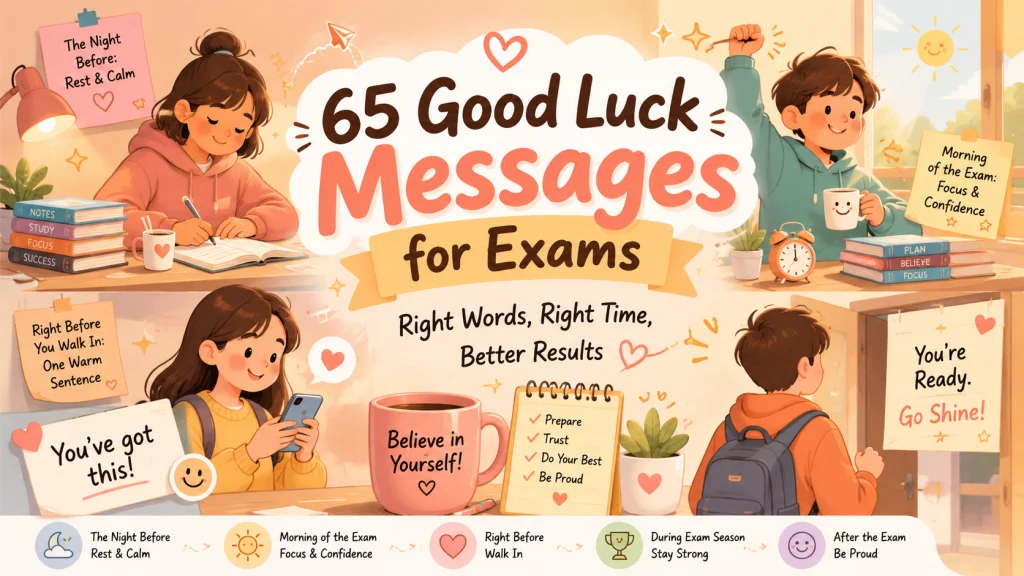
The night before an exam, the morning it starts, and the minute before someone walks in are three very different moments, and the words that help in one often fall flat in another. Good luck messages for exams work best when they match the timing, not just the occasion. Here are 65 messages organized by exactly when you are sending them, because that detail changes everything about what the words need to do. For broader context, see good luck before an exam or test.
Why the Same Words Don’t Work at Every Stage
Good luck before an exam sounds like one thing, but in practice it’s at least three. There is the message you send the night before, when someone is still reviewing notes or trying to stop. There is the one you send the morning of, when the nerves are starting and the focus is not quite there yet. And then there is the one that lands right before they walk in, when it is too late to prepare and all they can do is go. Each of those moments asks something different from a message, and most of what I have seen on this topic treats them as interchangeable. They are not.
I noticed this after texting a close friend the morning of her licensing exam. I sent something long: three paragraphs of encouragement, everything I wanted her to know about how capable she was. She told me later she had stopped reading halfway through because it made her more anxious. Too much to take in right when she needed to clear her head. That was the last time I sent a long message to someone on exam day. The moment shapes what the words should do, and the words should be shaped to fit it.

What Each Moment Actually Needs
Before getting into the messages, it helps to understand what each timing window is really asking for. Encouragement during exam season is not one continuous feeling. It shifts. Knowing what the moment needs makes it much easier to pick the right message, or adjust one to fit.
| When you are sending it | What the message needs to do |
|---|---|
| The night before | Restore calm. Signal confidence in the work they have already done. |
| Morning of the exam | Ground them. Help them find focus before it starts. |
| Right before they walk in | Be brief. One warm, honest sentence. Nothing more. |
| During a long exam season | Keep morale steady without adding pressure. |
| After they finish | Acknowledge the effort. Do not make it about the result. |
The night before is the easiest to overdo. The person is probably still reviewing notes, or trying to sleep, or both. A message that piles on more encouragement at 11 p.m. can read as pressure even when it is meant as comfort. What works better is something brief that gives them permission to rest, not a reminder of what is at stake. For a wider look at when and how these kinds of messages land across different situations, the full range of good luck messages goes deeper into what each occasion calls for.
The Night Before: 15 Messages for Rest and Calm
These messages are for the evening before the test, when the best thing you can do is help someone put the books down and actually sleep. Keep it short. Keep the tone calm. The goal is not to motivate them to study more tonight. It is to remind them that they have done the work, and the work is enough.
Notice that almost none of these are about the outcome. A message that says “you’re going to pass” is a prediction, and predictions add pressure. What these do instead is affirm the effort already made, and give the person something that feels more like steadiness than hype.
- You have put in the hours. Tonight, let that be enough. Sleep well.
- The prep is done. Trust it. Rest now so you can bring your best tomorrow.
- You know more than you think you do. Close the books, get some sleep, and go in ready.
- I am proud of the work you have put into this. Sleep well tonight.
- Tomorrow is yours. Rest up, and go show them what you know.
- Whatever happens, the effort you have given this is real. Sleep well.
- Stop studying. You are ready. Get some sleep and trust yourself tomorrow.
- You’ve got this, and you have earned the right to rest tonight. See you on the other side.
- I know you are nervous. That is normal. Sleep is the best thing you can do right now. Go get some.
- Big day tomorrow. Closing the books tonight is part of the prep. You’ve done the work.
- Not sending you a long message tonight because you do not need it. You are ready. Sleep.
- The test is not tonight. Tonight is for rest. Everything else waits until tomorrow.
- You have worked hard for this. That doesn’t change between now and morning. Sleep well.
- I am in your corner. Always. But right now: close the laptop, drink some water, sleep.
- Whatever tomorrow brings, you walked into it prepared. That is something. Good night.
One thing I have found worth keeping in mind: timing matters even within the night-before window. A message sent at 7 p.m. lands differently than one sent at midnight. If you know they tend to study late, send it early enough that it does not interrupt a study session, but close enough to bed that it carries them into sleep.
The Morning of the Exam: 15 Messages for Focus
Morning-of messages occupy a different space. The person is awake, the exam is hours away or less, and the nervous system is doing its thing. This is not the moment for long messages or deep reflection. It is the moment for something warm, grounding, and brief. Think of it as the text equivalent of a good breakfast: something that steadies, not something that excites.
There is a version of the morning-of message that people reach for instinctively: the “YOU ARE GOING TO CRUSH IT” text. I understand the impulse. But high-energy encouragement before a stressful event can tip someone from calm into heightened anxiety. Steady beats loud here, almost every time.
- Good morning. Today is the day. You are ready for it.
- Thinking of you this morning. You’ve got this.
- Go in calm. Trust what you know. Good luck today.
- I hope you slept well. Today is just you and what you’ve learned. That is more than enough.
- Sending you steady energy this morning. You are prepared, and it shows.
- Eat something. Breathe. You know this material. Go in steady.
- The hard work is already done. Today is just the part where you get to show it.
- Good luck on your test today. Rooting for you from over here.
- You are going to walk in knowing more than you realize. Trust that going in.
- Morning! Just wanted you to know someone is thinking of you and cheering you on today.
- Deep breath. You have been preparing for this. Let it come back to you when you need it.
- Not going to overwhelm you this morning. Just: you’ve got this. Go.
- Exam day. You’re ready. I am proud of you for showing up for it the way you have.
- Think of everything you’ve studied. It is all in there. Trust the prep.
- Today you get to show what months of work look like in practice. You’re ready.
A short message also signals something else: that you understand the moment. When someone is stressed and running through their mental checklist, getting a single warm sentence from someone they trust carries more weight than a long one. It says you read the room.

Right Before They Walk In: 12 Messages for the Last Moment
This is the hardest timing to get right, and the one most people over-do. When someone is standing outside the exam room or waiting for the proctor to say go, they do not need a paragraph. They do not need advice. What they need is one sentence, maybe two, that says: I see you, I believe in you, now go.
You know what you know. Go in and let it work. I’ll be right here when you come out.
That is the template. Short. Warm. Confident. Here are twelve versions of it.
- Walk in knowing you have done the work. Now go let it show.
- You are ready. Go.
- I believe in you. Always have. Go get it.
- Take a breath, walk in, trust yourself. You’ve got this.
- One thing for right now: you are more prepared than you feel. Go.
- Good luck. I mean it. You’ve earned this.
- Whatever nerves you’re feeling, they mean you care. That is not a bad thing. Go in.
- Walk through that door knowing someone is rooting for you. That someone is me.
- You know this. Not because I said so. Because you’ve put in the time. Go show it.
- Last message before you go in: I am proud of you already. The exam is only one part of the story.
- Close this. Walk in. You are ready for what’s on the other side.
- Go get it. I’ll be thinking of you until I hear back.
The person receiving one of these messages is not going to read it twice. They will look at it for ten seconds, feel something, and put the phone away. That is exactly the goal. A message that takes thirty seconds to absorb is thirty seconds of headspace they needed for the test.
For a Long Exam Season: 12 Messages to Keep Going
Exam seasons are their own thing. When someone has four exams spread across two weeks, the challenge is not one big moment but sustained effort over time. The messages that fit here are less about a single burst of encouragement and more about “I know this is a marathon, and I have not forgotten about you.” These land differently from the pre-exam messages, and they should.
If you find yourself sending daily encouragement to someone going through an extended stretch of tests, the same ideas that apply to sending daily messages to someone you care about are worth thinking through. Repetition without variation starts to feel hollow. Showing that you are paying attention to them as a person, not just tracking their academic schedule, is what keeps these messages from blurring together.
- Still thinking of you through all of this. You are doing better than you know.
- One down. You handled it. Keep going.
- I know this week is a lot. You are handling it, even when it doesn’t feel that way.
- Checking in. How are you holding up? And when is the last time you ate something?
- Almost there. I am proud of how you’ve kept showing up for this.
- Not every exam is the hardest one. But you are showing up for all of them, and that counts.
- I see how hard you’re working. That is not invisible. Keep going.
- End of the week, and you’re still standing. That’s something. Rest this weekend.
- Last stretch. You have come this far. Keep it steady now.
- Still in your corner. Always. How are you feeling about the next one?
- The fact that you keep going even when it’s exhausting says a lot about you. It does not go unnoticed.
- One more. Just one more. I’ll be waiting on the other side with real food and actual rest.
A few of these check in rather than push forward. That is intentional. By the middle of an exam season, what someone sometimes needs most is not another vote of confidence but a reminder that someone is paying attention to them as a person, not just tracking their performance.

After They Finish: 11 Messages for When It’s Done
The follow-up message is the one most people forget, and it is one of the most important ones. It does not matter whether they did well or not. What matters is that you followed through. You showed up before, and you are showing up after. That pattern says more than any single message can.
The mistake I keep seeing here is making the first question “how did it go?” That puts the result front and center immediately, when the person may not know yet, or may not want to think about it for a few hours. Start with the person. Ask how they are feeling, not how they scored. There will be time for the result later.
- It’s done. How are you feeling?
- You made it through. However it went, I hope you can breathe for a minute now.
- So proud of you for showing up and giving it everything you had. That is not nothing.
- Whatever happened in there, the effort you put into getting there was real. I saw it.
- Out the other side. I hope you’re giving yourself some credit right now, because I am.
- Done! Go eat something. Rest. And then tell me everything when you’re ready.
- It’s over. That takes something. I hope you let yourself feel that today.
- However it went: I am proud of how seriously you took this. The result doesn’t change that.
- You got through it. What do you need right now?
- I didn’t forget. How are you?
- Now you rest. Whatever the score says later, you earned the rest right now.
That second-to-last one is two words on purpose. Sometimes the most meaningful follow-up is just proof that you remembered. The person has been in exam mode for hours or days. Knowing that someone else was tracking time alongside them, and checked in the moment it was over, lands harder than a longer message ever could.
Final Thoughts: When Good Luck Is Really About the Person, Not the Exam
What I keep coming back to is that the best exam good luck messages are not really about the exam. They are about the person taking it. They say: I see the work you’ve done. I notice the effort. The exam is one moment in a longer story, and I am paying attention to the whole thing.
The timing matters because it shapes what that message can do. The night before, it gives permission to rest. The morning of, it grounds. Right before, it sends someone in feeling accompanied rather than alone. After, it confirms that you were paying attention to more than just the result. Pick the message that fits the moment, not just the one that sounds most encouraging. Encouragement that misses the timing is just noise. Encouragement that lands at the right moment feels like something else entirely.
FAQs
📱 How short should a good luck text be right before an exam?
Very short. One or two sentences at most. The person is about to walk into something stressful and does not have headspace for a long message. A single warm, confident sentence is more useful than a paragraph of encouragement right before the door opens.
🌙 Is it okay to text someone the night before their exam?
Yes, as long as you keep it brief and calm. Avoid sending it too late, and keep the tone steady rather than high-energy. The goal is to help them rest, not add stimulation. Something short that signals confidence in their prep and encourages sleep is about right.
💬 What do you say to someone who did badly on an exam?
Start with the effort, not the result. Something like “I know how hard you worked for this, and that doesn’t disappear because of one score” goes further than trying to reframe the failure as a good thing. Let them feel it. Acknowledge it was hard. Do not rush to the silver lining.
🎓 What is the best good luck message for a student?
The best one depends on when you are sending it. Night before: something that encourages rest and trust in their prep. Morning of: brief, grounding, warm. Right before: one sentence. After: ask how they are feeling, not how they did. Matching the message to the moment matters more than finding perfect wording.
⏰ Should I send a good luck message during the exam?
No. They should not be checking their phone mid-exam, and sending one creates a distraction rather than support. Send it before, and have your follow-up ready for when they come out.
💪 How do you wish someone good luck without adding pressure?
Avoid predictions about the outcome (“you’re going to ace it”) and focus on the effort already made (“you’ve worked hard for this”). Outcomes are uncertain. The work is real. Anchoring the message there takes the pressure off what is outside their control.