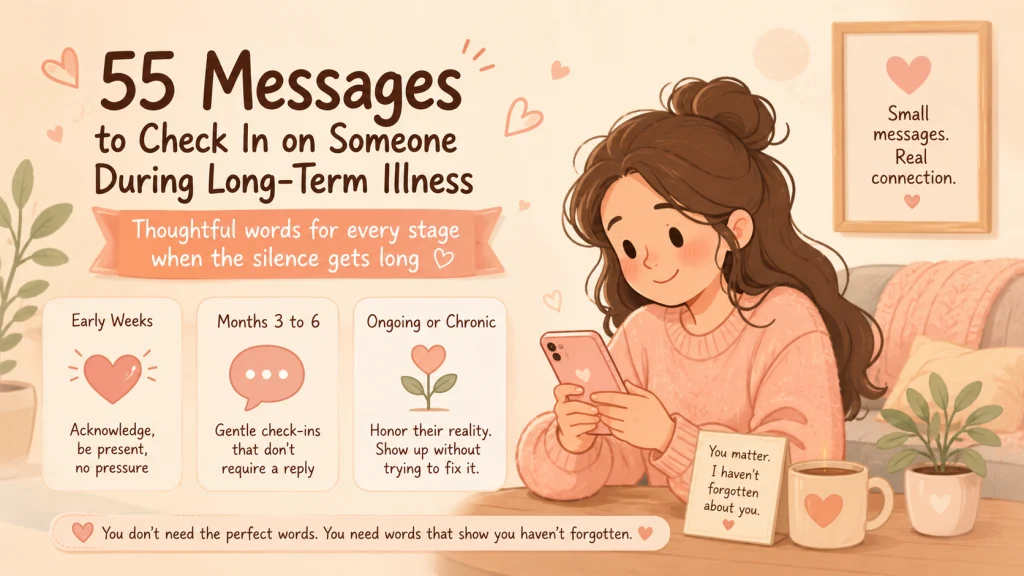
When someone gets a diagnosis, messages pour in. A few months later, most of them have stopped. These 55 messages are for everything that comes after that silence: the long stretch of illness when the world has moved on but the person you’re thinking about hasn’t. They’re sorted by where you are in the timeline, from the early weeks through months of ongoing illness to conditions that won’t resolve, so you can find something that fits the moment you’re actually in. You don’t need the perfect words. You need words that show you haven’t forgotten. For broader context, see messages to check in on someone during long term illness.
The Gap Nobody Talks About
Messages to check in on someone during long-term illness rarely arrive in month five, or month eight. They show up at the beginning, when the news is fresh and the instinct to reach out is strong. Then life keeps moving for everyone except the person who is sick, and the messages quietly stop.
I have been on both sides of that silence. I know how it feels to lose track of someone’s illness not out of cruelty but out of distraction, out of not knowing what to say once the obvious moment has passed. And I know how it feels to be the one still sick while everyone’s attention has drifted. The second feeling is lonelier.
That gap between the initial outpouring and the long quiet that follows is what this exists to fill. Not with dramatic declarations or apologies for going silent. Just with small, honest reminders that the person is still in your mind, still mattering, still worth a text even after the urgency of their illness has faded for everyone else.
| Stage | What tends to go wrong | What actually lands |
|---|---|---|
| Month 1 to 2 | Pushing optimism, asking for too many updates | Acknowledging uncertainty, making them feel seen without pressure |
| Month 3 to 6 | Disappearing because you don’t know what to say anymore | Low-pressure check-ins that don’t require a response |
| Ongoing or chronic | “Have you tried…” suggestions, framing illness as something to overcome | Honoring their current reality without pushing for recovery |
The earliest messages you probably sent came from a place of genuine shock and love. That first wave is well-covered elsewhere. If you’re still looking for what to say in those first days after a serious diagnosis, the get-well messages for serious illness collection handles that window better. What follows is for everyone who showed up early and wants to keep showing up, months later when the silence has grown.

Month 1 to 2: Messages for the Early Weeks
In the first couple of months, the situation is still sharp in everyone’s mind. The person is likely adjusting to a new reality: appointments, diagnoses, treatment schedules, the particular exhaustion of suddenly having to become an expert in your own illness. The messages that work in this window aren’t the ones that project how the story ends. They’re the ones that acknowledge how strange and hard this specific moment is.
What I’ve noticed is that most people write too much in these early weeks. There’s an impulse to fill the space with encouragement and hope, and while that impulse comes from somewhere real, it can land like pressure on someone who doesn’t feel particularly hopeful and has no room to perform optimism for you. Say less. Say something true.
- “I keep thinking about you. No need to respond, just wanted you to know I’m here.”
- “You don’t have to be strong or positive or anything right now. Just rest. I’m thinking of you.”
- “I know there’s a lot happening right now. I’m not going anywhere.”
- “Checking in. You don’t owe me an update. I just wanted you to know someone is thinking about you today.”
- “Your name has been on my mind a lot lately. No agenda. Just care.”
- “If today was hard, I hope you found at least one moment of rest. I’m here if you need anything at all.”
- “You don’t have to explain anything. I just wanted to reach out and say I’m with you in this, even from a distance.”
- “I know you’ve had a lot of people reaching out. No need to manage any of it on my account. I just care about you and wanted you to feel that.”
- “Thinking of you today and hoping you had a moment that wasn’t entirely about being sick.”
- “I don’t have the right words, and I know that. I just didn’t want to stay silent.”
- “Is there anything that would make this week even slightly easier? I’m asking because I genuinely want to help, not because it’s the thing people say.”
- “No update needed. I’m just keeping track of you and sending you something small: you matter.”
If some of these feel too soft for the person you’re thinking of, trust that instinct. Some people want directness, some want warmth, and you know the person better than any list does. The point is not to find the perfect message but to send something, rather than waiting for a better moment that may not come.
Month 3 to 6: Long-Term Illness Messages for the Long Haul
This is where most people fall off. Month three, four, five, six: the person is still sick, possibly still in treatment, still adjusting, but the visible drama of the early weeks is gone. Life has resumed for everyone else. The messages have dried up. And that silence, for the person on the other end, is its own kind of weight.
The messages that work in this window are different from the early ones. They don’t need to address the illness at all, necessarily. They just need to break the silence. Something that says: I thought of you, and I acted on it. The gap in time is not a reason to apologize at length. Acknowledge it briefly if you feel you need to, then just be present.
- “I’ve been bad at keeping in touch, and I’m sorry for that. I want you to know you’ve been in my thoughts even when I wasn’t saying so.”
- “I know the initial wave of messages probably faded a while ago. Mine didn’t, even if it took me this long to send it.”
- “Still thinking about you. I hope this month has been a little more manageable than the last.”
- “I know there’s no end date you can point to right now, and I imagine that’s exhausting. I just wanted to check in.”
- “You’ve been carrying this for a while now. I hope you know people are still holding it with you, even quietly.”
- “I was thinking about you today for no particular reason except that I miss your presence and I hope you’re okay.”
- “No pressure to respond. Just wanted to drop in and ask how you’re doing with all of this, not just medically, but as a person.”
- “I know the world probably moved on faster than your illness did. I didn’t want that to mean I stopped paying attention.”
- “Is there a day this week where you’d want company, a call, or just someone to send you something funny? I’m available for any of those.”
- “I’ve been thinking about you and also about how rarely I’ve said so lately. Wanted to fix that.”
- “This has been a long stretch. I hope you’re giving yourself some credit for still being in it.”
- “Checking in from here. Nothing on my end is more important than wanting to know how you are.”
The thing about month four or five is that the person has usually stopped expecting much. Which means even a short text lands harder than it might have at the beginning. They have had time to see who stayed and who quietly disappeared, and a single message in month six can mean more than ten messages sent at the start.

When It Won’t Get Better: Words for Ongoing Illness
Some illnesses don’t resolve. There is no treatment plan with an end date, no recovery moment to aim your messages toward. Checking in on a sick friend who lives with a chronic or permanent condition requires something different: words that honor the ongoing reality without pushing for something that isn’t coming.
The biggest mistake here is framing every message around hope for recovery. “I hope you feel better soon” is the right thing to say to someone with a cold. It is not the right thing to say to someone managing a condition they will live with for the rest of their life. It doesn’t land as encouragement. It lands as a reminder that you don’t quite understand what they’re dealing with.
The messages that actually work in this context are the ones that meet the person exactly where they are, without asking them to be anywhere else. Someone navigating ongoing loss sometimes needs the same thing. It’s a parallel worth naming: the long stretch after a loss, when everyone expects you to be “better” by now, mirrors this almost exactly. If you’ve ever wondered what to say to someone still grieving months later, the same instinct applies to illness support. Presence without pressure. Nothing more.
- “I’m not checking in because I think anything has changed. I’m checking in because you matter regardless of where things stand.”
- “I know there’s no ‘better’ to wait for right now. I just want you to know I’m not waiting for it either. I’m here for this version.”
- “You don’t have to explain or update me. I just wanted to reach out and say I’m thinking about you, exactly as you are.”
- “I’ve stopped waiting for news. I’m just here, and I wanted you to feel that.”
- “I know how long you’ve been managing this. I imagine it’s exhausting in ways you’ve stopped trying to explain. You don’t have to explain it to me.”
- “Not asking how you’re doing with the illness. Asking how you’re doing with the rest of life, the things that aren’t about being sick.”
- “I want you to know that my care for you isn’t conditional on things improving. I’m in this with you for the long version.”
- “There’s no end to wait for, and I’m not waiting for one to keep being in your corner.”
- “I know the world tends to move on. I’m trying not to be part of that. I’m still here.”
- “You’ve been living with this longer than most people realize. I see that, and I think about you more than I say.”
What matters most in these messages is the absence of pressure. Not “I hope things turn around” but “I’m here either way.” The person carrying a chronic condition already knows the prognosis. They don’t need your optimism. They need your presence, and your willingness to stay without needing anything from them in return.
Messages That Offer Something Real
General offers to “let me know if you need anything” are well-intentioned and nearly useless. The person who is sick is often the last person who will ask. They have spent months managing other people’s discomfort around their illness. Asking for help is one more thing they don’t have energy for.
Specific offers are different. “I’m going to the grocery store Tuesday, what can I pick up for you?” is an offer someone can actually respond to without having to generate the request themselves. These ongoing illness support messages below weave a practical offer into a check-in so the whole thing feels like connection rather than charity.
- “I’m heading to the store this week. No obligation, but if there’s anything you want me to grab and drop off, just say the word.”
- “I want to cook something for you. Can I drop off dinner one night this week? You pick the day, I’ll handle the rest.”
- “If you have any appointments coming up that you’d rather not do alone, I’m available. Let me know when and I’ll clear my schedule.”
- “I’d love to just sit with you sometime. No agenda. We can watch something or not talk at all. I just want to be in the same room.”
- “Is there anything that’s been piling up that would feel better if someone else handled it? Errands, calls, organizing. I’m genuinely offering.”
- “I know you probably have everything handled, but if there’s one thing I could take off your plate, I’d really like to. Anything at all.”
- “Can I bring you something this week? Not because anything’s wrong. Just because I want to show up for you in a real way.”
- “I’m free Thursday and would love to take one small thing off your plate. I can drop off food, run an errand, or just sit with you for a while.”
Notice that these do not make the sick person carry the whole burden of asking. You’re doing some of the work of figuring out what’s useful, and you’re making it easy to say yes. That’s where the real support lives, not in the broad open offer nobody takes anyone up on.
Short Check-In Texts for Any Stage
Sometimes you don’t have much to say, and you don’t need to. A short message that arrives with no pressure to respond and no requirement to perform gratitude can be more welcome than a long, carefully constructed one. These are for the moments when you want to reach out without making it a whole thing.
In my experience, these are the messages people save. Not because they’re elaborate, but because they arrive at the right moment and ask nothing in return. The effort they represent is clear in their simplicity. I once almost skipped sending a short message because I thought it would feel too small. I sent it anyway. Later, she told me it mattered because it did not ask her to explain anything, perform anything, or sound okay for my sake. The same logic applies here. Short and honest beats long and careful, almost every time.
- “Thinking of you today.”
- “You’re on my mind. No reply needed.”
- “Just checking in. I hope today is a little easier than yesterday.”
- “Still here. Still thinking about you.”
- “Sending you something small: I care about you and I haven’t forgotten.”
- “You don’t have to respond. I just wanted to say hi.”
- “How’s today?”
- “I was just thinking about you and wanted you to know.”
- “No news, no agenda. Just saying I love you and I hope today has something good in it.”
- “Dropping in to say I haven’t forgotten, not even a little.”
- “You’ve been on my mind. Wanted to let that out.”
- “Today felt like a good day to tell you I’m still thinking of you.”
- “Quiet check-in: how are you doing?”
These work as well in month one as they do in month twelve. The message doesn’t age. What ages is saying nothing at all.

Final Thoughts: The Message I Almost Didn’t Send
A friend of mine had been managing a serious illness for close to a year. I had texted in the early weeks, visited once, and then, somewhere in the autumn, I realized I had stopped. Not deliberately. I just didn’t know what to say anymore. The moment had passed and then kept passing.
I sent something short in November. Three sentences. She wrote back that mine was the only message she had received in two months, not because no one cared, but because everyone had run out of things to say and assumed that no news meant things must be okay by now.
They were not okay. They were just quiet.
If you’re here because someone in your life is still sick long after you expected them to be better, that’s the situation exactly. You don’t need a reason to reach out. You don’t need news or a milestone or the perfect sentence. You just need to send something now. The right words of comfort are almost always simpler than the ones we spend weeks searching for.
These messages don’t fix anything. A message rarely does. But they close a little of the distance that long illness creates, and in the long middle of being sick, that distance is the loneliest part of it.
FAQs
💬 What do you say to someone who has been sick for a long time?
Keep it simple and honest. You don’t need to reference the illness at all. “I’ve been thinking about you” or “I’m still here” lands better than forced optimism. The goal is presence, not reassurance.
📅 How often should I check in on someone with a long-term illness?
There’s no right interval, but consistency matters more than frequency. One steady message a month means more than a flood followed by months of silence. The person needs to know you’re still there, not that you’re watching the calendar.
🕰️ Is it too late to reach out if I haven’t texted in months?
No. A brief acknowledgment of the gap, like “I’ve been bad at keeping in touch,” followed by a genuine check-in is almost always welcome. People who are sick are usually grateful for anyone who shows up, even late.
🚫 What should I avoid saying to someone with a chronic illness?
Avoid “I hope you feel better soon” for conditions that won’t resolve. Skip unsolicited “have you tried…” suggestions. Don’t open with a request for a medical update. And try not to make your concern something they now have to manage for you.
🤝 How do I check in without pressuring them to respond?
Say it directly in the message: “No need to reply” or “just wanted you to know” removes the obligation. A short text with no question at the end is easy to receive. You can reach out without requiring anything back.
❓ What’s the difference between a supportive message and an intrusive one?
A supportive message offers presence without demanding anything. An intrusive one asks for updates, expresses worry in a way the sick person now has to soothe, or arrives so often that responding starts to feel like a job. Less is usually more.