A leap of faith doesn’t come with a guarantee, and most of the messages written for this moment pretend otherwise. I have spent enough time on the edge of my own decisions to know that what actually helps isn’t a promise that everything works out. It’s someone telling you that standing still has a cost too, and that the jump is worth making even when you can’t see the landing. Here you’ll find 55 messages built around that honesty: for the person about to choose, for the one who has already jumped and is waiting, and for the short, steadying lines that fit right before a big decision.
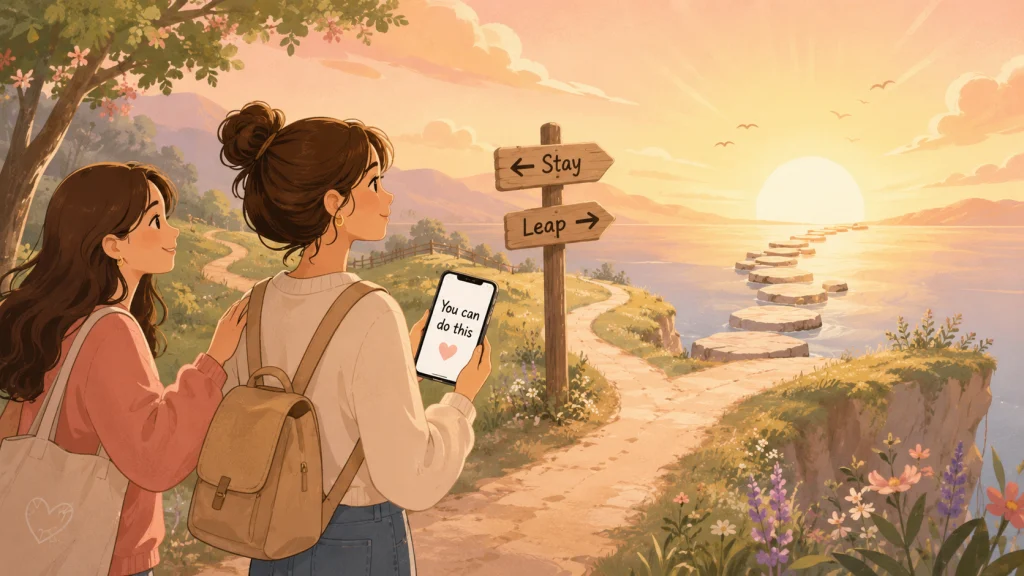
Why most leap of faith messages don’t land
Most leap of faith messages make a promise they have no right to make. They say things like “you’ll land somewhere amazing” or “everything happens for a reason,” as if the person sending the message has somehow seen the outcome already. I understand the impulse. When someone you care about is standing at the edge of something big, quitting a job, moving cities, ending something that’s been over for a while, you want to hand them certainty because uncertainty feels like the cruelest thing to leave them with. But certainty isn’t yours to give, and pretending otherwise usually backfires. The person reading your message already knows nobody can promise them a soft landing. What they’re listening for is whether you understand that, too.
I sent a message once to a friend who was about to walk away from a business she’d built for years. Everyone around her was saying “it’ll all work out, I just know it.” I didn’t know that. Nobody did. So instead I wrote something closer to: “I don’t know what happens next for you, and neither do you, but I know what staying was costing you, and I’d rather watch you find out than watch you stay stuck.” She told me later that was the only message that didn’t make her feel like she had to perform optimism back at the sender. follow your dreams messages can work well for someone chasing something they already believe in, but a leap of faith message is for someone who isn’t sure yet, and that’s a different kind of support.
This is the gap most leap of faith quotes never close. They’re written to be inspiring in isolation, shareable, quotable, the kind of thing that looks good on a graphic with a sunset behind it. But a real leap, the kind your friend or your sibling or you yourself are about to take, doesn’t happen against a sunset. It happens in a kitchen at midnight, or in a car in a parking lot, with the decision already half made and just needing one more nudge or one less reason to wait. The messages below are written for that moment, not the graphic.

Messages for someone about to make the leap
If someone you know is standing right at the edge of a big decision, what they usually need least is more information. By the time someone tells you they’re thinking about taking a leap, they’ve almost always already run every scenario, weighed every risk, and talked themselves in and out of it more times than they’d admit. What helps at that point isn’t analysis. It’s someone saying, in plain words, that the leap is allowed. That it’s not reckless just because it’s uncertain.
One thing I’ve noticed, more than once, is that people waiting to make a big choice often need permission more than encouragement. Encouragement can feel like pressure if it arrives too cheerfully. Permission feels like relief. The difference between “you’ve got this!” and “whatever you choose, I’m not going to think less of you” is enormous, even though both are meant kindly.
- You don’t need to know how this turns out to know it’s worth trying. That’s kind of the whole point of a leap.
- Whatever you decide, I want you to know I’d never think less of you for choosing the harder, scarier thing.
- You’ve thought about this enough. At some point, thinking turns into stalling, and I think you’re past that point.
- The version of you a year from now is rooting for the version of you right now to just go for it.
- I can’t tell you it’ll work out. I can tell you that not trying has its own kind of regret, and it’s usually the heavier one.
- You don’t owe anyone a guaranteed outcome before you’re allowed to try.
- If this doesn’t work, you’ll be okay. I’ve watched you handle harder things than this.
- Take the leap. Not because it’s safe, but because staying isn’t either.
- I know you’re scared. I’d be more worried if you weren’t.
- You’re allowed to want something you can’t guarantee. That’s not naive, that’s just being alive.
- Whatever happens after this, you’ll know you didn’t let fear make the choice for you.
- Go. I’ll be here either way, and so will the people who actually matter.
- You don’t have to make a perfect choice. You just have to make the one you can live with honestly.
- I’m not here to rush you. I’m here to remind you that fear doesn’t get the only vote.
- There may not be a clear sign. Sometimes the clearest sign is how tired you are of standing in the same place.
- Even if your voice shakes when you choose, it still counts as courage.
Notice that none of these say “it’ll be great.” They say something closer to “you’re allowed,” which, in my experience, is the thing people in this exact moment are actually waiting to hear from someone else before they can say it to themselves.
Messages that don’t pretend it’ll definitely be fine
There’s a particular kind of message that walks a line most writing in this space refuses to walk. It acknowledges, openly, that things might not go well, and still lands as encouragement rather than a warning. This is harder to write than it sounds, and it’s the part of this whole topic that I think gets skipped most often, because it’s uncomfortable to write “this might not work” to someone you love. But I’ve found that people can feel the difference between a message that’s honest about risk and one that’s just dressed-up cheerfulness, and the honest one is almost always the one that sticks.
The trick, if there is one, is to pair the honesty with something solid underneath it. Not a guarantee about the outcome, but a guarantee about what stays true regardless of the outcome: that the person tried, that they’re not alone, that the attempt itself changes something even if the result doesn’t go their way.
| What the message admits | What it offers instead |
|---|---|
| It might not work out the way you’re hoping | You’ll have tried, and that changes how this sits with you later |
| I can’t promise this is the right call | I can promise I’ll still be here if it isn’t |
| This could be hard for a while before it gets easier | Hard and wrong aren’t the same thing |
| You might land somewhere you didn’t expect | Unexpected isn’t automatically worse than where you are now |
With that shape in mind, here’s what those messages can actually sound like.
| Message | When it fits |
|---|---|
| I don’t know if this is going to work. I just know that you not trying isn’t really an option anymore, not for you. | Before a decision that’s already been delayed too long |
| This might be hard before it’s good. I think you already know that, and I think you’re still going to do it anyway. | For someone bracing themselves before a big change |
| I can’t tell you how this ends. But I can tell you that the version of this story where you didn’t try isn’t a better one. | When someone is weighing regret against risk |
| You might land somewhere you didn’t plan for. That’s not the same as landing somewhere wrong. | For someone afraid of the unknown specifically |
| I won’t pretend this is a sure thing. I will tell you that I’d rather watch you fall trying than watch you never jump. | For a close friend or partner taking a real risk |
| There’s a chance this doesn’t go the way you want. There’s also a chance you spend years wondering what would’ve happened if you hadn’t tried. | When someone is stuck comparing two unknowns |
| Whatever happens, you won’t be facing it because you were too scared to move. You’ll be facing it because you moved anyway. | For someone who needs the decision to feel like theirs |
| I’m not going to tell you it’s going to be fine. I’m going to tell you that you’ve survived not fine before, and you’re still here. | For someone who has been through hard things and knows it |
| This is a real risk. It’s also a real chance, and those two things exist at the same time. | General use, especially for career or relationship leaps |
| You might not land where you thought. But staying exactly where you are isn’t actually neutral either. It’s its own kind of choice, with its own cost. | For someone weighing whether to stay or go |
| I can’t promise you won’t wish parts of this were easier. I can promise that choosing honestly matters, even when the road is rough. | For someone who needs honesty more than hype |
| This may not become the clean, beautiful story people like to tell later. It can still be the brave and necessary one. | For someone leaving something complicated |
| If it doesn’t work, that won’t mean you were foolish. It will mean you were willing to meet your own life instead of hiding from it. | For someone scared of feeling embarrassed later |
| I don’t know whether this door opens the way you hope. I just know you deserve to find out what is on the other side. | For a gentle push before a life change |
If you’ve read through both of those tables, you’ve probably noticed they’re really saying the same handful of things in different shapes. That’s intentional. The honest version of a leap of faith message doesn’t have a hundred different angles. It has one or two true things, said in whatever words fit the person you’re sending it to.
Messages for someone who already jumped and is waiting
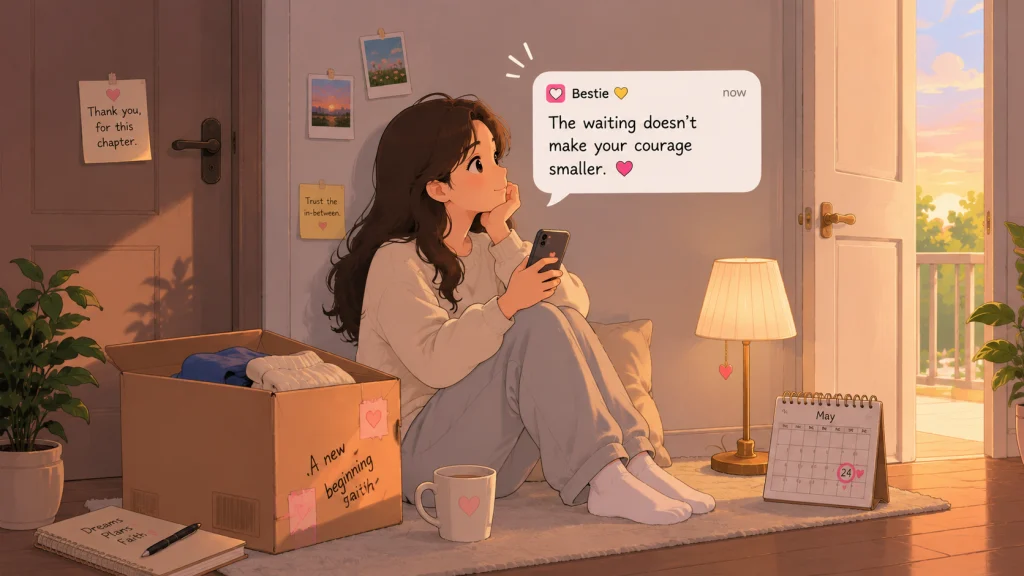
This is the part of the leap that almost nobody writes for, and it might be the part that needs words the most. The decision has been made. The leap has happened. Now there’s just the waiting, the in-between space where the old thing is gone and the new thing hasn’t fully arrived yet, and it can feel strangely lonelier than the decision itself did. People send a flood of messages before someone takes a big step and then mostly go quiet right when the person is sitting in the hardest part: not knowing yet.
I think this happens because once someone has made their choice, it can feel like the moment for support has passed. But the waiting is often where the doubt creeps in hardest, the “did I do the right thing” loop that plays at two in the morning. A message during this stretch doesn’t need to be big. It just needs to land at the right time, which is often: now, before they ask for it.
- You already did the hard part. The waiting is just the part where it hasn’t caught up yet.
- Whatever this turns into, you didn’t sit still and let it happen to you. That counts for something, even now.
- I know the in-between is uncomfortable. You’re allowed to feel shaky and still know you made the right call.
- It’s normal to second-guess this right now. That doesn’t mean you were wrong, it just means it’s real now.
- You don’t have to feel certain yet. You just made the leap. Certainty comes later, if it comes at all.
- However this lands, you’ll have been someone who tried, not someone who wondered.
- I’m thinking about you in this weird middle part. It won’t last forever, even though it feels like it might.
- If you’re doubting yourself right now, that’s okay. The doubt doesn’t undo the decision.
- You don’t have to turn this into a success story by tonight. You only have to let this day be what it is.
- The quiet after a big choice can feel louder than the choice itself. I’m still here in that quiet with you.
- You may not see the landing yet, but that doesn’t mean there isn’t ground coming.
- Nothing about waiting makes your courage smaller. It just means the next part hasn’t arrived yet.
Something I’ve come back to more than once is that the in-between is where people most need to hear that the leap was theirs, not a mistake just because the outcome hasn’t shown itself yet. A short message during this stretch often means more than anything sent before the jump.
Short messages to send right before a big decision
Sometimes there isn’t time, or space, for a long message. Someone is about to walk into the meeting, make the call, hit send on the application, and what they need is something short enough to read in the few seconds before they do it. These messages work because they’re brief enough to not add weight to an already heavy moment. They’re a hand on the shoulder, not a speech.
Whatever happens in there, I’m proud of you for showing up to it.
The shortest messages are often the ones that get reread the most, because they’re easy to hold onto in a moment when nothing else feels easy to hold. Here are a few more in that same spirit.
- You don’t have to feel ready. You just have to go.
- This is the scary part. It’s also the part that means you’re actually doing it.
- Whatever the outcome, you showed up. That’s the leap.
- One step. That’s all this is right now.
- You’ve got this, and if you don’t, I’ve still got you.
- It’s okay to be scared and do it anyway. That’s most of what courage is.
- Breathe. Then go.
- However it goes, I’m proud of you for trying.
- Let the fear come with you. It doesn’t get to lead.
- You can shake and still move.
- Do the next honest thing.
- You don’t need certainty to begin.
If you’re looking for more messages in this same spirit, especially ones built for someone standing at a turning point rather than mid-leap, wise words for someone at a crossroads covers that earlier moment, when the decision itself is still being weighed.
What a message can actually do here
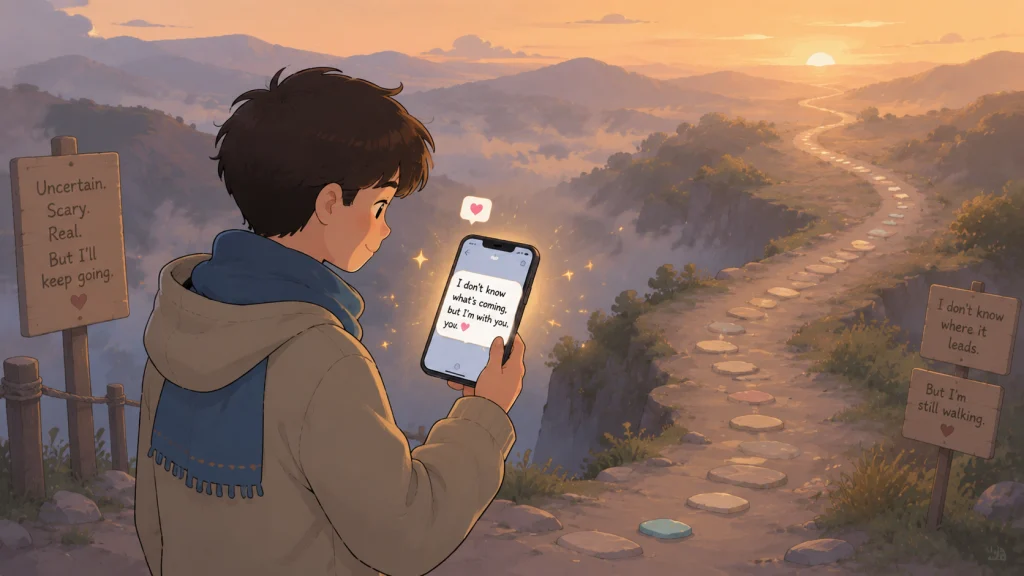
A message won’t make the leap less uncertain. It won’t tell you, or the person you’re sending it to, how this particular jump ends. What it can do is make the moment a little less solitary, which, when you’re standing at an edge, is sometimes the entire difference between freezing and going. I’ve sent messages I didn’t fully believe myself, not because I was lying, but because I genuinely didn’t know how things would turn out and said so. Those were almost always the ones that helped most.
If someone you care about is somewhere on this path, whether they’re still deciding, mid-jump, or sitting in that strange waiting space afterward, the right message probably isn’t the most inspiring one you can find. It’s the one that tells them the truth: that you don’t know what’s coming either, and that you’re glad they’re trying anyway. For more on what comes after the leap, when someone is figuring out what their next chapter looks like, new beginnings quotes picks up where this one leaves off.
FAQs
🌱 What do you say to someone taking a leap of faith?
Skip the promise that it’ll work out, since neither of you actually knows that. Instead, tell them the leap itself is worth something regardless of where it lands, and that you’ll be there either way.
💭 How do you encourage someone without promising things will be okay?
Focus on what’s true no matter the outcome: that they tried, that they’re not facing it alone, and that the attempt itself matters. Save the “it’ll be fine” for things you can actually know.
🕯️ What’s a good short message to send before someone makes a big decision?
Something brief and steady works best, like “whatever happens, I’m proud of you for showing up to it.” It doesn’t need to be long. It needs to be there right before the moment.
⏳ What do you say to someone who already made a big change and is waiting to see how it goes?
This stretch gets overlooked a lot. A message like “you already did the hard part, the waiting is just the part that hasn’t caught up yet” can mean more here than anything sent before the decision.
🌊 Are leap of faith quotes the same as leap of faith messages?
Not quite. Quotes tend to be general and inspirational, often written for nobody in particular. A message written for one person, about their specific leap, carries more weight because it’s honest about their actual situation.
🤝 What if I don’t think the leap is a good idea?
You don’t have to pretend to agree with the decision to support the person making it. You can be honest about your concerns separately, while still letting them know you’re with them either way.