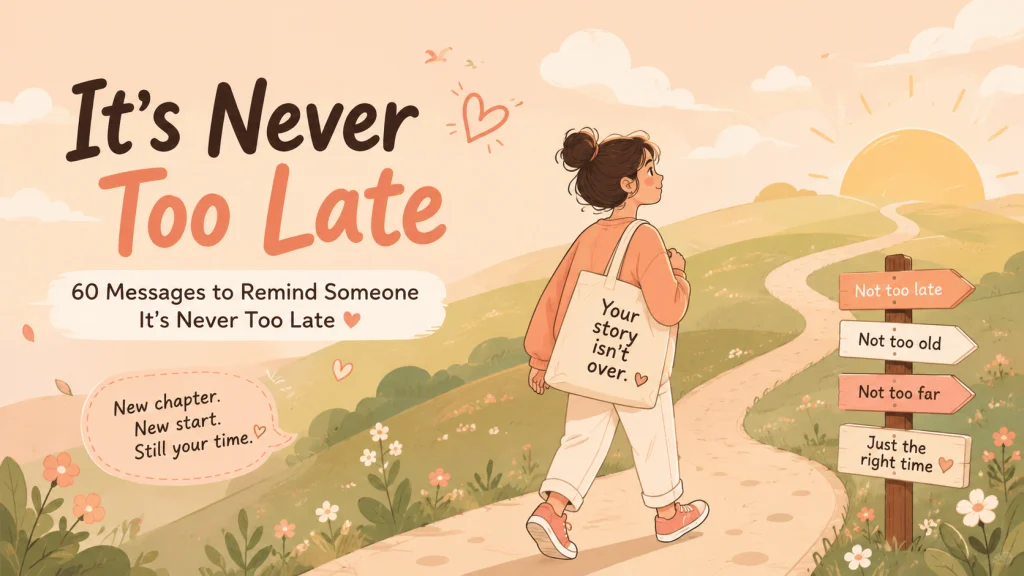
There is a specific kind of fear that generic encouragement doesn’t touch: the belief that your window already closed, that you started too late, that everyone else is too far ahead to catch. These 60 it’s never too late messages are built for that exact belief. Not for someone who needs a nudge, but for someone who has genuinely convinced themselves that time ran out, and needs words that address that belief directly, not cheerfully around it.
The “Too Late” Fear Needs a Different Kind of Message
Most encouragement is built for self-doubt. “You can do this.” “You’ve got what it takes.” That works for a lot of fears. It does almost nothing for the “too late” fear, because this fear isn’t about capability. It’s about timing. A message that doesn’t address timing doesn’t reach the person carrying it. For related message ideas, see never too late messages.
The belief that it’s too late has a specific texture. It comes with comparison, with arithmetic, with a quiet conviction that the moment has passed and starting now means arriving somewhere that no longer matters. If you’re sending something to someone holding that weight, the message has to name the weight. That’s what the 60 messages in this collection are designed to do, each one shaped for a particular version of the fear.
Why Generic Motivation Misses This Fear
I’ve sent and received enough encouragement over time to know the difference between a message that lands and one that floats just above what a person actually needs. For someone carrying the “it’s too late” belief, there is a short list of things that help. Vague positivity is not on it. The fear is too specific for that, and the person holding it has usually already heard the general version and found that it didn’t touch them.
There are a few things that sound encouraging but tend to make this particular fear worse, not better. I know because I’ve tried most of them. They come from the right place, but they address a nearby fear, not this one.
- Generic motivation: “Believe in yourself” doesn’t address timing. It floats above the specific fear and leaves the person exactly where they were.
- Minimizing the feeling: “You’re being too hard on yourself” tells someone their fear is wrong. That’s not the same as helping them through it, and it often makes them feel less heard.
- Famous late starters: “Colonel Sanders started at 65” tends to land as a deflection. It’s a fact, not a connection, and this kind of fear needs connection.
- Vague reassurance: “Everything happens for a reason” doesn’t engage with the belief that the window already closed. It sits beside the fear without touching it.
What tends to work is directness: a message that names the specific fear, takes it seriously, and then offers a different way to see it without pretending the fear isn’t real. The table below can help you find the right section depending on where the person you’re writing to actually is.
| What they’re carrying | Which messages fit |
|---|---|
| They feel behind because they started late | Messages 1 to 12 |
| They’re in their 40s or 50s and beginning again | Messages 13 to 22 |
| They’re watching peers who seem further ahead | Messages 23 to 30 |
| They’ve said “I’m too old for this” out loud | Messages 31 to 40 |
| They want a second chance but are afraid to take it | Messages 41 to 50 |
| They’ve almost given up entirely | Messages 51 to 60 |
The messages work best when they match the specific version of the fear. A person who is 50 and starting over is not in the same place as someone watching a colleague advance and wondering if they took a wrong turn years ago. Both deserve something that speaks to where they actually are.
Messages for Someone Who Feels They Started Too Late
This version of the fear is often the quietest. The person is still going, still trying, but carrying a background conviction that they should have begun sooner and that the delayed start means a diminished result. The fear rarely announces itself. It shows up as a low-level discouragement that sits underneath everything else and makes progress feel smaller than it is.
A friend told me once that she felt like she’d been handed a puzzle everyone else had started assembling years ago. What I wanted to say, and didn’t say well enough at the time, was that she wasn’t late to the same puzzle. She was starting a different one, with more of the pieces already sorted because of everything she’d been through. These 12 messages try to say that better than I did then.
- Starting later means you already know what the wrong direction feels like. That’s not a disadvantage.
- The calendar has never been able to tell a person when it’s the right time. That’s still your call, and it always was.
- You didn’t miss the window. You were getting ready.
- There’s a version of this path you can only walk now, with everything you know, everything you’ve survived. That version is better than the early one would have been.
- Late by whose measure? The timeline you’ve been comparing yourself to was made up. You’re allowed to make a different one.
- The fact that you’re still thinking about starting means the thing still matters to you. That’s the only clock worth watching.
- Some of the most real beginnings I’ve seen happened when the person had already stopped believing in beginnings. You are not done.
- Starting now doesn’t mean arriving last. It means arriving with more than you had before.
- You’ve been carrying this long enough to know it’s real.
- I know it feels like everyone else is further along. But further along on which road? You’re on yours. That’s not a consolation. That’s just the truth.
- The gap between where you are and where you want to be isn’t evidence that it’s too late. It’s just the distance. Distance can be crossed.
- You didn’t wait too long. You waited until now.
None of these messages argue that a late start doesn’t carry weight. They argue that “late” is the wrong frame entirely. That’s the distinction that tends to land when the other versions don’t, because it doesn’t ask the person to stop feeling what they feel.

Messages for Someone Who Is 40 or 50 and Starting Over
Starting over at 40 or 50 carries a particular kind of weight because it often follows something significant that ended: a career shift, a marriage, a chapter that felt like it was supposed to be the main one. The fear isn’t just “am I too late?” It’s “does any of it still mean something?” If you’re sending something to someone in that place, the message needs to address both layers without minimizing either.
I’ve watched people rebuild in their fifties and end up somewhere they couldn’t have imagined at thirty. The path that looked like a detour turned out to be the route. That doesn’t mean the fear isn’t real in the middle of it, but a message that says so plainly is often more useful than one that tries to make the situation feel simpler than it is. If the person you’re writing to is also carrying the weight of a major life change alongside this fear, the starting over messages on this site go deeper into that territory.
- Forty isn’t late. Fifty isn’t late. Age only tells you how much living you’ve already done, not how much is left.
- Starting over here doesn’t mean starting from nothing. You’re starting from experience, from clarity, from knowing what you actually want.
- The life you’re stepping into now is one you’ve earned the perspective to build. That’s not available at twenty-five.
- I’ve watched people rebuild at fifty and end up somewhere they couldn’t have imagined at thirty. The detour was part of how they got there.
- This isn’t your second chance. It’s your real one.
- Age doesn’t shrink what’s possible. It changes what it looks like. What you’re building now might look different from what you imagined, and that’s not a failure.
- You didn’t fall behind. You took a longer route. Longer routes go through places the direct path never reaches.
- The people who started early aren’t ahead of you. They’re on a different road. You’re going somewhere they can’t follow, because you’ve already carried things they haven’t had to face yet.
- Starting over can feel like proof that something went wrong. Sometimes the version of your life that was always possible could only be reached this way.
- A lifetime of living gave you something no shortcut could: the ability to know what you actually want. Start there.
There is a version of starting over that turns out to be a more honest beginning than the first one was. That’s a hard thing to believe when you’re standing inside it. But it’s worth saying out loud to someone who hasn’t found a way to say it to themselves yet.
For a Late Bloomer Who Sees Others Ahead
Comparison makes its own particular kind of pain. The person isn’t questioning their capability so much as their position, and the fear is that the position is too far back to recover from. The instinct to say “you’re not too old” is right, but the message has to address the comparison itself, not just offer general reassurance that misses why this version of the fear feels so specific.
I spent a long stretch of my own life checking where other people were before deciding how I was allowed to feel about where I was. It’s an exhausting way to measure anything, and it reliably produces a distorted result. The messages below try to offer a different measure. Not one that dismisses how real the comparison reflex is, but one that shows the person they’re measuring with the wrong tool. For someone who also needs support with the motivation side of this feeling, there’s a collection of follow your dreams messages that speaks directly to that territory.
- Comparison is the fastest way to make your own timing feel wrong. In my experience, it almost never is.
- When you look at where they are, you’re not seeing their cost. You’re only seeing their position. You don’t have the full picture.
- The pace you’re moving at isn’t the problem. The measure you’re using is.
- Being a late bloomer doesn’t mean you bloom less. It means you bloom after something in you was ready that wasn’t ready before, and that readiness tends to hold.
- I spent a long time convinced I was behind. What I was actually doing was building something slower, which meant that when it arrived, it held together in ways faster things hadn’t.
- The ones who seem ahead aren’t waiting at the finish line to judge you. Most of them are still figuring it out too, just quietly, from the inside.
- Your timeline is not broken. It’s just yours. Not every season arrives at the same time, and that has nothing to do with worth.
- There is no race. There’s just what you’re building, and when you decide to build it. No comparison can take that from you.
The comparison version of this fear eases when someone stops measuring progress against someone else’s map and starts measuring it against their own direction. These messages try to offer that shift without dismissing how real the fear is.

Messages to Send When Someone Says “I’m Too Old for This”
“I’m too old for this” is a sentence that sounds like a conclusion but is usually a question. The person is saying it out loud, at least partly, because they’re hoping to be answered. Not told they’re wrong, but given a reason to believe the sentence isn’t as final as it sounds. When someone has said the words out loud, the message that reaches them is usually shorter and more direct than the general kind.
The most common mistake when writing to someone in this version of the fear is trying to talk them out of it with evidence or examples. That often produces a debate they’re not ready to have. What works instead is a message that takes the fear at face value and then quietly refuses to agree with its conclusion.
- You’re too old for some things. This isn’t one of them.
- “Too old” usually means “afraid.” They aren’t the same thing. Fear can be worked with.
- The thing that makes you feel too old to start is the same thing that makes you more capable than you think: you’ve been paying attention.
- I hear “I’m too old” and want to ask: too old for what? Wanting and trying don’t expire.
- You’re not too old. You’re experienced, tired, and maybe a little scared. All of those are workable from where you are.
- The “too old” voice is loudest right at the beginning. It quiets down once you actually start.
- You’ve already done the hardest part, which was deciding that you still want this. “Too old” doesn’t get to undo a decision like that.
- Being too old for something is a choice you make, not a fact someone hands you. You haven’t made that choice yet.
- The fear of being too old is real. But it’s a fear, not a door that’s already closed. It just feels that way from the outside.
- What you’re calling “too old” is actually just “unfamiliar.” Start there and see what happens next.
Short and direct carries more weight than long and encouraging for this fear. A long message can feel like pleading. Two sentences that go straight to the point are harder to dismiss.
Short Messages About Second Chances
A second chance feels different from a first one. It comes without the innocence of not knowing what it costs, and with the specific weight of having already tried and stopped. The fear isn’t just about timing anymore. It’s about whether the person deserves to try again, whether the thing is still there waiting for them.
Second chances are quieter than first ones. They don’t announce themselves. Someone holding one might not need a long message. They might just need something that says: the window is still there, and it was waiting for you more patiently than you gave it credit for. The new beginnings quotes on this site offer something to pair with these when the person also needs something to hold onto for themselves, not just something to receive from someone else.
- Second chances don’t come with a guarantee. But they come. You’re holding one right now.
- This is not too late. This is exactly when you needed it.
- A second chance isn’t a redo of the first one. It’s a first chance at something else entirely.
- The fact that you want to try again means something didn’t finish when you thought it did. That’s a signal, not a mistake.
- Second chances are quieter than first ones. You have to choose them.
- You don’t have to get it right this time. You just have to get it started.
- The window didn’t close. You stepped away from it for a while. That’s different from the door being locked.
- What you’re stepping back toward has been waiting with more patience than you gave it credit for.
- A second chance means nothing changed about what was possible. It means you changed.
- There’s no rule that says you only get one. Start again.
The second-chance version of this fear is often the most personal of all the versions here, because it involves something specific that was tried and lost or left behind. These messages try to name that specificity without adding weight to something that is already heavy enough on its own.

Messages for Someone Who Almost Let the Fear Win
There is a version of the “too late” fear that becomes self-fulfilling if no one interrupts it. The person has been sitting with the belief long enough that they’ve started making decisions around it, stopped trying, started building a life around the assumption that the thing they wanted is no longer available. These messages are for the moment before that becomes permanent.
I’ve sent versions of some of these to people who thought they had already decided. In more than one case, the message wasn’t the thing that changed their mind. But it was the thing that reopened the question, and sometimes reopening the question is the whole job. For someone who might also need something broader alongside these, the uplifting messages here offer a companion to what’s below.
- The fact that you’re still thinking about this, still not fully letting go, means the fear didn’t actually win. It just got loud for a while.
- Almost giving up is not giving up. You are still in this.
- I know what it feels like to stand at the edge of something you want and convince yourself you don’t deserve to cross it. You do.
- The fear told you a story about how this ends. You haven’t reached the ending yet.
- You came back to this for a reason. Trust that reason. The fear doesn’t get a vote.
- Letting the doubt talk you out of it would be the only real ending here. Everything else is still open.
- Fear is very good at convincing people the timing is wrong. It is almost always wrong about that.
- The version of you that almost stopped is not the version that’s still here. Something in you kept going.
- Whatever you almost walked away from is still possible. That’s the part the fear never says out loud.
- You didn’t let it win. You’re still here. That’s the beginning, not the end.
These are not messages to send to someone in a casual low moment. They’re for someone who has been carrying this fear long enough that it has started to feel like a conclusion. The message needs to say clearly: it isn’t. Not yet.
Final Thoughts: The Fear Is Loudest Before You Send It
The “too late” fear disguises itself as logic. It sounds like a reasonable conclusion drawn from real evidence: years passed, chances missed, other people further along. It feels less like fear and more like arithmetic. That’s what makes it hard to argue with, and why a message needs to engage with the arithmetic directly, not just offer warmth around it.
What I’ve found, more times than I’d like to admit, is that the person carrying this fear often already knows, somewhere underneath it, that it isn’t actually too late. They just need someone to say it in a way that doesn’t feel hollow. Not “you’ve got this,” but something more like: I see what you’re afraid of, and here is why it isn’t the ending you think it is.
That’s what all 60 messages in this collection are trying to be. Send the one that fits. Send it before the doubt you’re holding about sending it has time to make a case for staying quiet.
FAQs
💬 What is a good message to send someone who feels it’s too late?
The most effective messages for this fear name it directly rather than cheering around it. Something like “You’re not behind, you’re on a different timeline than the one you’ve been measuring yourself against” lands better than general encouragement. Specificity is what makes the difference.
🌱 How do you encourage a late bloomer?
Avoid comparison and timeline language. Focus on what starting later actually gives them rather than what they missed. A message that reframes the delayed start as something that came with its own advantages tends to reach them better than one that dismisses the fear or tries to argue them out of it with examples.
🕐 What do you say to someone who thinks they’re too old to start over?
Short and direct tends to work better than long and reassuring for this version of the fear. Something like “You’re not too old. You’re experienced and scared, and both of those are workable” engages with the specific words they used rather than floating above them. Taking the fear seriously before questioning it lands closer to where they are.
🔁 What makes a second-chance message different from general encouragement?
Second-chance encouragement acknowledges that something was already tried and stopped. General encouragement doesn’t make that distinction. For someone on a second chance, a message that recognizes the weight of trying again, rather than treating it like a fresh start with no history, lands much closer to where they actually are.
📏 How long should an “it’s never too late” message be?
Usually shorter than you’d expect. For this specific fear, a long message can feel like overexplaining. Two or three sentences that go directly to the timing fear carry more weight than a paragraph of general encouragement. The person has already heard the general versions. What they need is something more precise.
❓ Is it ever actually too late?
For some specific things, practically speaking, yes. But the “too late” fear most people carry isn’t about those things. It’s about building something, trying again, starting a different path. For those, the honest answer is almost always: not yet. The fear tends to arrive long before the actual window closes, if it ever does.