
Most Thanksgiving messages arrive warmly and dissolve just as fast, not because the feeling behind them isn’t real, but because “I’m grateful for you” sounds identical no matter who receives it. The ones that stay are the ones that name something specific: a quality, a moment, a particular way someone has shown up. These 70 happy Thanksgiving messages are organized by relationship and occasion, from short and warm to heartfelt and specific, from the table that’s full to the one that isn’t, so you can find the version that was actually written for the person you have in mind.

The Table Is Set. The Only Thing Left Is Saying Something Real.
Writing a happy Thanksgiving message is, strangely, one of the harder tasks this holiday puts in front of people. The food is planned. The table is argued over. And then someone picks up their phone and stares at a blank field, trying to find something to say that won’t sound like a card their insurance company sends out every November. The feeling is real. The words for it don’t always follow.
The gap almost always comes down to one thing. Most Thanksgiving messages stop at the feeling without naming what it’s for. “I’m grateful for you” is true, but it could be sent to nearly everyone in someone’s contacts without changing a word, and the person on the other end can tell. It arrives, it’s acknowledged, and it dissolves, not because the sender didn’t mean it, but because meaning something toward a specific person and writing something that sounds like that are two entirely different things.
Why naming what you’re grateful for changes everything
The fix is smaller than most people think. The difference between “I’m grateful for you” and “I’m grateful for the way you pick up the phone before I’ve finished explaining why I called” isn’t a difference in length. It’s a difference in direction. One points at a general feeling. The other points at a person, and the person receiving it can feel that difference in the first sentence.
The table below shows what this looks like in practice. None of these are long messages. What changes is whether each one could have been sent to someone else without editing it first. That’s the only test that matters for a Thanksgiving greeting worth sending.
| What most people send | What actually lands |
|---|---|
| I’m so grateful for you. | I’m grateful for the way you remember things I mention once and never mention again. |
| Thinking of you this Thanksgiving. | I’ve been thinking about what you said to me in September. Still sitting with it. Grateful for you. |
| Wishing you a wonderful holiday. | I hope this Thanksgiving gives you some of the quiet you’ve been needing. You’ve earned it. |
| You mean so much to me. | The way you show up for people without being asked is something I think about more than I say. |
| Happy Thanksgiving to you and yours. | I hope your table today is full of people who actually know you. That matters more than the food. |
The messages below follow the same logic. Most of them are ready to send as written, but the ones that will land best are the ones where you swap in the actual thing you want to name, the real moment, the specific quality, the detail that came back to you when you sat down to write this. That’s the piece that turns a seasonal wish into something the other person reads twice.
Short Thanksgiving Messages
A short message is not a lesser message. Sometimes a few sentences, written with the right person in mind, carry more than a paragraph that tries to cover everything at once. These work well as a text, a note inside a card, or a moment when you want to say something honest without making it an entire conversation.
The instinct with short messages is to go generic, because brevity feels like it leaves less room for personality. The opposite is almost always true. A short message that names one real thing lands harder than a long one that stays warm and general all the way through.
- Grateful for you today. Happy Thanksgiving.
- This is the time of year I remember most clearly why you matter to me. Wishing you a full table and a full heart.
- Sending warmth from wherever I am. Happy Thanksgiving.
- Grateful for the ordinary days we share. Happy Thanksgiving.
- Wishing you a Thanksgiving full of people who make you feel like you belong.
- You are one of the things I count when I count my blessings. Happy Thanksgiving.
- Thinking of you today. Grateful you’re in my life.
- Hope your Thanksgiving is as good as you deserve. And you deserve a lot.
- Just wanted you to know I’m thankful for you. More than I usually say.
- Happy Thanksgiving. Not just the holiday kind, but the real kind.
The last message is the one I reach for when I’m genuinely not sure what to say. It’s a small way of acknowledging that there’s a difference between the seasonal version of gratitude and the version that actually means something, without needing a whole paragraph to say it. Some people will read it and know exactly what it means, and that’s usually the sign it was the right thing to send.
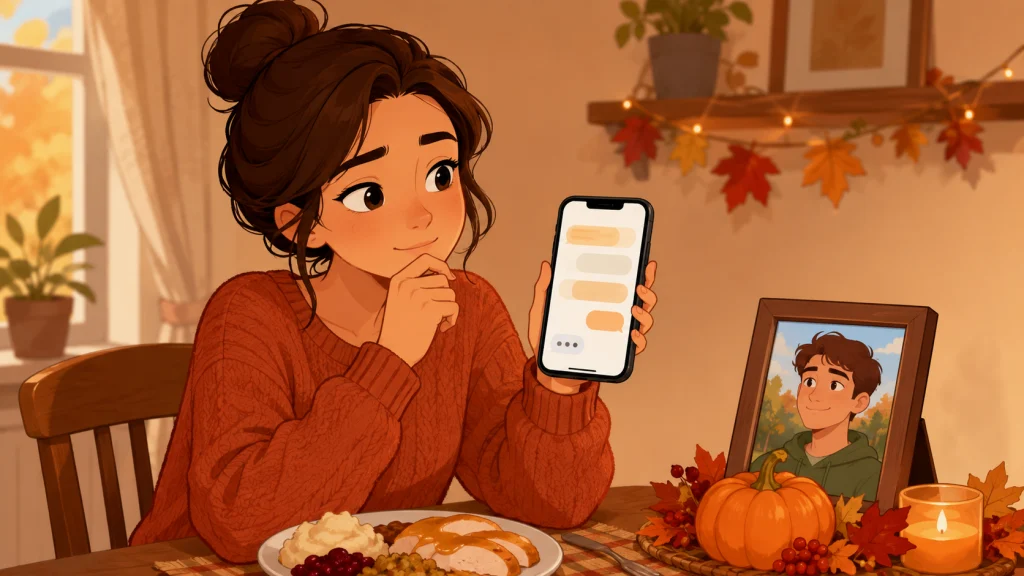
Heartfelt Thanksgiving Messages That Name Something Specific
These take a little more, but not as much as people think. The common version of “heartfelt” is long, dense, and over-explained. What actually makes a message feel that way is usually something smaller: a named quality, a reference to a real moment, a detail that the sender couldn’t have written about anyone else.
What I almost always write first is too long. I know this because I’ve done it from hotel rooms at midnight, trying to say everything at once and landing on something that reads like a school assignment about feelings. The ones that actually worked were shorter and more directed, pointed at one specific thing instead of trying to summarize a whole year.
- I’m grateful for the way you check in without being asked. For the texts that come exactly when I need them. For being the kind of person who remembers the small things. Happy Thanksgiving.
- What I’m grateful for this year isn’t easy to put into one message. But it starts with you, and the specific, unrepeatable way you’ve shown up. Thank you for that. Wishing you a beautiful Thanksgiving.
- I’m grateful for the late phone calls. For the way you listened when I didn’t have answers yet. For never making me explain why I needed to talk. You’re one of the best parts of my year. Happy Thanksgiving.
- This Thanksgiving I’m thinking about the afternoon we spent driving nowhere in particular. About laughing until we couldn’t breathe. About the fact that I can call you about anything and you won’t make it weird. Thank you for being exactly who you are.
- I don’t say it nearly enough. I’m grateful for how hard you work, how much you give, and how little you ask for in return. I hope this Thanksgiving gives you some of what you always give everyone else.
- What I’m most grateful for is the kind of friendship where we can go months without talking and pick right back up. That doesn’t happen with most people. It happens with you. Happy Thanksgiving.
- I’m grateful for every meal we’ve shared, every hard conversation we’ve gotten through, and every time you told me the truth when I needed it more than I wanted it. Wishing you a Thanksgiving that feels like all of those things at once.
- Grateful for your patience with me this year. Grateful for your honesty. Grateful that you stayed. Happy Thanksgiving. I mean every word.
- I’ve been thinking about what I actually want to say, not just the words everyone sends in November. What I want to say is: I am specifically, concretely grateful for you. For the way you remember things. For the way you show up. Happy Thanksgiving.
- Thankful for every ordinary Wednesday with you. For the coffee that went cold because we were talking. For the plans we keep half-making. You’re one of the best parts of my regular life. Happy Thanksgiving.
- This year I’m grateful for the way you held space for me when things were hard. You didn’t try to fix it. You just stayed. That mattered more than I think you know.
- I’m grateful for the way you love the people around you. Watching that, being on the receiving end of it, is something I don’t take for granted. Happy Thanksgiving. I hope someone makes you feel the same way today.
Several of these work better as a starting point than a finished message. If one is almost right, use it as a frame and swap in the actual detail that belongs there: the real thing you noticed, the moment that came back to you when you sat down to write. That one swap is what makes the difference between a message that’s good and one that gets remembered.
Thanksgiving Messages for Friends
The messages that tend to go unsent are the ones to close friends. There’s an assumption that they already know, that the friendship is established enough that a holiday text would feel like going through the motions. It probably isn’t. The friend who receives your honest version of “I’m glad you’re in my life” will feel something, even if they’d never say so.
I almost didn’t send a message to a friend once because I thought it would feel obligatory. I sent it anyway, short and honest. She told me later it was the only one that year that didn’t feel like a form letter. That’s not nothing, even from across a time zone.
- Thankful for you and the particular kind of chaos that follows you everywhere. Happy Thanksgiving.
- I hope your Thanksgiving is full of food you actually like and people who actually get you.
- You’re the kind of friend I don’t have to explain myself to. That’s rarer than you realize. Happy Thanksgiving.
- Grateful for a friendship that fits. Not because we’re the same, but because somehow we work. Happy Thanksgiving.
- Some friendships take work. Ours has always just felt like home. Wishing you a Thanksgiving that feels the same way.
- Happy Thanksgiving to the person who knows exactly what I mean even when I say it badly.
- Grateful for the friend who picks up on the first ring and never judges me for the choices I make at midnight. You know who you are.
- Thinking of you today. Grateful for the version of yourself you’ve let me know. Happy Thanksgiving.
- Wishing you a Thanksgiving with everything you love and none of the parts that drain you. You’ve earned a good one.
- Happy Thanksgiving. Thank you for being the kind of friend I didn’t know I needed until you were there.
Send these as a standalone text rather than part of a group message when you can. The difference between receiving something that feels written for you and receiving something clearly sent to a dozen people at once is enormous, even when the words are similar. It’s the same reason the specific message lands where the general one doesn’t.

From Parents to Children at Thanksgiving: What Parents See That Children Miss
There is a kind of gratitude that parents carry at Thanksgiving that children don’t yet have the vantage point to understand. It isn’t just love for the child. It’s the experience of watching a person become who they’re going to be, across years, in ordinary moments that look like nothing from the outside, and the particular weight of knowing this is finite and irreplaceable. Putting that into a Thanksgiving message for family without it sounding like a speech is the hard part.
The messages below try to say it without overdoing it. The honest ones land somewhere between warm and matter-of-fact: they say what’s true without asking the child to carry the full weight of what the parent is actually feeling. If none of them is quite right, find the one that gets closest and write the version that’s yours.
- You don’t know yet what it means to watch you become the person you’re becoming. I do. And I am more grateful than any holiday is long enough to say.
- Happy Thanksgiving. I am grateful for every ordinary day with you. The ones you don’t remember. The ones that look like nothing from the outside. Those are the ones I hold the closest.
- What I’m grateful for this Thanksgiving is simple: you. The way you laugh. The questions you ask. The way you’re learning how to be in the world. I get to watch that, and I don’t take a single day of it for granted.
- There’s a version of gratitude you’ll understand when you’re older. It’s quieter than you’d expect. It comes in the middle of watching you do something small, and it sits in your chest like a weight that is also somehow light. That’s what I feel when I look at you. Happy Thanksgiving.
- I don’t always say this the right way. But I am grateful for you in a way that doesn’t fit in a message. You are the best part of my life. I hope you feel some of that today.
- Happy Thanksgiving. I hope someday you understand what it felt like for us, having you at this table.
- You’ve had a big year. I’ve watched you handle things that would have stopped me. I’m not just grateful for you. I’m proud of you. Wishing you a Thanksgiving that reflects how much you’ve grown.
- The things I’m most grateful for don’t make the list easily. They’re the way you still reach for my hand sometimes. The way you ask follow-up questions. The way you’re turning into someone I genuinely love talking to. Happy Thanksgiving.
These land differently depending on the age of the child, and that’s fine. Some of these are also for the parent, a way of naming something true out loud even if the child won’t fully receive it yet. The eighth message is the one I’d reach for first: it says the specific things, the small ones, rather than trying to summarize a whole person in a single sentence. That specificity is what turns it from a holiday message into something that gets kept.
Thanksgiving Messages for a Partner or Spouse
Thanksgiving messages between partners are easy to either overcomplicate or undercomplicate, because the context is already there. You’re not explaining who you are to each other. What’s left is finding the version of gratitude that names something true about this person, this life, this particular year you’ve been through together. Generic warmth won’t do it. Neither will something that sounds like it belongs on a card for a wedding you didn’t attend.
The messages below run from quiet and sincere to warm and slightly playful, because the right tone depends entirely on the two people involved. Some relationships want the earnest version. Some want the one that lands a little lighter. Take the one that sounds like how you’d actually say it, then adjust from there.
- I’m grateful for the life we’ve built, and even more for the person you are in it. Happy Thanksgiving.
- Thankful for you. For the way you make ordinary days feel like something worth having.
- Happy Thanksgiving. I’m grateful for the way you take care of things I don’t even notice need taking care of. And I notice.
- Every year I get a little better at knowing what I actually have. Every year it’s more clearly you. Happy Thanksgiving.
- Grateful for the life we keep building, even when we’re doing it slowly and with a lot of revisions. You’re the best person to do it with.
- I’m grateful for how we are when things are easy. I’m more grateful for how we are when they aren’t. Happy Thanksgiving.
- Happy Thanksgiving. Thank you for making this the table I most want to be at.
- Grateful for you, for this, for all of it. But especially for you. Happy Thanksgiving.
The shorter messages here tend to work better between partners than the longer ones, because longer ones can tip into something that sounds rehearsed rather than felt. The sixth message is the one I’d choose for a year that’s been genuinely hard. It doesn’t gloss over the difficult parts. It names them and still finds the gratitude, and that’s a harder thing to write than it looks.

For the Thanksgiving When Someone Is Missing from the Table
Not every Thanksgiving is uncomplicated. Some of them come with an empty chair that wasn’t there last year, or arrive right in the middle of a loss that doesn’t pause for the holidays. The messages people need in those moments are the ones that don’t pretend. They don’t rush toward the silver lining. They don’t tell the person what to feel or how long they’re allowed to feel it.
What they can do is say: I see that this one is different. I’m here. That’s not a small thing to say. If you’re looking for words that go deeper into writing around grief without asking someone to minimize it, the birthday wishes for someone grieving on this site cover that territory more fully.
- Thanksgiving feels different this year. There’s a seat that should be full and isn’t. I’m holding you in this holiday, even if I can’t say it perfectly. Wishing you comfort wherever you are today.
- I know this Thanksgiving comes with its own kind of weight. You don’t have to pretend it doesn’t. I’m thinking of you and of the person who should be here.
- There’s a lot to be grateful for. There’s also a lot that hurts. Both can be true at the same table. Sending you love today, especially today.
- Missing you at this table this year. Grateful for every Thanksgiving we had together. Holding you close even from here.
- If today is hard, I want you to know I’m holding you in it. You don’t have to make it look like anything other than what it is.
- This season has a way of making absence louder. I see it. I’m here. Sending you more warmth than a message can carry.
The last message in this list is the one I’ve used when I genuinely had nothing more to say. Acknowledging that the message itself is not enough can, strangely, feel more honest than trying to write something that covers everything. It gives the person permission to feel what they’re feeling without also having to thank you for fixing it, and sometimes that’s exactly the right thing to offer.
Funny Thanksgiving Messages
Humor in a Thanksgiving message works when it comes from actually knowing someone and not from borrowing something that could have been printed on a novelty apron. The problem with most holiday humor is that it reads as found rather than felt: generic jokes about stuffing and elastic waistbands that land as performed rather than genuine. The messages below try to stay on the warm side of funny.
Use these for the people who would rather receive something that made them laugh than something that made them reach for a tissue. Both are perfectly good responses to someone who cares about them. You know which kind of person yours is.
- Wishing you a Thanksgiving where the turkey is good, the wine is plentiful, and nobody says anything before dessert that ruins the mood. You deserve all of that.
- Happy Thanksgiving. May your pants still fit by the end of the meal, but also may you not care if they don’t.
- Grateful for you, and also grateful that you always bring the good side dish. Both matter equally. Happy Thanksgiving.
- Wishing you a Thanksgiving with exactly the right amount of family. Whatever that number is for you, I hope you get it.
- Happy Thanksgiving. Here’s to the meal that takes all day to make and twelve minutes to eat, and somehow still being entirely worth it.
- May your Thanksgiving be warm, your leftovers be plentiful, and your relatives be on their best behavior. In that exact order of importance.
The fourth message is the most flexible of this group. It works for a sibling, a close friend, a cousin, anyone who would appreciate the implication rather than be bothered by it. When in doubt about whether a funny message is the right call, err toward the warmer option. Thanksgiving is not the occasion to test whether someone can take a joke from you.

Thanksgiving Messages When You Can’t Be There
Sending a Thanksgiving message from a distance carries a particular weight that the in-person version doesn’t. The text becomes the whole presence. There’s no moment at the table, no squeeze of an arm in the kitchen, no shared look across the room when something funny happens at the wrong moment. The message is the visit, and it’s worth treating it like one.
I’ve sent Thanksgiving messages from other countries, other time zones, places where the holiday itself doesn’t exist on the calendar. The ones that felt most worth sending weren’t the ones that said “wish I was there.” They were the ones that named what the absence actually felt like. That honesty is what holiday messages tend to do best when they’re working: they meet the person where they actually are instead of where you’d like things to be.
- I can’t be at your table this year, but I’m thinking of you so clearly it almost feels like I am. Happy Thanksgiving.
- Miles between us, and I’m still grateful for you. Especially today.
- I keep imagining your house right now. Who’s there, what it sounds like, what’s on the table. I hope it’s everything you want it to be. Happy Thanksgiving from wherever I am.
- The hardest part of not being there is knowing what I’m missing. But I’m still there in the only way I can be right now. Thinking of you. Happy Thanksgiving.
- Happy Thanksgiving from the wrong side of too many miles. I miss you and I’m grateful for you in equal measure.
- Distance doesn’t make the gratitude smaller. Just louder, sometimes. Thinking of you today. Wishing you a full and warm Thanksgiving.
- I’ve been thinking about this time last year. About how different it felt to be in the same room. I’m holding that today. Happy Thanksgiving.
- Not being there this year is one of the harder parts of this season. I want you to know I feel the distance too. Sending you all the warmth I’ve got. Happy Thanksgiving.
- Even from here, I’m at your table in every way that counts. Thinking of you. Happy Thanksgiving.
- Grateful for you across every mile between us. Especially today. Happy Thanksgiving.
The fifth and sixth messages are the most honest of this group. They don’t try to make the distance feel like nothing, and they don’t make it heavier than it needs to be. If you’re sending something to someone you genuinely wish you could be with, either of those is a good starting point, and you can add the one real detail that makes it yours.
Final Thoughts: The Message Worth Sending This Thanksgiving
Most happy Thanksgiving wishes that get sent are fine. Fine is not nothing. But fine is also not the message someone reads twice or brings up later in the day. The difference, almost always, is whether the person on the receiving end can tell it was written for them specifically, not for the holiday, not out of obligation, not to get through the list. For them, as the actual person they are in your life.
None of the messages above are perfect as written for anyone in particular, because they can’t be. They don’t know the inside reference, the hard thing that happened in the spring, the quality in this person that you’ve been meaning to name out loud for months. You do. That’s the piece you bring. If you’re looking to carry the same approach through the rest of the season, the christmas message for family follows the same logic: honest, directed at the actual person, and trusting specificity more than length. And for occasions beyond the holidays, the celebration messages on this site return to the same idea across a range of moments.
Thanksgiving is a reasonable day to say the thing you’ve been meaning to say. Not because it has to be attached to a holiday, but because the holiday makes it slightly less strange to say it. Send the one that sounds most like you. That’s the one that will land.
FAQs
🦃 What do you say in a Thanksgiving message?
Say what you’re grateful for, not just that you are. “I’m grateful for you” is true but could go to almost anyone. “I’m grateful for the way you always call when you can tell something is off” is written for one person. Keep it honest, keep it brief if that’s the right tone, and name one real thing. That’s usually enough.
💬 How do you say happy Thanksgiving in a heartfelt way?
Attach one specific thing to the greeting. A memory, a quality, a moment from the year. “Happy Thanksgiving” becomes heartfelt the second it’s connected to something true about the person receiving it. One honest sentence beats three paragraphs of general warmth, almost every time.
🕯️ What do you say to someone on their first Thanksgiving after a loss?
Don’t pretend it isn’t hard. A message that acknowledges the weight of the day, without trying to move the person past it, does more than one that reaches for the bright side before they’re ready to go there. Something like “I know this one is different. I’m thinking of you and I’m here” is honest, and honest is what people in grief actually need.
📱 What’s a good short Thanksgiving text to send?
Short messages work best when they carry something specific rather than something seasonal. “Grateful for you today. Happy Thanksgiving” works. So does “Just wanted you to know I’m thankful for you. More than I usually say.” Pick the one that sounds like you, not like a holiday notification.
👨👩👧 What should parents say to their children on Thanksgiving?
Tell them what you see that they can’t see yet. The gratitude parents carry while watching a child grow up is specific and different from general holiday warmth. Name something particular: a quality you’ve noticed, a moment from the year, the way they’re becoming someone you’re glad to know. That’s the message they’ll actually remember.
✈️ How do you wish someone Happy Thanksgiving when you can’t be there?
Acknowledge the distance instead of pretending it isn’t there. “I can’t be at your table this year, but I’m thinking of you so clearly it almost feels like I am” does more than “wish I was there.” Naming what the absence actually feels like tends to make the connection feel closer, not farther.
😄 Are funny Thanksgiving messages okay to send?
Yes, when they fit the relationship and sound like something you’d actually say to that person. Generic holiday humor reads as filler. Humor that comes from actually knowing someone reads as warmth. Know which one you’re writing before you send it, and when in doubt, err toward the warmer version.