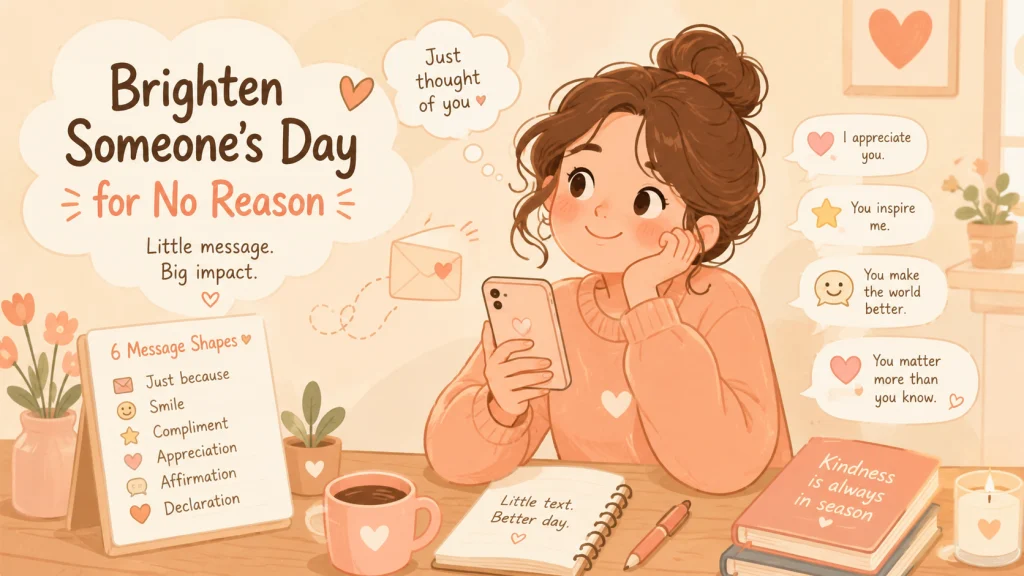
Most message advice online assumes you’re either celebrating something or trying to fix something. This is for the category nobody writes about properly: the ordinary Tuesday when someone just crosses your mind and you want to say so. I’ve sent a hundred versions of these brightening messages, badly at first, before I learned that the smallest ones often land the hardest. What follows isn’t one list but six different shapes this kind of message can take, depending on what you’re actually trying to say. Pick the one that fits, then go find the full set waiting on its own page.
There’s a Whole Category of Messages With No Occasion Attached
Most of the messages people search for come with a built-in reason. Someone got a promotion, someone is grieving, someone’s birthday is in two days. But messages to brighten someone’s day are different. They don’t wait for a reason to exist. They show up because you were standing in line at the pharmacy and a smell, a song, a stranger’s laugh, suddenly pulled someone’s name into your head, and you decided to do something about it instead of letting the thought pass.
That impulse is the entire premise here. Maybe you’re hunting for messages to cheer someone up because the last few weeks have been heavier than usual for them. Maybe nothing is wrong at all, and you simply want to be one of the few people who reaches out without being prompted by a calendar or a crisis. Either way, the goal is the same: say something real, send it, and let it land however it lands. You don’t need a special occasion. You need about ninety seconds and a little honesty.
The moments that trigger this kind of message tend to repeat themselves once you start noticing them:
- You saw, heard, or smelled something that pulled their name into your head out of nowhere.
- They’ve been a little quiet lately, and you noticed before they said anything.
- Nothing happened. You just thought of them, and thought you’d say so.
- You caught yourself smiling at a memory that had nothing to do with today.
None of those require an occasion. They require you to act on the thought before it disappears, which is the part most people skip. The six types below are simply different shapes that thought can take once you decide to send it.

Six Shapes, One Idea
I used to think there was one correct way to send a message like this, and it took longer than I’d like to admit before I noticed the actual pattern. Uplifting messages to send when someone crosses your mind for no reason are not one thing, even though most lists about this topic treat them as interchangeable. Underneath the impulse to reach out, you’re usually saying one of a few different things: I noticed something about you, I’m grateful you exist, or I don’t say this enough and I should. Knowing which one you mean changes the entire shape of the message.
Here’s the short version of all six, before the longer one. Each type further down has its own full page with everything you might want to send, but this table is the decision point before you get there. None of the six are ranked by importance, only by how much emotional weight they tend to carry, which matters more in practice than people expect.
| Type | What it’s really saying | Best moment for it |
|---|---|---|
| Just because | I thought of you, no other reason needed | The most ordinary moment you can think of |
| Smile | I wanted to make today a little lighter | When the mood between you can handle being playful |
| Compliment | I noticed something specific about you | When you caught yourself admiring a real detail |
| Appreciation | I’m grateful you’re in my life | When gratitude has been sitting unsaid for a while |
| Affirmation | I see who you are, not just what you did | When someone needs reminding of their own worth |
| Declaration | You matter to me more than I usually say out loud | When the relationship can hold something bigger |
That weight matters because mismatched weight is its own kind of mistake. Sending a declaration to someone you talk to once a year can feel disproportionate, almost alarming. Sending a quick smile text to someone going through something genuinely heavy can feel like you weren’t paying attention. The shape has to match the moment, not just the feeling sitting in your chest when you decide to write.
When There’s Genuinely No Reason at All
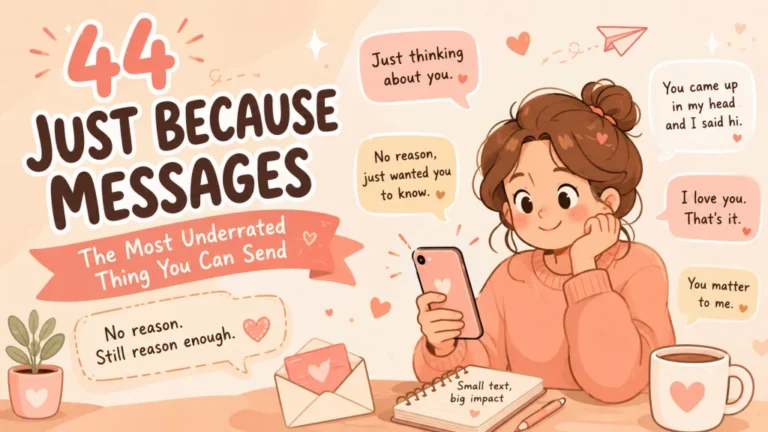
This is the purest version, and also the hardest for people to send, because we’ve been trained to think a message needs a justification, when it doesn’t. The entire point of this type is that you skip the reason entirely and go straight to the thought. I sent one once from a train platform in Lisbon, four words long, to someone I hadn’t spoken to in two months. I almost didn’t send it because it felt too small to matter. She wrote back within the hour saying it was the nicest thing anyone had done for her that week.
What makes this type work is restraint. The moment you start explaining why you’re sending it, you’ve turned it into something else, an apology, an excuse, a setup for a favor. The full set of just because messages on its own page leans into exactly this: short, unexplained, and built to work precisely because they ask nothing in return.

When You Just Want Today to Be a Little Lighter
Sometimes the impulse isn’t deep at all, and that’s fine. You don’t owe every message emotional weight. Maybe you remembered an inside joke, or saw something genuinely ridiculous and thought of the one person who’d find it as funny as you did. That’s reason enough. Humor travels well over text in a way sincerity sometimes doesn’t, because it asks nothing of the reader except a smile.
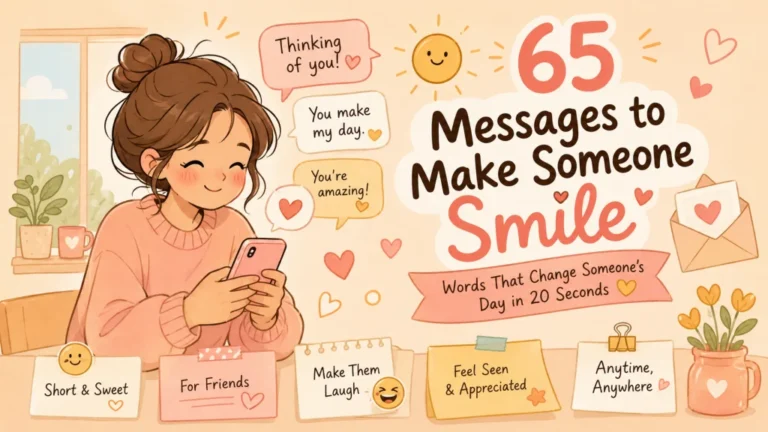
The mistake people make here is trying too hard, reaching for a joke that isn’t quite theirs, or one that needs three lines of setup to land. A joke that requires an explanation has usually already lost. The better version is almost always shorter and more specific to the actual person, which is exactly what the messages to make someone smile collection is built around, lines that work because they sound like you and not like a greeting card trying to be funny.
When You Noticed Something Specific
There’s a particular kind of compliment that lands harder than the generic ones, and it’s almost always the one that proves you were actually paying attention. Not “you’re so smart,” but the way someone explained something complicated to a confused stranger at a party last month, patiently, without ever making the stranger feel small. Specificity is what separates a compliment that gets a quick thanks from one that gets saved, screenshotted, and read again later.
This only works if the detail is real. A vague compliment sent for no occasion can feel like flattery without a name behind it, which is worse than saying nothing at all. If you’ve noticed something true and small about a friend recently, the random compliments for a friend set has more on how to phrase it so it reads as observation, not performance.
When Gratitude Has Been Sitting Unsaid
Gratitude tends to get saved for big occasions, weddings, eulogies, anniversaries, when most of it is actually earned in the ordinary stretch of time between those events. This type comes from that gap. It’s less about a single moment and more about something that’s been quietly true for a while, that you’re grateful this person is in your life and you haven’t said so in those exact words. People rarely think to send it outside of a milestone, which is exactly why it tends to land so hard when it shows up uninvited.
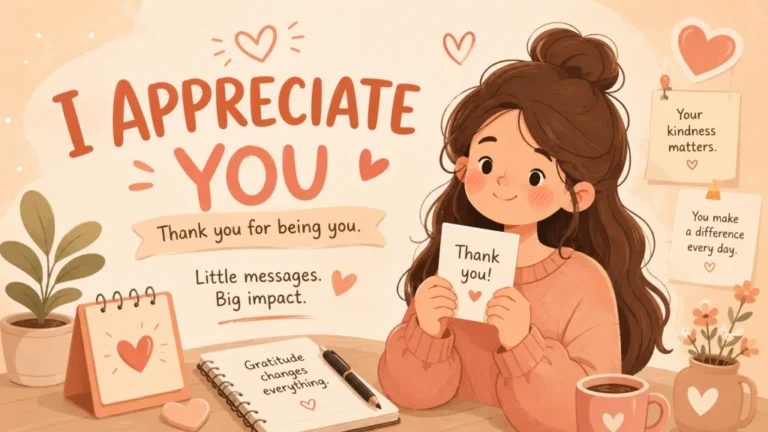
What I’ve found is that people are often surprised by how much an unprompted “I appreciate you” lands, precisely because it wasn’t tied to anything they did that week. It’s not a thank-you for a favor. It’s closer to an acknowledgment of presence over time. If that’s the feeling you’re chasing, the full page on ways to say I appreciate you goes further into how to make it sound earned instead of generic.

When Someone Needs Reminding of Who They Are
Affirmation is different from a compliment because it isn’t about a single action. It’s about identity, telling someone what you see when you look at the whole of them, not just the latest thing they did well. This matters most when someone has been defining themselves recently by a mistake, a setback, or a string of days where nothing went right, and they’ve started to forget the rest of who they are.
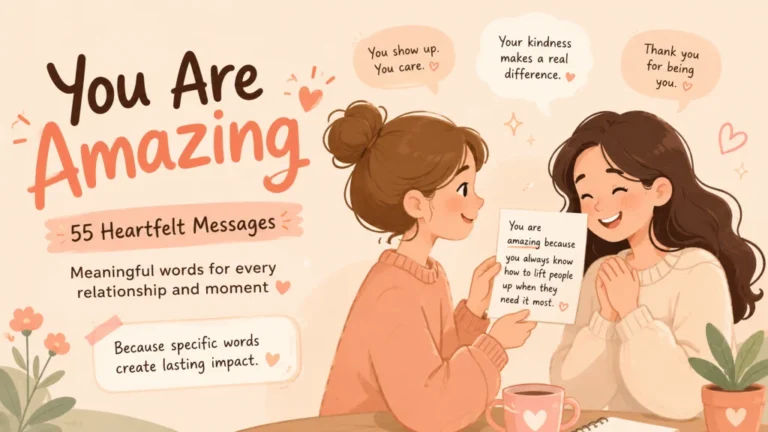
The risk here is sounding like a poster on a classroom wall. Generic affirmations, the kind that could be sent to literally anyone, tend to bounce off rather than land. The version that works names something true and specific about that one person, which is the entire approach behind the you are amazing messages collection: built around specificity instead of volume.
When the Relationship Can Hold Something Bigger
Of the six, this one carries the most weight, and that’s exactly why it should be used sparingly. Not because the feeling itself is rare, but because saying it plainly, out loud, in words, is. A declaration says something close to: you matter to me in a way I don’t usually put into words, and today, for whatever reason, I wanted you to know it directly. It works best in relationships that have already earned the weight, a parent, a partner, a friend who’s been there long enough that the words won’t feel sudden.
Sent to the wrong person, or at the wrong moment, this type can feel like too much. Sent to the right one, it can be the message they remember years later. If you’re sitting with that kind of feeling and want help finding the words for it, the you mean the world to me messages page is built specifically for that weight.

The Version That Actually Gets Sent
What I’ve found, more times than I can count, is that the message people spend twenty minutes drafting could usually have been three honest sentences sent five minutes earlier. The hesitation is rarely about not knowing what to say. It’s about wondering whether it’s appropriate to say anything at all when nothing prompted it. It is. That’s the entire point of a message with no occasion attached.
If today is one of those ordinary days and you want to send something positive to a friend, pick the shape that matches what you’re actually feeling rather than reaching for whichever one sounds the most impressive. A short, true line beats a long, careful one almost every time. And if this particular kind of reaching out becomes a habit, that’s not a bad habit to have. Some of the best relationships I’ve watched up close are the ones where someone kept doing this long after they had any practical reason to.
FAQs
😅 Is it weird to text someone for no reason?
No, and it’s becoming rarer, which makes it land even better. The slight discomfort you feel right before sending it is normal. Send it anyway.
💭 What’s the difference between a thinking of you message and a just because message?
Not much, honestly. They overlap. A thinking of you message usually leans on the memory or moment that triggered it, while a just because message often skips the explanation entirely and goes straight to the point. Either works.
⏳ How often is too often to send these?
There’s no fixed number, but if every message starts to feel routine rather than noticed, it might be losing its weight. I’d rather send one every few weeks that means something than one every day that doesn’t.
📵 What if they don’t text back right away?
That’s fine, and it’s not a verdict on the message. People read these at odd hours, mid-task, without the bandwidth to reply right away. The point was sending it, not getting an instant response.
🎯 What makes a message feel genuine instead of random?
Specificity, almost every time. A line that could be sent to anyone reads as random. A line that only makes sense for that one person, because it references something true about them, reads as genuine.
🤷 Can I send one of these to someone I haven’t talked to in a while?
Yes, and it’s often exactly the right moment for one. Just keep it short and skip any guilt or apology about the gap. Let the message be about them, not about the silence beforehand.