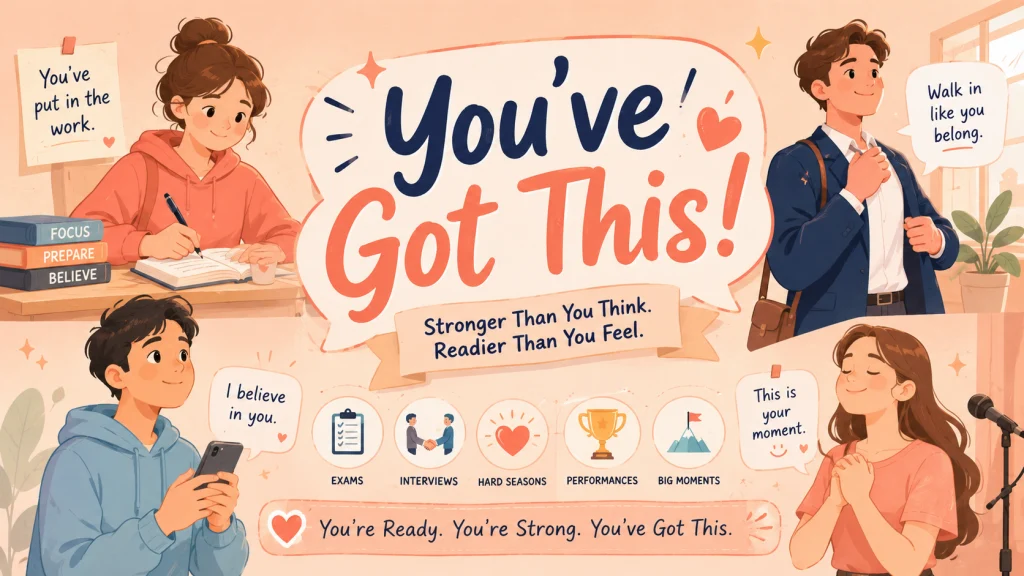
“Good luck” is a wish. “You’ve got this” is a statement. The distance between those two things matters more than it looks, especially to the person reading your text in a parking lot before they walk in. These 60 you’ve got this messages are built around confident, specific encouragement for the moments that call for something more than hope: exams, interviews, personal challenges, and big life moments people have been building toward for a long time.
Good Luck Is Passive. “You’ve Got This” Is Not.
When someone you care about is walking into something hard, “good luck” is usually the first thing that comes out. It is easy. It is familiar. And it is almost completely passive. Luck is something that happens to you. It implies chance, uncertainty, an outcome that could go either way. “You’ve got this” is something else. It is a statement of certainty. It says: I know you. I have seen what you are made of. And I am not wishing for you. I am telling you: you are ready. For related message ideas, see you got this message.
That distinction sounds small until you are the one standing outside the exam room, or reading your phone in the car before you go in. Then it feels like everything. “Good luck” leaves the outcome uncertain. “You’ve got this” takes that uncertainty and replaces it with something solid. Not a prediction. A reflection of what the other person has already put in and already has.
The version most people reach for is too cautious. I know because I have sent it. There is a kind of superstition in “good luck,” as if naming certainty might jinx it. But what I have found, again and again, is that people do not need hope from the people who love them. They need to be reminded of what they already have. A well-written you’ve got this message does exactly that.
| Situation | What tends to work | Ideal length |
|---|---|---|
| Exam or test | Competence-focused, references their preparation | 1 to 3 sentences |
| Job interview | Confident, “you belong in that room” | 1 to 2 sentences |
| Personal challenge or hard season | Honest, steady, no silver linings | 2 to 4 sentences |
| Someone who doubts themselves | Quiet certainty, no cheerleading or pressure | 2 to 3 sentences |
| Big performance or public moment | Direct, acknowledges the moment, no advice | 1 to 2 sentences |
The one thing all of these have in common is specificity. Messages that land are the ones that make the other person feel seen, not just encouraged. Generic warmth is easy to scroll past. Something that sounds like it came from someone who actually knows them is the kind of thing they save.

You’ve Got This Messages for an Exam or Test
Exams carry a particular kind of anxiety that is hard to name. It is not just about the grade. It is about whether everything you put in was worth it, whether your brain will cooperate on the day, whether you actually know what you think you know. Most people sending a message before a test reach for “good luck” because they are trying not to add pressure. What they do not realize is that a well-aimed “you’ve got this” does not add pressure. It removes it. It says the hard part is already done. Today is just the part where you show it.
What works here is something that references preparation, even briefly. Not “I hope it goes well” but “you’ve put in the work.” The difference is subtle, but the person reading it will feel it. For more message variations built around exams specifically, the good luck messages for exams page covers different tones and relationships across that same pre-test moment.
- You have put in the work. Today is just the part where you show it.
- I have watched you prepare for this. You are ready. Go prove it.
- Every hard question on that paper is one you have already asked yourself. Trust that.
- You know this material. Walk in like you know it.
- The nervousness you are feeling right now is just your brain taking this seriously. That is a good sign. Go get it.
- You have studied, you have shown up, and the hard part is already done. Today is just the delivery.
- I am not wishing you luck. I am telling you: you have got this.
- Whatever that test throws at you, you have an answer. I have seen how hard you have worked for this.
- One question at a time. You know more than you think you do right now.
- I believe in the version of you who sits down at that desk. That version knows exactly what to do.
One pattern worth naming: the messages that fall flat are usually the ones loaded with “don’t worry” or “I’m sure it’ll be fine.” Both place the focus on the anxiety rather than the preparation. Short, certain, preparation-anchored messages are what cut through.
You’ve Got This Messages for an Interview or Professional Challenge
A job interview is a specific kind of test, and the message that works before it is slightly different from the exam version. There is a professional layer to navigate, but that does not mean the message needs to be formal. What it needs is confidence. Not cheerleading, not reassurance, just a clear signal that you believe they belong in that room. The pressure of an interview often comes from the feeling of auditioning for something. The right message subtly reframes it: they are not asking to be chosen. They are letting the interviewer see why they should be.
I sent something like this once, from a hotel room in Barcelona, to a friend who had her first interview for a senior role she had been working toward for a long time. I kept it to one sentence: “You’ve earned the seat at that table. Now go sit in it.” She got the role. She told me later she read it three times on the train. I am not saying a text did that. But she said it helped her walk in differently. If you want more options across different professional contexts, the good luck on your interview messages page offers variations across different seniority levels and relationship types.
- They are going to be lucky to have you. Go remind them of that.
- You have earned the seat at that table. Now go sit in it.
- Answer every question like the conversation has already started. Because it has.
- You are not hoping they pick you. You are letting them see why they should.
- Walk in like you belong there. Because you do.
- They called you in because they are already interested. Go show them why they are right.
- Be exactly who you are in that room. That is the person they should be hiring.
- You have prepared. You know your material. Now just have a conversation.
- Whatever nerves show up today, just keep talking. You know what you are talking about.
- You are ready. Not kind of ready. Actually ready.
The common mistake in interview messages is over-enthusiasm that tips into pressure. “You’re going to crush it” can land wrong if the person is already wound tight. Quieter certainty, the kind that says “you belong there,” tends to carry more weight and stay with them longer.

You’ve Got This for a Personal Challenge or a Hard Season
Not every challenge has a clear finish line. Some of what people are going through is not an exam on Tuesday or an interview next Monday. It is an illness with no timeline. A period of grief. A relationship that fell apart. A stretch of difficulty that has gone on longer than anyone expected. In these moments, “you’ve got this” needs to mean something different. Not “you will succeed” but “you have what it takes to keep going, even when it is hard.”
The instinct to reassure often leads people in the wrong direction here. I sent a very long message once to a friend going through something extended and exhausting, full of silver linings and things to look forward to. She responded kindly, but I could tell it had landed next to her, not inside her. What she needed was not perspective. It was to feel accompanied. The messages below try to stay inside that line: present, not prescriptive.
- You do not have to have it all figured out right now. You just have to take the next step. You can do that.
- I know this is harder than you let on. And I know you are going to get through it.
- Whatever today asks of you, you have what it takes to answer it.
- You have come through hard things before. Not easily. Not without cost. But you came through.
- This stretch is not all of your life. And you are still going to be here, one step at a time.
- The hard part is not the obstacle. It is deciding you are still going. You have already decided. So you have got this.
- I am not telling you it is going to be easy. I am telling you that you are the right person to handle it anyway.
- You have been in the middle of things before and found your way through. You will find it again.
- Even on the days when it does not feel like it, you are still doing it. That counts.
- You are carrying this with more grace than you know.
These messages leave out timelines deliberately. Not “it will be over soon.” Not “you’re almost through it.” No one knows that, and the person going through it especially does not. What they can hold onto is that the person sending the message sees them as capable of handling what is right in front of them, right now.
Short “You’ve Got This” Texts to Send Right Now
Sometimes a message does not need to be long. Sometimes the person you are texting is already in the building, or five minutes from going in, or has asked you to stop overloading them with encouragement. What they need is one clear sentence that sounds like it came from someone who means it. Short messages can carry just as much weight as longer ones. Sometimes more. The shorter the message, the more certain it sounds.
What makes a short “you’ve got this” text land is not brevity alone. It is certainty. “Good luck” is short and it lands flat. “You’ve got this” is also short and it lands differently. The ones below are built on that same principle: direct, grounded, specific enough that the person reading them does not have to guess whether you mean it. These work as the whole message or as a closing line on a longer one. For a completely different register, where the goal is not a single high-stakes moment but staying connected through ordinary days, daily messages to send someone you care about cover that quieter kind of reach-out.
- You’ve got this.
- You’re ready. Go.
- I believe in you. Fully.
- You trained for this. Trust it.
- This is your moment.
- Go get it.
- Whatever this is, you are more than ready for it.
- You are more prepared than you feel right now.
- I have seen what you can do. You have got this.
- Just be you. That is enough.
- You can do this. I know because I know you.
- Ready or not, you are ready.
One pattern I keep seeing: people pad these out because they feel guilty sending something so short. They add two extra sentences to soften the brevity. More often than not, the version without the extras is the better one. Send the short version. It sounds more certain.
For Someone Who Does Not Believe They’ve Got This Yet
There is a specific kind of person these messages are for. The one who texts back “I don’t know if I can do this” five minutes before they have to go in. The one who has been talking themselves out of it for weeks. The one who has done the preparation, made the effort, shown up repeatedly, and still cannot shake the feeling that it is not going to be enough. These are not ordinary “you can do it” messages for someone who only needs a quick confidence boost. They are for someone who needs to borrow someone else’s certainty while their own catches up.
The mistake most people make here is trying to argue the person into confidence. “Of course you can,” “stop doubting yourself,” “you’re so talented.” None of those land when someone is in the grip of real doubt. What lands is something quieter. Something that does not demand they feel confident but simply offers your certainty as something they can hold onto for the next few hours.
- I know you do not feel ready. That is okay. I feel ready on your behalf. You have got this.
- You do not have to believe it yet. Just take the first step. The rest will follow.
- The fact that it matters this much is part of what will carry you through.
- You keep saying you are not sure you can. From the outside, I can see that you already are.
- I do not need you to feel confident. I just need you to go. The rest will take care of itself.
- Every person who has ever done something like this has stood exactly where you are standing right now. And then they did it anyway. So can you.
- Doubt is just your brain being careful. Your instincts already know what to do. Trust those.
- You have been underestimating yourself for a while. I am asking you to stop. Just for today.
- What if you went in assuming it is going to be okay? Just as an experiment. Because I am pretty sure it is.
- I am not saying this to make you feel better. I am saying it because it is true: you are ready.
One detail worth noting: these messages work best when they are not followed by a list of reasons why the person should feel confident. The message does the work. The explanation undermines it. Say the one thing. Let it sit.

You’ve Got This Encouragement for a Performance, Competition, or Big Leap
Some moments are not about preparation in the traditional sense. A performance. A competition. A speech in front of a room full of people. A creative project released into the world after months of quiet work. These are the moments where everything has already been done and the only thing left is to show up and let it happen. The message before something like this needs to do one specific thing: acknowledge the size of the moment without adding to the weight of it.
From what I have found, the message people want most before something like this is not advice. It is a witness. Someone who sees them, sees what they have been building toward, and says: I see it. You are here. Go. The options below come from that angle. Steady, short, not asking anything of the person receiving them except to walk out there and be exactly what they already are.
- I have watched you get here. You belong in this moment.
- Everything you have done to get here has already done its job. Now just go do yours.
- The nerves, the stage, the pressure, you have been preparing for all of it. Go do what you came to do.
- This is the part you have been building toward. You are not just ready. You have been becoming ready for a long time.
- You have put in the work. Now go let it show.
- Your moment is here. Go meet it.
- Stand up there like you belong. Because you do.
- I will be thinking of you every second. But you do not need luck. You have already done the hard part.
One thing to leave out of these messages entirely: technical advice. “Remember to breathe,” “take your time,” “just stay calm.” The person has heard all of it. What they need is the human equivalent of someone’s hand on their shoulder for three seconds before they walk out. These messages are trying to be that.
Final Thoughts: What a Good “You’ve Got This” Actually Does
A message is not magic. It does not make a hard thing easy or turn an uncertain outcome certain. What it can do, when it is written honestly, is make someone feel less alone for the thirty seconds they read it before walking into the room. That is not a small thing. For the right person, at the right moment, it is the thing that gets them through the door.
The difference between a message that does this and one that doesn’t usually comes down to a single question: does it sound like it came from someone who actually knows them? Not a card. Not a template. Something specific, something that sounds like you. The ones above are a starting point. Take what fits and make it yours. Change one detail, add one sentence that only you would know to add, and it becomes something they will remember.
If you want something broader across the hope-versus-certainty spectrum and across more relationship types, good luck messages covers more of that terrain. And for when the moment is less about a single event and more about keeping someone going over the long stretch, motivational messages to keep going picks up where these leave off.
FAQs
💬 What is the difference between “good luck” and “you’ve got this”?
“Good luck” is hope-based. It implies the outcome is uncertain and wishes it goes well. “You’ve got this” is certainty-based. It asserts that the person already has what they need. For someone walking into something hard, the second one tends to land with more weight because it puts the credit where it belongs: on them, not on chance.
📝 What do you text someone right before a big exam?
Keep it short and preparation-focused. Something like “You’ve put in the work. Today is just the part where you show it” does more than “good luck” because it places the emphasis on what they have already done, not on what might happen. Avoid anything that sounds like reassurance about the outcome.
💼 Is “you’ve got this” appropriate to send before a job interview?
Yes, and it often lands better than a generic “good luck.” Keep the tone confident and direct. Something like “you belong in that room” works well because it is not about the outcome, it is about their right to be there. Avoid anything that sounds like you are adding to the pressure.
🤔 What do you say to someone who doesn’t think they can do it?
Don’t try to argue them into confidence. It rarely works. Instead, offer yours. “I don’t need you to feel ready. I just need you to go” takes the pressure off while still moving them forward. Let your certainty do the work rather than giving them a list of reasons they should believe in themselves.
✍️ Is “you got this” grammatically correct?
“You’ve got this” is the standard form, with “you’ve” as a contraction of “you have.” “You got this” is informal and colloquial but widely understood, especially in texts. Both work in casual messaging. In slightly more formal or professional contexts, “you’ve got this” reads more cleanly.
⏰ When is the best time to send a “you’ve got this” message?
As close to the moment as possible without arriving after they have already gone in. The night before or morning of tends to work well. A message that arrives while they are already sitting in the waiting room is often read after the fact. Give it time to land before the moment arrives.