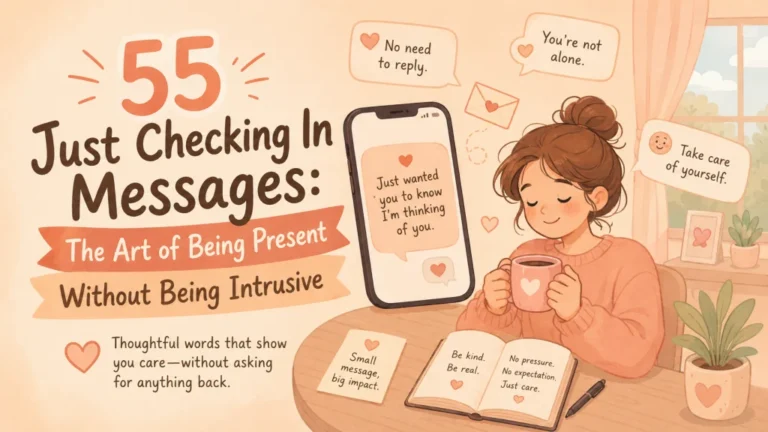
Thinking of you messages exist for the moments that do not come with a label. No occasion, no milestone, just the quiet fact of someone being on your mind and the feeling that they should know it. This page covers every version of that: everyday check-ins, long-distance care, the words for when someone is going through something hard, messages for reaching back after a long silence, and the ones that simply say “you are not alone in this.” Pick the context that fits closest to where you are, and the words follow from there.

The Message That Does Not Need a Reason
Most of the messages people hesitate over are not the milestone ones. Birthday texts arrive on a date that is already circled. Sympathy messages come with a clear and specific occasion. The ones that sit in the drafts folder, half-written and never sent, are the in-between ones. Someone has been on your mind. You are not sure that is a good enough reason to say something. Thinking of you messages live in exactly that space. They are the words for a Tuesday with no occasion attached, for the moments when someone matters to you and you want them to feel it.
What I have found, more times than I can count, is that these unoccasioned messages tend to arrive exactly when someone needed them and had stopped expecting anything. A friend who had a rough week that nobody knew about. Someone who moved to a new city and has not said out loud that they miss people. A parent who never asks to be checked on. The message that says “you were just on my mind” does something a scheduled birthday text almost never does. It proves the thought came on its own, with no prompt and no obligation behind it.
The single mistake people make most often here is over-explaining the impulse. They write two or three sentences accounting for why they are reaching out before they get to the actual feeling. The preamble is almost always unnecessary. “I was just thinking about you” is a complete message. Everything layered around it tends to soften it rather than strengthen it. If you are sitting with a blank field and nothing feels right, the shortest honest version is almost always the one to send.
If you need something right now, before going deeper into a specific context, here are a few starting points that work across most situations:
- No occasion: “You’ve been on my mind. I hope you’re doing well.”
- Long distance: “You came to mind today and I wanted you to know I’m thinking about you from here.”
- Reconnecting: “It’s been too long. You crossed my mind and I didn’t want to let it pass without saying something.”
- Someone struggling: “I’ve been thinking about you and what you’re going through. I’m here if you need anything, and also here if you don’t.”
- Missing someone: “I miss you. I saw something today that made me think of you immediately and I had to say so.”
- No reply needed: “Just wanted you to know you were on my mind. No need to reply, just sending this your way.”

When You Just Want to Check In
General care messages are the ones that ask nothing of the situation. No one is sick. Nothing happened. There is no reason except that someone crossed your mind and you wanted to say so. These are also the messages people talk themselves out of most often. They assume the other person will wonder why they are hearing from you right now, or that the gesture will come across as odd without context. In my experience, the answer to “why now” is almost never what the reader assumes. It is almost always: “I just thought of you.” That tends to be enough.
The tone for an everyday check-in shifts more by relationship than by occasion. What reads as warm between close friends can feel strange between people who are less familiar. What works between a parent and an adult child might come across as too much between acquaintances. The table below is a rough sense of how the tone should adjust depending on who is on the other end. It is not a formula, just a starting point for where to aim.
| Relationship | Tone that tends to land | What usually misses |
|---|---|---|
| Close friend | Casual, personal, specific to your shared history | Overly polished wording that sounds like a card |
| Family member | Warm, direct, low-pressure | Anything that sounds like a formal check-in |
| Acquaintance you want to stay close to | Light, genuine, brief | Long explanations for why you are reaching out now |
| Someone going through a hard time | Steady, quiet, no expectations of a reply | Positivity that glosses over what they are actually carrying |
| An old friend after a long silence | Honest, a little open, no guilt assigned to either side | Lengthy apology for the absence before anything warm is said |
The most useful check-in messages tend to reference something specific, even briefly. “Thinking of you” is enough. “Thinking of you, that trip you mentioned is coming up soon” is better, not because it is longer, but because it shows the thought was actually about them. The specificity is where the warmth lives. Just thinking of you, with a small detail attached, carries more weight than any number of well-crafted phrases. For a wider range of everyday versions, general thinking-of-you messages collects the ones that work for almost any relationship and any regular moment.
When the Miles Are Part of It
Long-distance thinking-of-you texts carry something the in-person ones do not have to: the weight of actual distance. The person receiving them knows you cannot simply show up. You cannot grab coffee or sit on the same couch. What you can do is send something that says the gap has not made them smaller in your mind, that wherever you are, they are still fully present in it. When that message lands right, it does more than the sender usually expects.
The version people get wrong most often in long-distance care messages is the one that leads with guilt. “I know we haven’t talked in so long, I’m sorry I’ve been bad at keeping in touch” is technically a thinking-of-you message, but it puts the other person in the position of reassuring you instead of simply feeling cared for. The better version usually lets warmth come first. “You came to mind today and I didn’t want to not say something” carries none of the guilt and all of the care. I have learned that one slowly, mostly from getting it wrong first and watching the message land sideways.
The messages that work best across distance tend to be the ones that make the person feel close for a moment, not the ones that dwell on how far they are. Name something you would have said if you were in the same room. Share a small detail that reminded you of them. Send the kind of message that makes them feel like the miles are briefly beside the point. If you are looking for the specific versions written for long-distance relationships and friendships, thinking of you across distance covers the range of what works when someone is far away.
Reaching Back After a Long Silence
Reconnecting messages carry their own particular weight. Both people on either side of the message are aware that some time has passed. There is something slightly tender about that, a mix of warmth and mild awkwardness, and the ones that work best are the ones that acknowledge the gap without making it the center of the message. The silence was real. You do not need to pretend otherwise. But what you are sending is about what is still there, not about accounting for the time in between.
There was a message I almost did not send once, to someone I had not spoken to in well over a year. We had not had any kind of falling-out. Life had simply moved in different directions, the way it does, and the gap had grown without anyone deciding to let it. I wrote about five versions of what to say. Some of them were too long, explaining the absence as though I owed a full account of the past year. The one I finally sent was much shorter: that they had been on my mind, and that I hoped things were going well. She wrote back the same evening. The long version would have been harder to receive. The short one just opened a door.
Reconnecting messages share something with the words of comfort people reach for in harder moments: both require the willingness to send something without knowing exactly how it will land. If there is a silence between you and someone that feels like something worth breaking, reconnecting with a friend after time apart has the words for how to start without making the gap the whole point of the conversation.

When Someone Is Going Through Something Hard
A significant number of thinking-of-you messages are sent not because nothing is happening, but because something is. Someone is grieving, or sick, or quietly struggling in a way they have not put into words yet. The message is not about checking an obligation off a list. It is about presence, about making sure the person on the other end knows that someone is holding them in mind while they are carrying something heavy. That is a different kind of message than a casual check-in, even if it sometimes uses the same words.
The pattern I keep seeing in support messages that miss is that they try to do too much. They encourage, they reframe, they offer perspective. The intent behind all of that is real and kind. But the person receiving a message sent in a hard moment is usually not looking for a solution. They are looking for someone willing to sit with the weight of what they are going through for a moment. “I am thinking of you” does that better than most people believe it can. The version that says nothing except “I see you and I am here” is often the one that stays with someone longest. ❤️
The range of support messages is wide. Here are the most common types and what each one is really doing:
- Simple presence: “I’m thinking of you” with nothing added. No questions, no expectations, no pressure to reply. The message carries the weight entirely on its own.
- A soft opening: “I was thinking about you and wanted to check in. No rush to answer.” This opens a door without pushing anyone through it.
- Acknowledgment without advice: “I heard what you’re going through, and I just wanted you to know I’m here.” It names the situation and offers company, without trying to fix anything.
- Warmth across distance: “Can’t be there right now, but you’re very much in my thoughts.” This is especially useful when physical presence is not possible but you want your care to reach anyway.
- The reminder: “You don’t have to carry all of this alone.” Short, but it lands deeply when someone has been trying to do exactly that.
This is where messages that say “I’m thinking of you” begin to overlap with “I’m here for you.” The feeling is the same: I see what you are carrying and I want you to know you are not carrying it invisibly. For the specific words that say this in harder moments, I am here for you messages and you are not alone messages each cover a different angle on what that presence sounds like in practice. If you want something that goes a step further and sends something warmer, sending love and support messages has versions for when thinking-of-you alone does not feel like quite enough.

When It Is Not Just a Check-In but Something Closer to Missing
There is a version of the thinking-of-you message that is not really a check-in at all. It is the one that comes from an actual ache, a feeling of someone’s absence that goes beyond wanting to catch up. Missing someone has a different ache. The message that belongs to it is different from the one you send when you are just being a good friend who reaches out now and then. The missing version is rawer. It does not always need to say the word “miss” to carry the feeling, but it needs to be honest enough that the other person can feel what is behind it.
The mistake people make with missing-someone messages is softening them so much that the real feeling disappears. They become generic check-ins. They sound like something you might send to anyone. The specificity is what makes a missing-someone message feel true: a particular memory, a specific thing about that person that nobody else has, the exact kind of joke only the two of you would understand. That is what makes it feel like it came from someone who actually knows them, not like a “just thinking of you” text that could have been sent to a list. For the versions that are honest about the ache, missing you messages for a friend has the words that do not water it down. And for the everyday check-in that stays light and low-pressure, just checking in messages is the right starting point.
Final Thoughts: Start With the Feeling
Every thinking-of-you message starts in the same place. Someone is on your mind, and you want them to know it. The reason it feels complicated is that there is no established script for this particular kind of reaching out. Birthday messages have a shape. Condolence messages have conventions. These do not. And because they do not, people second-guess themselves far more often than they should, and far more often than the situation requires.
The best version of any of these messages is the honest one. It does not have to be polished, long, or carefully structured. It just has to sound like it came from a real person, to a specific person. “You’ve been on my mind” is real. “I don’t know why you came to mind today but I wanted you to know” is real. Whatever version you land on, the pages below are organized by the context you are writing from. Start with whichever one fits closest to where you are right now.
Find the Words for Your Situation
Each of the pages below focuses on a specific version of what it means to reach out and say “I’m thinking of you.” Some are for everyday moments. Some are for harder ones. Some are for specific relationships or specific kinds of distance. If you know what you are feeling but not quite how to say it, start with the one that matches your situation most closely.
| What you are looking for | What you will find there |
|---|---|
| General thinking-of-you messages | Everyday versions for any relationship, no occasion needed |
| Just checking in messages | Low-pressure check-ins that open a door without demanding a reply |
| Thinking of you across distance | Messages written for the specific weight of miles between people |
| Missing you messages for a friend | When it goes beyond a check-in and into a real ache for someone’s presence |
| Reconnecting with a friend | How to reach back after a long silence without making the gap the whole point |
| I am here for you messages | Support messages for someone carrying something they have not named yet |
| You are not alone messages | Words for someone who needs to know they are not facing something by themselves |
| Sending love and support messages | When thinking of you feels like not quite enough and you want to offer something more |
FAQs
💬 What do you say in a thinking-of-you message?
Keep it honest and short. Something like “You’ve been on my mind and I wanted to say so” is enough. The shorter and more direct the message, the more it usually lands. Over-explaining why you are reaching out tends to take the weight out of the gesture.
🤔 Is it weird to send a thinking-of-you text out of nowhere?
Not at all, and in most cases the opposite is true. A message that arrives with no occasion behind it tends to carry more weight precisely because there was no obligation to send it. It means the thought was genuine.
💙 What is a good thinking-of-you message for someone who is struggling?
Keep it simple and ask nothing of them. Something like “I’ve been thinking about you and I just wanted you to know I’m here” is enough. Avoid trying to encourage or reframe what they are going through. Presence, with no pressure attached, is usually what someone in a hard moment most needs to hear.
📱 How do you reach out to someone you haven’t talked to in a long time?
Skip the long apology for the silence. A short, warm message that says something like “You came to mind and I didn’t want to let the thought pass without saying something” tends to work better than a paragraph explaining where the time went. The warmth lands first, and the catch-up can follow from there.
🌍 What do you text someone who lives far away when you miss them?
Be specific about the thought that brought them to mind. A message that references something personal to your friendship, a memory, an inside detail, a thing only they would understand, lands differently than a general “miss you.” The specificity is what makes it feel true rather than like a form message.
✉️ What is the difference between a thinking-of-you message and a check-in?
A check-in usually asks how someone is doing and expects an answer. A thinking-of-you message does not have to ask anything at all. It can simply say “you were on my mind” without opening a question the other person needs to respond to. That distinction matters when the other person may not have the emotional energy for a full conversation.
🕊️ Do thinking-of-you messages need a reply?
No, and the best ones make that clear either in tone or explicitly. If you send a message with no question in it, you have already removed the social pressure to reply. The thought was the point. Whether the other person responds or not, the message arrived.