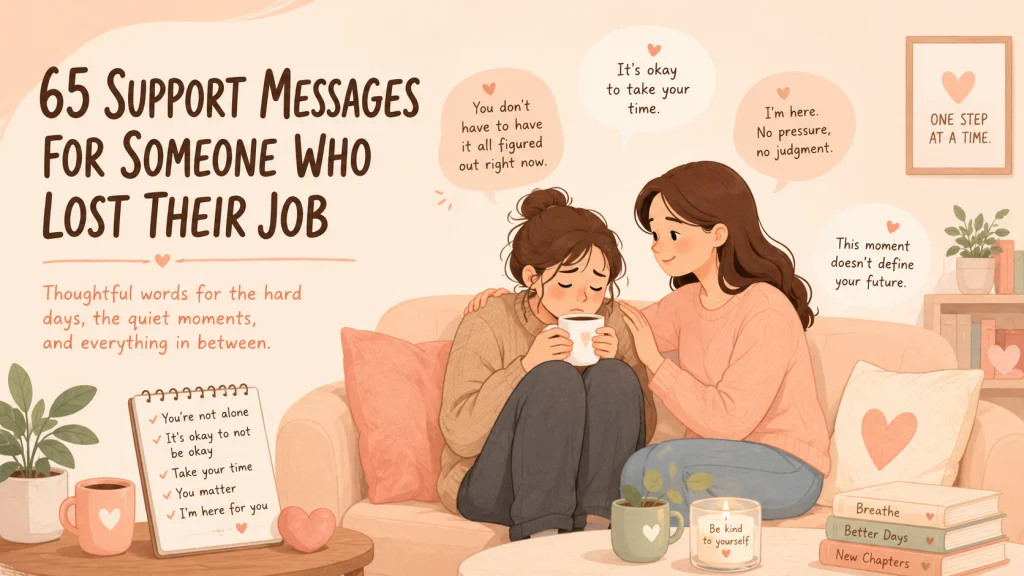
Job loss hits in layers that most support messages never reach. The first layer is income. The layers underneath it are harder to name: the routine that disappears, the identity that was tied up in the role, and, for a lot of people, a quiet shame that well-meaning encouragement can accidentally make worse. These 65 messages were written with all of that in mind. Some are for the first raw days when nothing needs to be solved yet. Some are for weeks later, when everyone else has moved on and the person is still very much in it. If you have been staring at a blank message field wondering what to say, start here. For broader context, see support messages for job loss.
The Part Most Support Messages Get Wrong
The first instinct, when someone loses their job, is to reach for optimism. “You’ll find something better.” “This is actually an opportunity in disguise.” “Everything happens for a reason.” I have sent versions of all of these. I understand the impulse, because watching someone you care about in pain and having nothing useful to offer is genuinely uncomfortable, and optimism at least feels like doing something. The problem is that it is often as much for the sender as it is for the receiver. For related message ideas, see encouragement messages for job loss.
The person on the other end is usually not ready for optimism yet. They are in shock. And underneath the shock, for a lot of people, is something that does not get named in most messages about this topic: shame. Not the logical kind, not the kind that would hold up if you tried to reason your way through it, but the kind that just sits there quietly, coloring everything. The shame of having to tell people. The shame of a Monday with nowhere to go. The shame of checking job listings at midnight and feeling like the results are somehow a verdict on you personally.
Most support messages skip this layer entirely, not because people do not care, but because addressing shame feels risky. What if naming it makes it worse? What if it comes across as pity? The messages in this collection try to navigate that carefully. They do not label what the person is feeling or try to talk them out of it. They just write around it honestly, in a way that says: I see what this actually is, and you do not have to perform okay for me. That is a harder thing to do than it sounds, and it is the gap that most other message collections leave open.
If you want something for a wider range of hard moments beyond job loss, encouraging words for hard times covers other situations where the same kind of honest, shame-aware support applies. For now, every message here is specific to this one.
For the First Days: Messages for the Shock Phase
The first thing a lot of people do after losing a job is go quiet. Not because they do not want support, but because they do not know what to do with it yet. They are still absorbing what happened, still running through the sequence of events, still making sense of an ordinary Tuesday that suddenly became a dividing line between before and after. A message sent in those first days does not need to offer anything. It just needs to arrive, and to arrive without requiring anything in return.
What I have noticed, both in sending these messages and in receiving them during a stretch when I was on the other end of this kind of loss, is that the ones people remember from those early days are almost never the long ones. They are the short, honest ones that did not try to solve anything. They are the ones that said: I know this is hard, I am not pretending it is not, and I am here. These twelve messages are written for that window, the first few days before the dust settles and well before anyone needs to think about next steps.
- “I heard what happened and I just wanted you to know I’m thinking about you. You don’t have to have anything figured out yet.”
- “I’m so sorry. That’s a lot to absorb all at once. I’m here when you want to talk, or if you just want company, that works too.”
- “What happened is genuinely unfair, and I don’t want to rush past that. You don’t have to be okay right now.”
- “I heard the news. No pressure to respond or update me on anything. I just wanted you to know you’re on my mind.”
- “That kind of news is a lot to sit with. I’m not going anywhere, and you don’t have to figure out what comes next today.”
- “I don’t have the right words, but I didn’t want to say nothing. I’m sorry this happened, and I’m here.”
- “You’ve been through a lot this week and I just wanted to check in. No agenda, no advice. Just checking in.”
- “I’m really sorry to hear this. I know how much that role meant to you. Give yourself time to breathe before you start thinking about next steps.”
- “This is one of those things that takes a minute to absorb. I’m not going to tell you what to do next. I just wanted you to know I’m in your corner.”
- “I heard and I wanted to reach out. Sometimes things happen that are just hard to make sense of right away. I haven’t forgotten about you.”
- “I’m sorry this happened. You don’t have to land on your feet right this second. Take your time.”
- “I just heard. I don’t want to pile on with advice or optimism when you’re still in the middle of it. I’m just glad I know you, and I’m here.”
A few of these land well exactly as written, via text, no changes needed. Others work better by phone or in person, especially the ones that mention being there in a physical sense. Read them against what you know of the person and the relationship before you decide how to send.

Messages That Acknowledge the Shame Without Making It Bigger
This is the section most message collections skip, and it is the one that matters most. The shame that comes with job loss is rarely spoken aloud, partly because naming it feels dramatic and partly because the person carrying it does not always recognize it as shame. It shows up instead as a reluctance to pick up the phone, a tendency to avoid social situations where the question “so what are you up to these days?” might come up, a habit of preemptively downplaying the loss before anyone else can react to it. The role gets framed as “not a great fit anyway” or “honestly probably better this way,” even when that is not quite true.
The right message in this space does not label the shame, confront it, or try to reason the person out of it. What it does is gently separate the person from the loss: you are not your job title, the version of you I know exists independently of this, and nothing about what happened last week changes how I see you. This sounds simple on paper. It is harder to write than it looks, because the words have to be honest enough to carry weight and careful enough not to feel like hollow reassurance. These ten messages try to walk that line.
- “I know job loss comes with a lot of feelings that are hard to name. Whatever you’re carrying right now, you don’t have to carry it alone.”
- “There’s nothing about this that reflects who you are as a person. I mean that. The version of you I know has nothing to do with a job title.”
- “I’ve been thinking about you. Not about your resume or your next move. Just you.”
- “You don’t have to have a plan or a positive spin for me. I know what this is like, and I’m not going anywhere.”
- “The part nobody talks about is how much a job can become part of how you see yourself. I see you fine without the title.”
- “I hope you’re being kind to yourself right now. This is harder than people let on, and you don’t have to pretend otherwise.”
- “I know this kind of thing comes with some feelings that are hard to talk about. You don’t have to talk about them with me if you don’t want to. But I’m here if you do.”
- “Whatever Monday looks like this week, I want you to know that how I see you has not changed.”
- “You gave a lot to that role. It makes sense that losing it would feel like losing more than just a job. That’s not weakness. That’s just how it works when you actually cared.”
- “I don’t need you to be okay yet. I just need you to know that I’m still here.”
Notice that none of these promise a good outcome. They do not say “you’ll be fine” or “this will work out.” What they say instead is: I see you, and I am not going anywhere. That is a quieter thing to offer, but it is the thing that actually lands in this kind of moment. The reassurance people need in this window is not about the future. It is about right now.

Practical Encouragement: When They Need Both Empathy and Something Real
There comes a point, usually a week or two in, when what someone needs starts to shift. The shock has passed. The initial wave of support has been received and appreciated. Now comes the longer, quieter stretch of figuring out what to do next, and the messages that work in this window are the ones that combine genuine warmth with something concrete. Not advice, not an unsolicited opinion about where to apply, but an actual offer: something specific you can do, said in a way that makes it easy to accept without feeling like a burden.
The mistake people make here, and I have made this one too, is the open-ended offer. “Let me know if there’s anything I can do.” It is sincere. It also puts the burden on the person who is already overwhelmed to figure out what to ask for, figure out whether the offer is real, and figure out how to phrase the request in a way that does not feel presumptuous. A better version names something specific and makes it easy to say yes. That is what these ten messages try to do.
- “If you want someone to look over your resume before you send it anywhere, I’m happy to help. No rush at all.”
- “If it would help, I can look at your resume, make an introduction, or just get you out of the house for coffee. No pressure on any of it.”
- “I know a few people in your field I’d be happy to introduce you to when you’re ready. No pressure on timing at all.”
- “I’m thinking about you. And when you’re ready to start talking through options, I’m a good sounding board. Until then, I’m just here.”
- “If you want to get out of your head for a few hours, let’s do lunch. On me. No job talk required.”
- “I have some contacts who might be useful. When you’re at the point of wanting introductions, just say the word.”
- “I know the days right after this can be disorienting. If you need company, a distraction, or just someone to sit with you while you sort through things, I’m available.”
- “I’ve been through something similar before. It was harder than I expected. I’m happy to talk through what helped, or to just listen if that’s more what you need right now.”
- “If there’s a way I can help, practical or otherwise, please actually use me. You’ve done that for others. Let me return it.”
- “I don’t want to assume what you need, so I’ll just say: whatever form that takes, I mean it.”
There is a pattern worth naming here, because it comes up a lot. The things people most regret saying after someone loses a job are usually not cruel. They are well-intentioned things that landed wrong because the timing was off or because the message was written to make the sender feel better rather than the receiver feel seen. The table below covers the most common ones.
| What tends to miss | Why it misses | What tends to land instead |
|---|---|---|
| “You’ll find something better.” | Rushes past the present pain toward a future outcome that is not yet real | “I know this is a lot to absorb right now.” |
| “Everything happens for a reason.” | Asks the person to accept a framework they may not believe in and did not ask for | “What happened is genuinely unfair.” |
| “At least you’ll have time to rest.” | Minimizes the loss by framing an unwanted situation as a hidden benefit | “Give yourself time to breathe before thinking about next steps.” |
| “Have you tried LinkedIn?” | Skips empathy entirely in favor of logistics before empathy has been offered | “When you’re ready, I know a few people I’d be glad to connect you with.” |
| “Let me know if you need anything.” | Puts the burden of asking on the person who is already overwhelmed | “I’d like to take you to lunch this week. What day works?” |
The right column does not require more words. It just requires a different order of operations: acknowledgment before action, presence before problem-solving. The shift is small on paper. It is not small to the person reading it.
For a Close Friend Who Lost Their Job
When the person who lost their job is someone close to you, a different register opens up. You do not have to be as careful as you would be with an acquaintance or a colleague. You can be angrier on their behalf. You can be more direct. You can say things that would feel presumptuous from someone who does not know them well. The messages in this section are written for that kind of closeness.
One thing I have noticed is that close friends sometimes hold back more than near-strangers do, because they are afraid of saying the wrong thing to someone who really matters. I did this once, with someone I had known for years. She lost her job on a Wednesday and I spent three days drafting and deleting texts because I did not want to make it worse. By the time I finally sent something, she had stopped checking her phone. Not because she was angry. Because the window had passed and she had retreated into herself, and the silence from the people closest to her had started to feel like a kind of confirmation of whatever she was already afraid of. If you are holding back: do not. An imperfect message that shows up is worth more than a perfect one that stays unsent.
- “I’m angry on your behalf, honestly. That should not have happened. I’m here.”
- “You don’t have to be strong around me. I’ve seen you on a bad day before, and I’ll still be here when this one is over.”
- “Can I bring food over? I’m asking because I want to, not because I feel like I have to. Say yes.”
- “I don’t have anything useful to say. I just wanted to tell you that I love you and this situation is genuinely awful.”
- “Tell me how bad it actually is. I can take it. You don’t have to filter it for me.”
- “I know you’re going to be okay eventually. I also know that ‘eventually’ feels very far away right now. I’m not going to rush you toward it.”
- “You’ve been through hard things before. That doesn’t make this one easier, and I’m not going to pretend it does. But I’ve watched you get through things, and I’ve got you this time too.”
- “I’m clearing my Saturday. I don’t care what we do. But you’re not spending it alone if you don’t want to.”
- “You don’t have to keep me updated or have good news to share. Just know I’m rooting for you, quietly, every single day.”
- “The thing I keep wanting to say is: this is not a reflection of who you are. And I know you know that, but sometimes it helps to hear it from someone who really knows you.”
Message 37 is the one people underestimate most. Giving someone permission to tell you exactly how bad it is, without filtering, without finding the silver lining in real time, is an unusual thing to offer. Most people want a version that is manageable. A close friend can afford to want the real one, and saying so out loud matters more than most people expect.

For a Professional Contact: Genuine Without Overstepping
Professional contacts present a particular challenge when it comes to job loss. You care enough to say something, but you are not close enough to say everything you might want to say. The wrong message here can feel patronizing, or worse, like networking dressed up as sympathy. A message that mentions job leads before it acknowledges the person, or one that pivots too quickly to optimism, lands as hollow even when it is sincere. The right message is warm without being presumptuous, and specific enough to not feel like a template.
What tends to work in this register is keeping it short, making any offer of help concrete and easy to decline, and resisting the urge to fill the message with reassurances you cannot actually deliver. They know the job market better than you do. They do not need you to promise it will work out. What they need is to feel seen by someone who respects their work, and that is genuinely within reach, even at arm’s length.
- “I heard about what happened and wanted to reach out. I have a lot of respect for your work, and I know the right opportunity will recognize that.”
- “I hope you’re doing okay. If I can be helpful in any way, whether that’s an introduction or a reference, please don’t hesitate to reach out.”
- “I wanted to let you know I’m thinking of you. If you ever want a fresh set of eyes on a cover letter or resume, I’m happy to help.”
- “These transitions are hard, even when they eventually lead somewhere good. Wishing you well through this one.”
- “I’ve always admired the steadiness and care you bring to your work. I hope the next place recognizes that quickly. Please reach out if there’s anything I can do.”
- “I heard the news. I’m sorry this happened. If you’re open to it, I’d be glad to make an introduction or two when the timing feels right.”
- “This industry is smaller than it looks, and your reputation speaks for itself. I hope you know that. Rooting for you.”
- “If you ever want to grab coffee and think out loud about what’s next, I’m easy to reach. No obligation at all.”
Messages 44, 46, and 48 work well over LinkedIn, where a slightly more professional tone fits naturally. The others are better via email or text, where there is a little more room for warmth. With a professional contact, brevity is almost always the right instinct. Say the one true thing, make the one real offer, and leave it there.

Checking In Weeks Later: When the First Wave Has Passed
The support that comes in the first few days after a job loss is often generous. Messages arrive, offers of help accumulate, the person feels held by their network. What tends to happen next is that the support fades while the situation continues. Weeks pass. The search is harder and slower than anyone expected. The rejection emails, or the complete silence, have started to pile up. And the people who sent all those kind messages in week one have mostly moved on with their own lives, which is natural and not unkind, but it does leave a particular kind of quiet.
A message sent in week three or week six means something different from a message sent on day two. It says: I have not forgotten, not just in the first wave of sympathy, but now, when things are quieter and in some ways harder. That is worth sending. It should not ask for an update unless the person offers one, and it should not require a response. The goal is not to check in on the job search. The goal is to check in on the person. These eight messages are written for that window.
- “I’ve been thinking about you and wanted to check in. No expectation of an update. Just wanted you to know you’re still on my mind.”
- “It’s been a few weeks and I know the initial support tends to fade. I’m still here.”
- “Hey. How are you actually doing? Not the performing-okay version. The real one.”
- “I know this stretch can be harder than the first week in some ways. I just wanted you to know I haven’t forgotten.”
- “I was thinking about you today. Not about your search or your timeline. Just you.”
- “I don’t want to ask about your job hunt unless you want to talk about it. I just wanted to say hi and let you know I’m thinking about you.”
- “These weeks after the initial shock can be the hardest. If you need to vent, or just need a distraction, or both, I’m available.”
- “I know you’re figuring a lot out right now. I’m not going to pretend I know exactly what that’s like. But I’m here whenever you need it.”
Message 53 is the one I would reach for first with someone close. Asking how someone is “actually doing” is a signal that you are not looking for the socially acceptable answer. It tells them you can handle the real one, and that you want it. That specific kind of permission costs almost nothing to give and tends to mean more than a longer message would.
Sometimes job loss arrives alongside other kinds of disruption, when one area of someone’s life becomes unstable and others follow. The encouraging words for someone going through a divorce collection addresses the overlap that can happen in those harder seasons. And if you are looking for a broader starting point for supporting someone through a difficult stretch, the encouragement messages collection covers more ground than any single situation can hold.
Short Messages for When You Just Want Them to Know
Sometimes the right thing to send is not a message so much as a signal. A short, low-pressure text that says: I have not forgotten, I am not going to make this a whole conversation, and you do not need to respond. These are for the days when you have been thinking about someone and do not want to let the thought go unsent, but you also do not want to open a whole thing. They work as follow-ups, as mid-search check-ins, or as the kind of message you send on a random Tuesday because something reminded you of them.
The value of a short message is that it requires nothing from the recipient. They can read it, feel something, and set the phone down without the weight of figuring out what to say back. That is its own kind of gift. It is also, in my experience, the kind of message people hold onto longest.
- “Thinking of you today.”
- “Still here. Whenever you need.”
- “You don’t have to have it together for me.”
- “I see you. I’ve got you.”
- “No news required. Just checking in.”
- “Take your time. I’m not going anywhere.”
- “This matters. You matter. That’s all.”
The last one is the one I keep coming back to. It does not promise anything, does not ask for anything, and does not frame the loss as anything other than what it is. It just says: you, in this moment, are worth naming. For some people, on some days, that is the whole message, and it is enough.
Final Thoughts: What a Good Message Actually Does
A message does not fix a job loss. It does not shorten the search, fill the income gap, or undo the identity disruption that comes with losing a role you cared about. What it can do, when it is written honestly, is narrow the distance between where someone is and where the people who care about them are. That is a smaller thing than it sounds when you write it down, and a larger thing than it sounds when you are the one receiving it on a Tuesday that has nowhere to go.
The 65 messages here were written because most of what exists for this topic is too bright. Too optimistic too soon. Too focused on the next chapter and not enough on the person who is still sitting inside this one. If you send something from this collection, or if it gives you the language to say something in your own words, that is the goal. You do not need to be perfectly articulate to matter to someone in a hard moment. You just need to show up, and to show up without requiring them to perform okay for you first. That is the whole thing, and it is more than enough.
For moments when the support someone needs reaches into other areas of difficulty, words of comfort for difficult times offers language for the quieter, harder feelings that often sit alongside the ones people name out loud.
FAQs
💬 What do you say to someone who just lost their job?
Keep it short and honest. Acknowledge what happened without rushing toward optimism or advice. Something like “I’m so sorry, that’s a lot to absorb, I’m here whenever you need” covers most of what needs to be said in the first days. The goal is to show up, not to fix it.
🤔 Is it better to say something imperfect or say nothing at all?
Almost always better to say something. People rarely remember the exact words of a message. They remember who reached out and who did not. An imperfect message that arrives is worth more than a perfect one that stays unsent because you were not sure what to say.
📱 Should I text or call someone who just lost their job?
For most people, a text first is the lower-pressure option. It lets them respond on their own timeline without having to perform okay in real time. If you are very close to the person and know they would welcome a call, call. Otherwise, lead with a message and follow their cue.
🙅 What should you not say to someone who lost their job?
Avoid “you’ll find something better,” “everything happens for a reason,” and “at least you can rest now.” These are well-intentioned but tend to rush past the present pain or minimize the loss. Skip the advice unless they ask. Skip the silver linings in the first week. Just be there.
⏳ How long should I wait before checking in again after the first message?
A week or two is a natural window for a second check-in. The initial wave of support tends to fade while the situation continues, so a message that arrives in week three or four, saying simply “still thinking about you, no update needed,” can mean more than anything sent in the first days.
💼 How do I reach out to a professional contact who lost their job without it feeling like networking?
Lead with the person, not the opportunity. Say you heard the news and wanted to reach out because you respect their work. Make any offer of help specific and easy to decline. Keep it short, skip the optimism, and resist pivoting to job leads before empathy has been established. The goal is to make them feel seen.
😶 What if I waited too long and now it feels awkward to reach out?
Reach out anyway. A late message is almost always better than no message. You can acknowledge the delay simply: “I’ve been thinking about you and I realize I haven’t said so.” That honesty, without over-explaining or apologizing at length, is usually enough to open the door again.