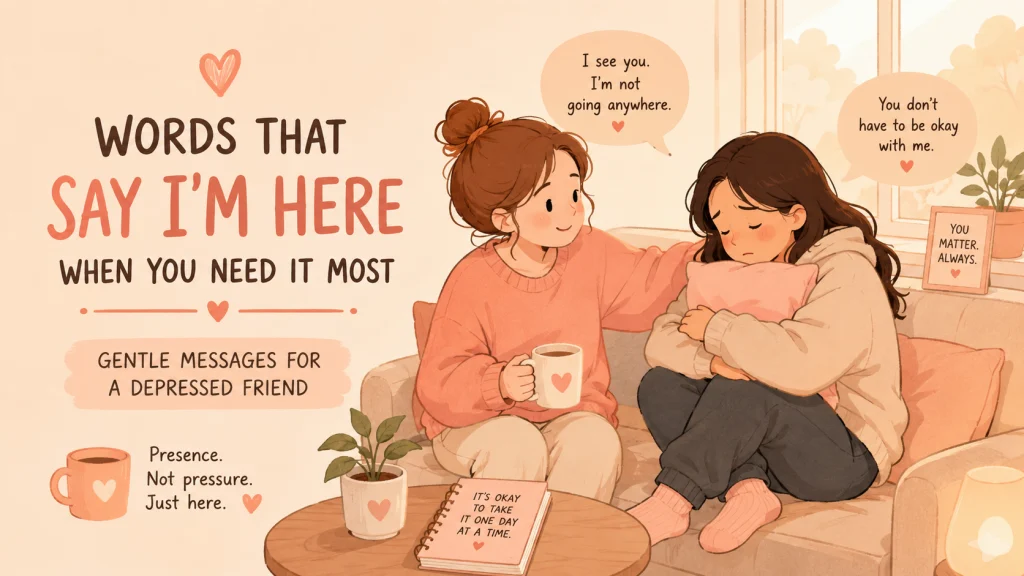
Depression isn’t the same as having a rough week, and the words that help someone through a hard patch often say exactly the wrong thing to someone who is depressed. These 65 messages are organized around one idea: presence without pressure. No fixing, no brightening, no asking someone to perform gratitude they don’t feel. Just words that say, honestly, that you’re there.
Why “Cheer Up” Doesn’t Work, and What Actually Helps
There’s a specific kind of silence that settles in when you don’t know what to say to someone who is depressed. You type something, delete it, start again. You want to help. You don’t want to make it worse. And somewhere in that back-and-forth, you land on something that sounds positive and encouraging, because that feels like the right direction. It usually isn’t. For related message ideas, see what to say to someone with depression.
Messages for a depressed friend work differently than messages for someone going through situational hardship. If a friend lost a job or went through a breakup, “it’s going to get better” has some footing. The situation changed; it can change again. Depression isn’t a situation. It’s a weight that doesn’t lift on command, and words that imply it should can make someone feel more broken for not being able to do exactly that.
What I’ve found, again and again, is that the messages that actually land aren’t the ones with the most hope packed into them. They’re the ones that don’t ask anything of the person receiving them. No performance of gratitude. No confirmation that the advice helped. No response required at all. Just: I see you, and I’m not going anywhere.
That’s the thread running through everything here. You don’t have to fix it. You can’t fix it. But you can make someone feel less alone in it, and that is not a small thing.

Messages That Offer Presence Without Asking for Performance
These are the messages that say “I’m here” without tacking on a “but” or a “when you’re ready” or anything that asks the person to eventually show up differently. They don’t require a reply. They don’t set a timeline. They just hold space.
This sounds simpler than it is. In practice, most people’s first instinct is to add something hopeful at the end, because a message that just says “I’m here” feels incomplete. It isn’t. It’s exactly enough. The hardest thing to resist is the urge to offer a silver lining nobody asked for.
- I’m not going to ask how you’re doing because I know today isn’t easy. I just wanted you to know I’m thinking about you.
- No need to reply. I just wanted to reach out. I’m here.
- You don’t have to pretend anything with me. I’ve got time, and I’m not going anywhere.
- I’ve been thinking about you. Not because I need anything from you. Just because you matter to me.
- You don’t have to feel better for me to still care about you. Just wanted to say that.
- I’m not going to fill this with advice. I just wanted you to hear from me today.
- If you want company, I’m here. If you want quiet, that’s okay too. Either way, I’m around.
- Sending this with no expectations. Just love, and a reminder that you’re not alone in this.
- I know words don’t fix it. I’m sending them anyway because you deserve to know someone’s thinking of you.
- You don’t owe me a response or an update or anything. I just wanted you to hear from me.
- I’m not checking in to see if you’re better. I’m checking in because I care about you right now, exactly as you are.
- There is no version of you that is too much for me. I just wanted you to know I’m still here.
- I’m not going anywhere. That’s not a pressure thing. It’s just true.
- Some days I don’t know what to say, so I just say: I’m thinking about you. Today is one of those days.
- You don’t have to perform being okay for me. I already know it’s hard, and I’m still here.
After sending any of these, give the person room. A follow-up asking “did you get my message?” immediately puts pressure back where you just removed it. Send it. Mean it. Let it sit.

Messages That Validate the Difficulty Without Trying to Fix It
There’s a difference between acknowledging that something is hard and trying to talk someone out of how hard it is. The first feels like being heard. The second, even when it comes from kindness, often feels like a gentle argument you didn’t ask to have.
Validation in this context doesn’t mean agreeing that things are hopeless. It means acknowledging that the person’s experience is real, that you’re not minimizing it, and that you’re not waiting for them to snap out of it before you’ll fully show up. These messages try to do exactly that.
- I’m not going to tell you it’s not as bad as it feels. I believe you that it’s hard.
- You don’t have to explain it to me. I know depression doesn’t work on a schedule or make logical sense. I’m just here.
- Whatever you’re carrying right now, I don’t need you to put it down or dress it up for me. It’s okay to be where you are.
- I know some days the smallest things take everything you’ve got. I see that. I’m not rushing you.
- You don’t have to be okay. Not with me, not today, not on any timeline. I just wanted to reach out.
- I’m not going to pretend I know what this feels like from the inside. But I know it’s real, and I know it’s hard, and I’m thinking about you.
- This is a hard thing you’re living through. I just wanted to say I know that, and I’m not forgetting about you.
- There’s nothing you need to do or say or feel right now except know that someone’s in your corner.
- You’re not being dramatic. You’re not making it up. I believe you, and I’m here.
- I don’t need you to have a good update. I don’t need you to have any update. I’m just glad we’re still talking.
- You are not a burden. You are a person I care about who is going through something hard. Those are different things.
- I know you might not have the energy to respond. That’s okay. I’ll keep showing up anyway.
- Whatever today brought, you don’t have to sort through it alone. I’m here when you’re ready, and I’m here when you’re not.
- You don’t owe me a version of yourself that’s doing better. I’m here for this version too.
One thing I’ve noticed is how much the phrase “I believe you” can do in this context. Depression is often invisible in a way that leaves people wondering, quietly, if others think they’re exaggerating. Saying it plainly removes that doubt.
Short Check-In Texts for a Friend with Depression
Not every message needs to be a paragraph. Sometimes a short text lands better than a long one, because it doesn’t feel like an occasion that requires a matching response. It’s just someone thinking of you, without fanfare. That can matter more than people realize.
These are designed to be sent on an ordinary Tuesday, or on a day when you haven’t heard from your friend in a while and you’re starting to worry, without making the check-in feel heavy or like something they now have to manage.
- Thinking of you today. No need to reply.
- Just checking in. You don’t have to have anything to report. 💙
- Hey. I’m here if you need me. No pressure at all.
- Saw something today that reminded me of you. Sending a quiet hello.
- No agenda here. Just wanted you to know you’re on my mind.
- How are you holding up? And it’s completely fine to say “not great.”
- Reaching out because I care, not because I need anything. Just: hi. I’m glad you’re around.
- Thought of you today and didn’t want to talk myself out of reaching out. Hope today’s okay.
- Hey, just wanted to say I’m thinking about you. No updates needed, just saying hi.
- Not sure how today is going, but I wanted you to know someone out here is rooting for you quietly.
- I know you’re going through it. I’m not going to ask you to explain. Just wanted to check in.
- You’ve been on my mind. Sending this because I didn’t want to not send it.
The “thought of you today” text is one I’ve actually used. There’s a version of “I should probably check in on them” that most people successfully talk themselves out of because they don’t know what to say, or they don’t want to be intrusive. Saying it out loud in the message, that you almost didn’t send it, tends to land well. It’s honest.
For When You Don’t Know What to Say But Want Them to Know You’re There
Sometimes the most honest thing is to admit you don’t have the words. This isn’t a failure. For someone who is depressed, receiving a message that says “I didn’t know what to say but I wanted to reach out anyway” can feel more real than a perfectly curated paragraph, because it doesn’t have the shape of something that was crafted to solve them.
If this is where you are, these messages are for you. They work because they’re not trying to be more than they are. They’re just one person telling another: I didn’t forget you. I don’t have the right words. I’m here anyway.
- I’ve been wanting to reach out for days and I keep not knowing what to say. So I’m just saying that. I’m thinking about you.
- I don’t have the right words. I’m not sure anyone does. But I didn’t want another day to go by without you hearing from me.
- Honestly I don’t know what to say in moments like this, and I’ve been sitting with that. I guess: I care about you, and I’m here.
- I’m not going to pretend I have anything useful to offer right now. I just didn’t want to be another person who went quiet.
- I know I’m not great at knowing what to say. I’m working on just sending the message anyway. Hi. I love you. That’s it.
- I’ve been checking in on you from a distance and I finally decided to just say something instead. Not much, just: I’m here.
- You deserve people who show up even when they don’t know how. I’m trying to be one of them.
- I didn’t want to say the wrong thing, so I kept not saying anything. But I think saying something imperfect is better than the silence. So: I’m thinking about you.
- I keep starting a message and then deleting it. So here’s the undeleted version: I care about you a lot and I wish I knew what to say.
- I’m not going to pretend I have any idea what you need right now. I just know I don’t want to be someone who disappears when it matters.
- This is probably the tenth draft of this message. I still don’t have the words. But I wanted you to know I’ve been trying.
- I’ve been thinking about what to say for a while, and I think the honest answer is just: I miss you, and I’m here.
- I don’t know how to help. I’m saying that out loud because pretending I do doesn’t seem right. I’m just here if you need me.
These work across most relationships, close friends, people you’ve drifted from a little, people you’re not sure still want to hear from you. The honesty in them is what makes them land. Nobody reads “I didn’t know what to say” and hears something cold.
If you’re looking for a broader set of words that work across different kinds of difficult moments, the section on words of comfort covers some of that ground and might be useful alongside what’s here.

Messages for When They’ve Gone Quiet and You’re Worried
Sometimes the silence is the part that worries you most. Your friend has stopped responding, gone a few days without reaching out, and you’re sitting with the particular unease of not knowing if they’re okay. This is one of the harder moments to navigate, because reaching out feels intrusive, and not reaching out feels like abandonment.
What I’ve found is that the messages that work here are the ones that make the quietest possible ask. Not “why haven’t you replied” and not a long check-in that makes the person feel they’ve created a problem by going silent. Just a gentle, low-stakes signal that you’re still there, no reply required, no explanation owed.
- No pressure at all to reply. I just wanted you to know I’m still thinking about you and I’m here when you’re ready.
- I haven’t heard from you in a bit and I just wanted to send a quiet hello. You don’t have to explain anything.
- I’m not reaching out to ask where you’ve been. I’m reaching out because I care about you and I wanted you to know that.
- If things are hard right now and you don’t have the energy to respond, that makes total sense. I’m here when you do.
- You don’t have to show up for this conversation. I just wanted to make sure you know the door’s still open.
- I noticed we haven’t talked in a while. No agenda, no worry, just: I miss you and I hope you’re okay.
- If you need space right now, I completely understand. I just didn’t want silence to feel like I’d gone anywhere.
- Sending this with no expectations. Just a reminder that I’m still here, still in your corner, whenever you’re ready.
- If replying feels impossible right now, you can ignore this and still know I care. I just wanted to send a small light in.
- You don’t have to come back with an explanation. Whenever you’re ready, even if it’s just one word, I’m here.
- I’m going to keep checking in gently, not because I’m upset with you, but because you matter to me.
If the silence goes on long enough that you’re genuinely concerned about their safety, a message isn’t enough. That’s the moment to call, to show up in person, or to reach out to someone who can check on them directly. If they mention hurting themselves, wanting to die, or not being safe, contact emergency help or a crisis line right away instead of waiting for the right text. Words sent over text have real limits, and knowing when those limits apply is part of showing up well for someone.

What Not to Say to Someone with Depression
This section might be the most practically useful one here, because the phrases below come from a good place almost every time. People say them because they want to help, because silence feels worse, because they believe in the person they’re talking to. That’s exactly why they’re hard to avoid without thinking specifically about why they don’t work.
| What people say | Why it misses | What to say instead |
|---|---|---|
| “You have so much to be grateful for.” | Depression isn’t caused by insufficient gratitude. This implies the person could fix it if they tried harder to see the good. | “I know this is hard even when things look fine from the outside.” |
| “Just try to stay positive.” | Positive thinking is not a treatment for depression. This puts the burden of getting better entirely on the person who is already struggling to do the basics. | “I’m not asking you to feel differently. I just wanted to reach out.” |
| “Things could be worse.” | Comparative suffering doesn’t reduce the current pain. It adds guilt on top of it. | “I’m not going to rank it. I just know it’s hard for you right now.” |
| “Have you tried exercise / getting outside / eating better?” | This reframes depression as a lifestyle problem with a simple fix. For someone in the middle of it, these suggestions can feel dismissive of how serious it actually is. | “You don’t have to do anything in particular. I just wanted to check in.” |
| “I went through something similar and what helped me was…” | Redirecting to your own experience, however well-intentioned, makes the conversation about you. Depression also varies significantly from person to person, so what helped you may not apply. | “I’m not going to pretend I know exactly what this feels like. I just know I care about you.” |
All five of these come from care. That’s what makes them worth naming specifically, because they’re easy to miss precisely because they feel kind when you write them. The test I keep coming back to: does this message ask anything of the person receiving it? If yes, even implicitly, it’s worth reconsidering.
A broader look at how tone and intention affect what someone actually receives from a message shows up in the collection of encouragement messages, which goes deeper into the mechanics of what makes a supportive message actually land.
A Note If You’re the One Who Is Depressed
If you came here looking for words to send someone else and recognized yourself in the description instead, that’s worth pausing on.
Depression can make it genuinely hard to reach out, even to people who care about you. The energy it takes to write a message, the worry about being a burden, the distance between what you feel and what you can put into words. All of that is real and it makes sense.
If you’re in a dark place, talking to someone who is trained to help matters. The 988 Suicide and Crisis Lifeline (call or text 988 in the US) is available around the clock, for any level of struggle, not only in crisis. You don’t have to be at a specific point before it’s appropriate to reach out.
Final Thoughts: Send the Imperfect Message
The reason most people don’t reach out to a depressed friend isn’t indifference. It’s the fear of saying something wrong. They weigh the options, decide they don’t have the right words, and end up saying nothing. From the outside, silence can be indistinguishable from not caring, even when it comes from the opposite place.
What I keep coming back to is this: the message doesn’t have to be right. It has to be honest. It has to not ask too much. And it has to be sent. The person on the other end is not grading you. They are, in a lot of cases, wondering if anyone still thinks about them. Your imperfect text is an answer to that question. It’s enough.
Pick one of the messages above that feels close to what you’d actually say. Edit it until it sounds like you. Send it without waiting until you’re certain it’s perfect. You won’t be certain. Send it anyway.
FAQs
💬 What do you say to someone with depression when you don’t know what to say?
Admit it. “I don’t have the right words, but I didn’t want to say nothing” is an honest message that lands better than something polished but hollow. You don’t need to have an answer. You just need to show up.
📱 What should I text a depressed friend?
Something short that doesn’t require a response. “Thinking of you today, no need to reply” removes the pressure of the exchange. Keep it genuine, keep it low-demand, and resist the urge to end with something hopeful they have to confirm.
🤍 Is it okay to check in on someone with depression even if they haven’t replied?
Yes. A gentle follow-up after a few days is not intrusive, it’s caring. Just don’t make the follow-up about the lack of reply. “Just checking in again, no pressure” is fine. “You never responded to my last message” is not the move.
🚫 What should you never say to someone who is depressed?
Avoid “stay positive,” “you have so much to be grateful for,” “things could be worse,” and unsolicited advice about exercise or routines. These come from kindness but imply the person could fix their depression if they tried differently, which is not how depression works.
💙 How do I let a depressed friend know I’m there without overwhelming them?
Keep it short, say you don’t need a reply, and mean it. One honest sentence with no agenda tends to land better than a long message they feel they need to emotionally process and respond to. Let the message do its work and give them space.
🌧️ Should I ask my depressed friend if they’re okay?
You can, but frame it so they can answer honestly. “How are you holding up, and it’s fine to say not great” works better than “are you okay?” which invites the reflexive “I’m fine.” Give them permission to tell the truth and they’re more likely to.