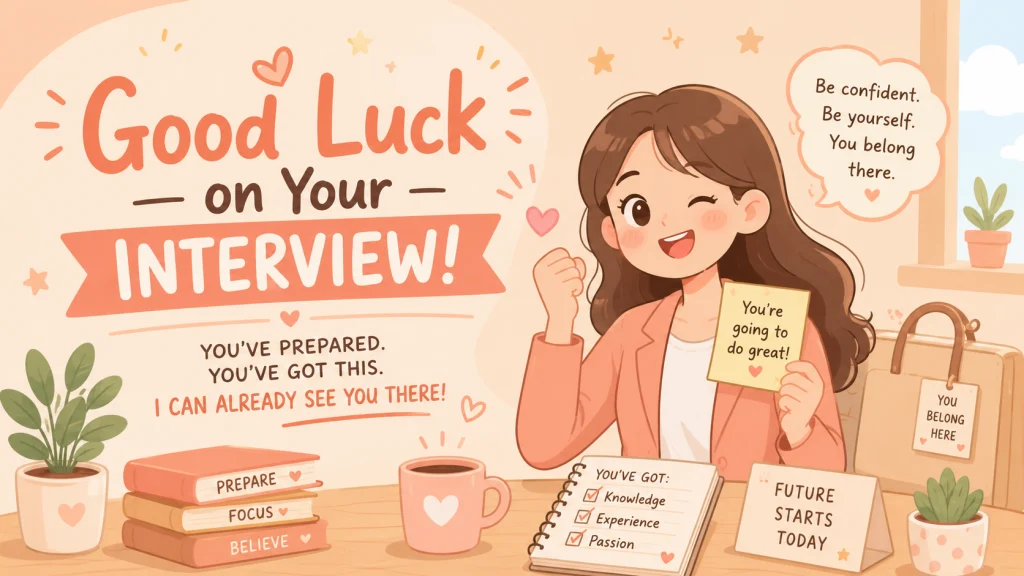
“Good luck” is well-meaning and almost entirely useless before a job interview. It hands the outcome to chance rather than to the person who has done the work. What lands better, and more memorably, is a message that tells someone you already see them in the role, that speaks to where they are emotionally right now, and that shows up at the right moment. These 65 good luck on your interview messages are organized around exactly that: vision-based wishes, night-before calm, morning-of grounding, encouragement for nervous candidates, and words that hold regardless of how the interview goes.
Why “Good Luck” Misses the Mark
The problem with “good luck” is not that it’s unkind. It’s that it locates the outcome somewhere outside the person. Luck implies randomness. It implies that whether they get the job is partly a matter of chance, and that the best you can do is hope the coin lands the right way. For someone who has spent weeks preparing, researching the company, rehearsing answers, that framing subtly undercuts everything they’ve already done. For related message ideas, see good luck job interview.
What I’ve noticed, and this showed up clearly the first time I sent something other than a reflexive “good luck” before a friend’s interview, is that specificity lands differently. Not “I hope it goes well” but “I’ve watched you put everything into this, and they’re going to feel it.” Not “fingers crossed” but “you know more about this role than most people in that room will.” The message stops being about hope and starts being about something the person can actually hold on to. That shift matters more than the words themselves.
The other thing most interview messages miss is timing. Sending “good luck!” at 6pm the night before is a different moment than sending something the morning of, when the person is in the parking lot trying to slow their breathing. The emotional need is different. The right message for one moment can feel completely off at the other. That’s what the sections below are built around.

Vision-Based Messages: I Can Already See You There
These are the messages that skip luck entirely and go straight to what you already know. They work because they don’t position the outcome as uncertain. They position the person as already a fit, and let the interview be the formality it often is for someone who has genuinely prepared. If you want to send one message that actually does something, make it one of these.
The phrasing does something specific: it replaces hope with observation. “I hope you do well” puts the weight on an unknown future. “I can already see you in that role” puts it on what you’ve actually witnessed in this person. That’s not just feel-good language. It reframes the entire thing. A single well-placed message like this does more to settle nerves than almost anything else someone will hear that day. You’ll find other formats in the full good luck messages collection, but for interviews specifically, the vision-based approach is the one worth starting with.
- I don’t need to wish you luck. I’ve watched you prepare for this, and I already know what they’re going to see.
- I can already picture you in that role. Walk in like someone who knows it too.
- You’ve done the work. Today is just showing someone else what I already know about you.
- I keep thinking about how well this fits you. Not the job description, the actual work. You were made for it.
- I’ve seen you handle things harder than a job interview. This one is going to feel like confirmation.
- I don’t know how it will go. What I do know is that you are genuinely right for this, and that kind of thing tends to come through.
- I can already see you thriving in this role. Go show them what I see.
- Forget luck. You’ve earned this conversation. Walk in like it.
- They’re going to realize pretty quickly that finding you was the best part of their hiring process.
- I’ve been saying for a while that this is the kind of role you belong in. Today you just get to prove it to someone new.
- You’ve thought about this more carefully than most people think about anything. That’s going to come through.
- You’re not going in there hoping. You’re going in there knowing. There’s a difference, and they’re going to feel it.
- I already see you on the other side of this, relieved and a little surprised at how well it went.
- They asked for someone who can do this job. You are that person. The interview is just the introduction.
- The way you talk about this role, why you want it, what you’d bring to it, that’s going to come through today. Let it.
What makes these land better than generic encouragement is that they assume the outcome rather than hope for it. That assumption, coming from someone the person trusts, is often exactly what’s needed to walk into a room standing straight.
Send the Right Message at the Right Moment
One of the most common mistakes with interview encouragement is treating the whole window as one emotional moment. It isn’t. The night before is a different landscape than the morning of. The candidate running on adrenaline needs something different from the one who’s been awake since 4am, rehearsing in the dark. Sending the same message at both times misses what the person actually needs.
Here’s a quick way to think about timing before you reach for your phone:
| When | Emotional state | What helps |
|---|---|---|
| Night before | Anxious, overthinking, rehearsing | Warmth and permission to rest, not hype |
| Morning of (1 to 2 hours before) | Focused, nervous, already in motion | Short, grounding, calm |
| Right before (30 minutes) | On edge, possibly in transit | One calm sentence, no pressure to reply |
| After the interview | Relieved, unsure, quietly replaying it | Acknowledgment first, debrief later |
Use the night-before messages to settle nerves and give the person permission to stop preparing. Use the morning-of ones to send them off grounded. The distinction sounds small until you’ve been on the receiving end of the wrong message at the wrong moment.
For the Night Before the Interview
The night before is when most people spiral. They lie in bed replaying answers, second-guessing their outfit, wondering if they researched enough. What they need is not more preparation tips. They need someone to remind them that they already have what it takes, and that the outcome, whatever it is, does not come down to one more hour of notes.
Keep these messages warm without being heavy. A long message the night before can add to the anxiety rather than ease it. Think of it as the conversational equivalent of a calm hand on the shoulder. The best night-before message gives the person permission to put the preparation down and rest. Almost no one gives that permission, and almost everyone needs it.
- Hey, put the notes away. You’re ready. Get some sleep and go in tomorrow feeling like it.
- I just wanted to say I’m thinking about you tonight. Tomorrow is going to go well. I really believe that.
- Stop rehearsing. You know your stuff. The rest is just showing up, and you’re good at that.
- Sending you some calm for tonight. You’ve done everything you can to prepare. The rest is tomorrow’s job.
- Whatever version of you walks into that room tomorrow, they’re going to be more than enough. Rest up.
- I know tonight’s the hard part. But you’ve already done the actual hard work. Tomorrow is just showing up.
- Thinking of you tonight. You’re going to walk in there tomorrow and remember why you wanted this in the first place.
- Sleep well. You’ve got this tomorrow, and I mean that based on everything I know about you, not just as something to say.
- The nerves tonight mean you care. That’s not a bad thing to bring into a room with you.
- Put the phone down, get some rest. You are so ready for this, and tomorrow you’re going to feel it.
- Not here to hype you up. Just to say: you’ve prepared, you care, and that combination is rarer than you think. Tomorrow’s going to show that.
- I’ve been rooting for you since before this interview was even on the calendar. Tonight, just rest. Tomorrow, just be yourself.
Notice what most of these do: they give permission. Permission to stop preparing, to rest, to trust the work already done. That is almost always more useful the night before than any last-minute advice.
For the Morning of the Interview: Calm and Focused
Morning-of messages need to be short. The person is already in motion, thinking about getting there on time, already rehearsing in the shower. A long message adds more to process when they’re trying to quiet everything down. What they need is a sentence or two that says: I see you, I believe in you, go.
The ones that miss tend to be too enthusiastic. A burst of “YOU’VE GOT THIS!!! SO EXCITED FOR YOU!!!” when someone is trying to breathe through nerves can feel more like noise than support. Calm is the right register in the morning. Short and steady beats loud and cheerful here, every time.
- Today is yours. Go get it.
- Thinking of you this morning. Answer like yourself, take your time, and let the work speak. That’s all you need to do.
- Deep breath. You’re ready. Go show them.
- You’ve been working toward this. Today, you get to let it show.
- I’ll be thinking about you today. Go in calm, go in confident. You’ve earned this conversation.
- You know your stuff. They’re going to know it too. Not luck in the random sense, the kind that comes from everything you’ve put into this.
- Today’s the day. You’ve got everything you need. Go prove it.
- Sending you steady energy this morning. You are more prepared than you feel right now. Trust that.
- You’ve already done the hard part. Today is just the conversation. Go have it.
- Whatever you’re feeling right now: it’s okay. Nerves and readiness often feel the same. You’re ready.
- Take your time in there. You don’t have to fill every silence. Let your answers land and trust them.
- Thinking of you. Go show them why you’re the one they’ve been looking for.
Short works. A single sentence that carries genuine conviction will do more than a paragraph of enthusiasm. The person you’re sending this to is not looking for a speech right now. They’re looking for a signal that someone who knows them believes in them.

For a Nervous Candidate: Reframe the Interview as a Two-Way Conversation
Most interview encouragement assumes the candidate is in a position of supplication, hoping to be chosen. That framing makes the anxiety worse, not better. If the person you’re writing to is genuinely spiraling, one of the most useful things you can do is shift the frame entirely: remind them that they are also interviewing the company.
This is not a confidence trick. It’s genuinely true. A job interview is a conversation between two parties figuring out whether there’s a fit. The candidate has real leverage in that room, even when it doesn’t feel that way. A message that reflects this can do more to reset someone’s nerves than ten cheerful “you’ve got this” texts. The same shift in framing applies to other high-stakes moments, which is why the exam encouragement messages take a similar approach for candidates facing something equally unnerving.
These messages work best when you know the person is genuinely anxious. They acknowledge the feeling without feeding it, and they gently shift where the power sits in the room.
- Remember: you’re not the only one being evaluated today. You’re also figuring out if they’re the right place for you.
- You don’t need them to like you. You need to figure out if you like them. Go in with that energy.
- The nerves make sense. But don’t forget: you’re also interviewing them. You get a vote in this too.
- Interviews are two-way streets. You’re not auditioning, you’re having a conversation. Walk in like it.
- It’s okay to be nervous. But remember: they reached out to you. They already think you might be the one.
- The anxiety is normal, and it doesn’t mean you’re not ready. It means you care. There’s a difference.
- You are allowed to take your time, ask your own questions, and decide whether this is where you want to be. Don’t forget that.
- If the nerves are loud right now: take them with you. They tend to quiet down the second you start talking.
- You have spent a lot of time thinking about whether you want this job. They have spent a lot of time thinking about whether they want you. Today you both find out.
- The pressure you’re feeling is real. So is the fact that you’re exactly the kind of person they’re hoping to find. Hold both of those things.
- They need someone like you more than they’re letting on. Interviews are awkward for everyone in the room. You’re not alone in that.
- You’ve done harder things than walk into a room and be yourself. This is just that, with slightly better chairs.
- Nervous is not the same as unprepared. You are prepared. The nervous part is just your brain taking it seriously.
- Go in curious instead of desperate. Curious people ask better questions. Curious people remember that they have a choice too.
The message that works for a nervous candidate is usually the one that shifts the axis from “please pick me” to “let’s see if this is a real fit.” That small reframe can change how someone carries themselves through an entire conversation.

After the Interview: Messages for Whatever the Outcome Is
The post-interview message is the one most people forget, or get wrong. They either wait to hear the result before saying anything, or they dive straight into “so how did it go?” when what the person actually needs first is acknowledgment that they showed up and did a hard thing, regardless of what comes next.
The best messages in this window don’t ask about the outcome right away. They land in the quiet between the interview and the news, where the person is often replaying everything that happened and trying not to read too much into how a particular question landed. Something that says “I’m proud of you for doing that” holds better in that space than “any updates?” For the stretch of waiting that sometimes follows, the daily encouragement messages are worth having nearby. And when you want to keep showing up with steady belief in someone across that whole stretch, the you’ve got this messages are built around exactly that kind of sustained support.
- However it went, I’m proud of you for going in there and doing it. That part was yours, and you did it.
- I’ve been thinking about you. How are you feeling now that it’s done?
- Whatever they decide, you showed up for yourself today. That is not a small thing.
- I want to hear everything, when you’re ready. For now, just know I’ve been rooting for you all day.
- You did the thing. Whatever comes next, today was yours.
- Take a breath. You showed up, you gave it your best, and now it’s out of your hands. That deserves a moment.
- I know the waiting is the worst part. But you went in there and gave it everything you had. I hope they know what they found.
- Checking in. Not asking for a debrief, just wanted to say I’ve been thinking of you and I’m glad you did that.
- The outcome is still coming. But the part that was in your control? You handled it. I’m proud of you.
- Good news or not, you walked in there prepared and you walked out having done it. That counts for more than it feels like right now.
- I hope it went the way you wanted. And even if it didn’t, this was a step, not the end of anything.
- Whatever happens, I’m glad you went for it. And I’ll still be glad, no matter what they say.
What ties these together is that none of them make the person feel like the only thing that mattered was the result. The result matters, but so does the courage it takes to put yourself in the room. Saying that, directly and without conditions, is one of the more useful things you can do after someone has gone through something like this.
Final Thoughts: The Message Is Not About Luck
What I keep coming back to with interview encouragement is this: the message someone receives before they walk into a room can genuinely shape how they carry themselves in it. Not because words are magic, but because feeling seen by someone who actually knows you lands differently than a coin flip framed as a wish.
These messages are starting points, not scripts. If you know the person you’re writing to, add something specific. One line that references something only you would know, something they said about this job, something you’ve watched them work toward, will always outperform a perfectly worded generic message. The specificity is the point. The warmth is in knowing them, not just in knowing what to say.
Go send them something good.
FAQs
💬 What is a good message to send someone before a job interview?
Skip generic luck and go specific instead. Something like “I’ve watched you prepare for this, and they’re going to see exactly what I see” does more than “good luck!” It grounds the encouragement in what you actually know about them, which is what makes it land.
⏰ When should I send a good luck message before an interview?
The night before works well for something warmer and a little longer. The morning of is better for something short and grounding. Avoid sending anything in the 30 minutes right before, unless it’s one calm sentence with no expectation of a reply.
😰 What do you say to someone who is really nervous about a job interview?
Reframe it gently. Remind them that they are also evaluating the company, not just being evaluated. Something like “you’re also figuring out if this is the right place for you” shifts the dynamic in a way that actually helps with nerves more than cheerleading does.
📱 What do you text someone after their interview?
Don’t lead with “how did it go?” Lead with acknowledgment. Something like “I’ve been thinking of you, I’m so proud of you for doing that” lands better in the waiting window than jumping straight into a debrief.
🎯 What’s the difference between “good luck” and a vision-based message?
“Good luck” frames the outcome as uncertain. A vision-based message frames the person as already a fit, and the interview as the formality. “I can already see you in that role” is more grounding because it’s based on something real, not something hoped for.
✍️ Should I write a long or short pre-interview message?
Short, almost always. The night before, you have a little more room. The morning of, one or two sentences is the most useful thing you can send. The person is already in their head. You want to settle them, not add more to read.