Most of us reach for the future when someone we care about is struggling with anxiety. “It’ll be okay.” “You’ve got this.” “It’s going to be fine.” Those words come from love. But anxiety doesn’t live in the future, where okay is waiting. It lives right now, in this body, in this moment, and the 60 messages here start exactly there.
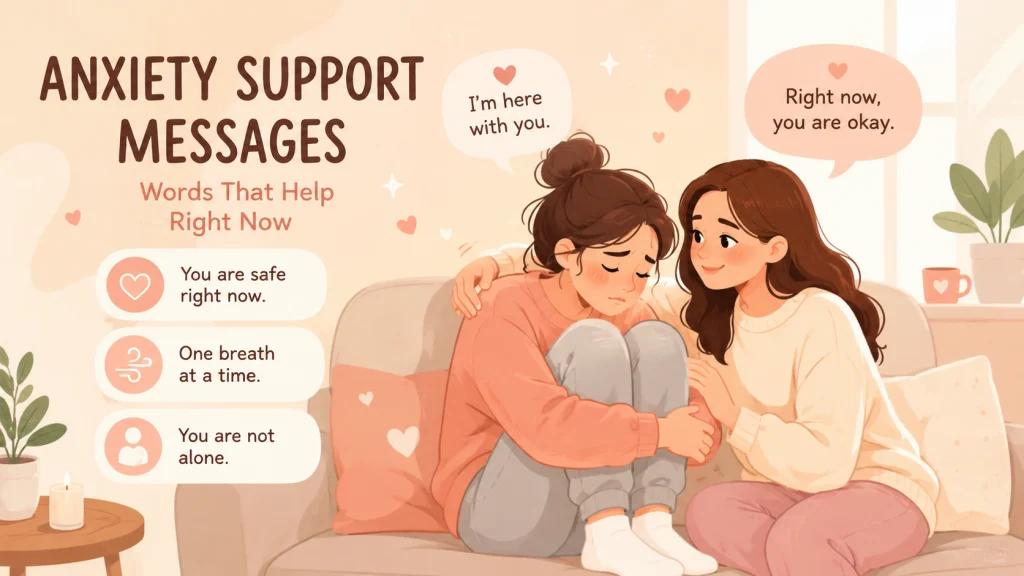
The First Thing Your Friend Needs to Hear
If you’re searching for anxiety support messages for a friend, you’ve probably noticed that most of what’s out there starts in the wrong place. It reaches for outcomes. “This will pass.” “Everything’s going to work out.” Those things may be true, and they may eventually matter. But they land wrong in the moment, because the moment is the problem. Anxiety is a right-now experience: the chest tightness, the racing thoughts, the sense that something terrible is either happening or already about to. It doesn’t care about next week.
The messages that actually help share one quality: they don’t try to solve the anxiety. They acknowledge it, and then they anchor the person to what is true right now, in this room, in this body. I’ve seen this work from both sides, being the person in the spiral and being the one trying to reach through it. What broke through was never the reassurance. It was presence. The message that arrived and said, quietly and without expectation: I’m here, and right now, you are not alone.

Why Anxiety Needs Different Words Than Depression
It matters that we’re talking about anxiety specifically, not just hard times in general. For someone going through grief, a major life change, or an extended rough stretch, words of encouragement for hard times tend to work by sitting with the person in the weight of it: acknowledging the difficulty, affirming their strength, staying present without rushing them toward better. That approach is right for those moments. It isn’t always right for anxiety.
Anxiety runs on the future. The spiral is almost always some version of “what if”: what if this goes wrong, what if I can’t handle it, what if the worst actually happens. Depression tends to need validation of how heavy things feel. Anxiety tends to need something else: language that pulls the person back into the present moment, into what is actually true right now rather than what might be true later. The approach in encouragement messages for depression is deliberately different for this reason, focused on sitting in the difficulty together. Anxiety often needs a different kind of pull.
Using heavy validation language with an anxious friend can sometimes extend the spiral instead of interrupting it. Confirming that yes, things are hard and heavy, doesn’t help when anxiety is already generating its own weight. What helps is something more direct: not the future, not a promise, just right now. And right now, you’re okay.

Grounding Messages: Present-Tense, Immediate, Safe
These are the messages for the moment when your friend is inside the anxiety. Not before it, not after it. Right in the middle of it. The goal of each one is the same: bring the person back to what’s actually true right now. Not a promise about tomorrow. Not a reassurance about the outcome. Just this moment, and the fact that in this moment, they are okay.
A note on sending these: no preamble needed. Don’t lead with “I thought this might help” or “I read that grounding can work well.” Just send the message. Anxiety-brain is already processing too much. In my experience, the messages that do the most tend to arrive as if they always existed, not as something you assembled. What it needs isn’t context. It needs something solid to hold.
- “Right now, in this moment, you are safe. I know that might be hard to feel. But it’s true.”
- “You don’t have to figure out what comes next. You just have to be here. And you’re doing that.”
- “Right now you’re breathing. Right now you’re safe. That’s enough for this moment.”
- “Your mind is running ahead. But your feet are on the ground right now. Stay with that.”
- “I’m not asking you to feel better. I’m just here with you while you feel what you feel.”
- “One breath at a time. That’s all. I’ll be here for every single one.”
- “You don’t have to know how this ends. You just have to get through the next five minutes. I think you can.”
- “Right now, this second, you don’t have to solve everything. I know anxiety makes it feel urgent. But you can stay with this moment.”
- “I’m not trying to talk you out of what you’re feeling. I just want to stand right next to it with you.”
- “Look around. You’re exactly where you are. I’m right here.”
- “The spiral feels huge right now, I know. But it’s not what’s actually in front of you. I am. And I’m not going anywhere.”
- “You’re here. That took something. I see that.”
- “What you’re feeling is real. And right now, in this room, you are okay.”
- “Wherever you are right now, I want you to feel me with you. You’re not alone in this moment.”
- “I want you to know: this moment is safe. Not the next hour. Not tomorrow. Just right now.”
- “This moment is survivable. I know the ones ahead feel like too much. Just this one. You’ve got it.”
The simplest of these often do the most. What anxiety needs in the middle of it isn’t something to decode or think through. It needs something to hold onto, and these are the text version of that.
Messages That Offer Presence Without Adding Pressure
One of the quieter problems with supporting an anxious friend is that the support itself can become a source of pressure. Someone already overwhelmed by their own thoughts doesn’t need a message that quietly asks them to update you, respond to you, or account for how they’re doing. The messages in this section give without taking. They’re sent because you mean them, not because you need something back.
I’ve sent versions of a few of these to the same person more than once, weeks apart, and been told both times that it helped. Not because the words were different. Because the consistency was its own message: you don’t have to have gotten better for me to still be here. That’s what this category is really about. If you’re looking for a broader range of encouragement across different situations beyond anxiety, the encouragement messages collection covers much more ground.
- “No reply needed. I just want you to know I’m thinking about you.”
- “I’m around all day. No expectations, no pressure. Just here if you need something, even if that’s quiet company.”
- “You don’t have to explain anything. You don’t have to perform okay. Just be wherever you are.”
- “If you want to talk, I’m ready. If you don’t, I’ll check in later. Either way, I’m not going anywhere.”
- “I know you might not feel like texting back. That’s fine. I sent this because I wanted to, not because I need something from you.”
- “Canceled plans are fine. Feel-better plans are better. Whenever you’re ready.”
- “I’m not keeping score. You don’t owe me a response, or an update, or anything.”
- “I’m available in whatever way is most helpful right now. Or not at all, if that helps. I mean that.”
- “No check-in required. Just wanted you to know you crossed my mind and I care.”
- “If today’s bad, tomorrow’s okay too. There’s no deadline on needing support.”
- “I don’t need you to be okay. I need you to know I’m here whether you are or not.”
- “Please don’t worry about being too much. You’re not. You’re just going through something.”
- “You can say ‘I don’t want to talk right now’ and I will completely respect that. I’ll still be here when you do.”
- “There’s no version of this where you reach out to me and I wish you hadn’t. Just so you know.”
- “I’m not going to give you advice unless you ask. I’m just going to be here. That’s enough.”
- “Whether you want space or company, I’ll respect it. You don’t have to decide right away.”
Messages for an anxious friend work best when they genuinely release the other person from any obligation to respond. If there’s even a faint implication of “let me know how you’re doing,” anxiety will find it. These are designed to close that door completely.

For a Friend Whose Anxiety Is Spiraling
Spiraling is a specific state. It’s different from a hard day and different from baseline anxiety. When someone is in a spiral, their thoughts are cascading: one fear leads to a worse one, which leads to a worst-case scenario, which triggers a physical response, which confirms to the brain that something must be terribly wrong. It feeds itself. The language that helps here is a little more direct, a little more targeted. Less about presence and more about interruption.
The first time I tried to help a friend who was mid-spiral, I made the most common mistake: I explained why what she was afraid of probably wouldn’t happen. She went quiet. Not because I helped, but because now she had to manage me on top of everything else. What finally worked was something much simpler. I stopped explaining and asked her to tell me five things she could see. She named them, slowly at first, then a little less slowly. She came back. The message that helped wasn’t the one that argued with her fears. It was the one that asked her for something real, immediate, and present.
- “Hey. Stop. You’re ahead of yourself. Come back to right now. What’s actually in front of you?”
- “Your brain is running through a hundred terrible outcomes. Pick just one thing that’s true right now, in this moment.”
- “What’s the worst thing that’s actually happened so far today? The real answer. Not the predicted one.”
- “The spiral is making every outcome feel certain. It’s very convincing. But you don’t have to follow it all the way. Stay with me.”
- “Can you feel your feet on the floor? Just try that for a second. Tell me when you feel them.”
- “You’ve made it through every single one of these before. I know this one feels different. They all do. And you’re still here.”
- “Breathe with me. In for four. Hold for four. Out for four. Again. I’m doing it right now too.”
- “What do you see directly in front of you? Tell me five things. I’ll wait.”
- “Your body is trying to protect you, even when there’s nothing to protect you from. That’s what this is. You’re not broken.”
- “Stop looking at the whole staircase. Just the next step. That’s it.”
- “I know it feels like it will never stop. It will stop. It always has. And I’ll be here when it does.”
- “You don’t have to be brave right now. You just have to breathe.”
- “Right now you’re safe, I’m here, and nothing is required of you. Let that be enough for this moment.”
- “You don’t have to solve this right now. You just have to stay.”
That last one is short for a reason. When someone is deep in a spiral, the most useful message is often the one with the fewest words. Long messages become things to decode. Short ones become anchors.
Short Texts for Someone Having an Anxious Day
Not every day is a spiral. Some days are just hard in a quieter way: a low hum of unease, a mind that won’t settle, a body that’s been tense since morning with no single trigger. These shorter messages are for those days. They’re low-pressure by design. They take three seconds to read and don’t ask for anything back. Sent in the middle of a rough afternoon, they can do something a longer message sometimes can’t: land without weight.
These are also the messages for when you’re not sure what’s going on. You know your friend is struggling, but you don’t know the degree or the details. A short message says “I see you” without asking them to explain themselves, which is sometimes the most useful thing you can offer. Sometimes that’s all the day needs.
- “Thinking of you today. Nothing required.”
- “Hey. You okay? Genuinely asking.”
- “No pressure to talk. Just wanted you to know I see you today.”
- “Hard day? I’ve got ears whenever you want them.”
- “You don’t have to be crushing it today. Surviving counts.”
- “Just checking in. No reply needed if today’s rough.”
- “Rooting for you today, quietly and without expectation.”
- “If today’s loud in your head, I’m a call away.”
- “Hope today’s gentler than yesterday.”
- “Sending quiet support for whatever today is bringing you.”
- “No agenda. Just checking in.”
- “You crossed my mind. Hope that’s a good thing today.”
- “If anxiety’s loud right now, I’m here. Call me if that helps.”
- “You don’t have to hold this alone today.”
Knowing what to text someone dealing with anxiety on a hard but not acute day is often just this: something small, with no strings attached. These messages don’t try to fix anything. They just make sure your friend knows they haven’t disappeared from your radar.

Four Phrases That Make Anxiety Worse
Knowing what to say to someone with anxiety is easier once you understand what not to say first. These four phrases are not cruel. Every one of them comes from a good place. The problem is that anxiety is already working against itself, and these phrases add friction without giving the person anything solid to hold onto. Here’s what tends to go wrong, and what to reach for instead.
| What you said | Why it lands wrong | What to try instead |
|---|---|---|
| “It’s going to be okay.” | Sends the message that the problem is the outcome. Anxiety isn’t waiting for the outcome. It’s happening right now, and “okay” is somewhere in a future that feels completely out of reach. | “Right now, in this moment, you’re safe. I’m here.” |
| “Just calm down.” | Implies a switch exists that the person is choosing not to flip. Nobody with anxiety has forgotten that calming down is an option. It lands as dismissal, sometimes as contempt. | “Let’s just breathe for a second. I’ll do it with you.” |
| “You’re overthinking it.” | Even when accurate, this reframes the problem as the person’s error. Being told you’re overthinking while you’re mid-spiral is like being told you’re falling while you’re mid-air. True. Not useful. | “I know your mind is running ahead. Can you stay with what’s actually in front of you right now?” |
| “Everyone gets anxious sometimes.” | Comparison minimizes. The subtext lands as: “What you’re feeling isn’t unusual, so why is it this big for you?” That question, however unintended, adds shame on top of the anxiety itself. | “I can’t fully understand what this feels like for you. But I’m here, and I want to.” |
The pattern across all four is the same: each one either asks the anxiety to justify itself or points toward a future the person can’t reach right now. The language that actually helps does the opposite. It starts exactly where the person is, and it offers company instead of solutions.
A Note, If This Is for You
If you came here because you’re the one dealing with anxiety, not searching for words to send someone else, that matters. A lot of people land here while they’re in it. What you’re carrying is real, and a message, however well-chosen, has real limits.
If anxiety is something that comes often or stays long, talking to a therapist or counselor can offer something no message collection can. Your doctor is usually a good first step. The Anxiety and Depression Association of America also has resources for finding specialized support. What you’re feeling deserves real care, not just better wording.
Final Thoughts: What Your Friend Actually Needs Right Now
There’s something that happens when we care about someone going through something hard. We want to fix it. We want to say the exact right thing that makes the anxiety stop. That instinct is kind. It’s also, almost always, the wrong instinct. Anxiety doesn’t want to be solved. It wants to be met. Encouraging someone with anxiety isn’t about lifting their mood or helping them see a brighter side. It’s about holding the ground steady while they find their footing.
The messages here don’t promise your friend that everything will be fine. They don’t offer timelines or silver linings. What they offer is what actually helps: presence, without conditions, and the reminder that right now, in this moment, they are not alone. If your friend’s anxiety is tangled up in something larger, a loss or a period of sustained uncertainty, there may be moments when what they need reaches beyond anxiety-specific language. The broader space of words of comfort is worth having in your back pocket for those moments. But for right now, the most useful thing you can give is also the simplest: I’m here.
FAQs
💬 What do you text someone having an anxiety attack?
Keep it short and anchored in the present. “I’m here. Right now you’re safe. Just breathe, I’m breathing with you.” Don’t offer explanations or promises about what comes next. Anchor them to right now, and make it clear they don’t need to respond.
😰 Should I tell someone with anxiety that it will be okay?
It usually backfires. Anxiety doesn’t live in the future, where okay is waiting. Messages like “right now you’re safe” or “I’m with you in this moment” land better because they meet the anxiety where it actually is, rather than redirecting to a future the person can’t access right now.
🤔 How do I check in on an anxious friend without adding pressure?
Send something that explicitly removes the obligation to respond. “No reply needed. Just thinking of you” or “I’m here whenever, no pressure at all” are enough. The goal is to make your friend feel seen without making them feel like they owe you an update or explanation.
💡 Is there a difference between supporting someone with anxiety versus depression?
Yes, and it matters. Depression often needs you to sit in the weight of it with someone, validating how hard things are. Anxiety often needs you to bring them back to the present moment. Using heavy validation language with someone who’s anxious can sometimes extend the spiral instead of interrupting it. Grounding language, words that anchor to right now, works better for anxiety.
📱 What do I text a friend with anxiety who keeps canceling plans?
Let them off the hook explicitly. “Canceled plans are fine. Feel-better plans are better. Whenever you’re ready.” What anxious people often dread most is having to manage someone else’s disappointment on top of their own anxiety. A message that removes that shame entirely is more helpful than any attempt to reschedule.
🔄 How do I help a friend who is spiraling, over text?
Try to interrupt the loop rather than argue with it. Asking them to name five things they can see, or to breathe with you, or to tell you what’s actually in front of them right now, tends to work better than explaining why the thing they fear probably won’t happen. Keep it short. When someone is mid-spiral, a brief message lands better than a long one.